
The Invite Review Verdict: Witty, warm, and more emotionally honest than most films dare to be, The Invite is a screwball dinner-party farce that earns genuine tears by the end. Olivia Wilde has made her best film, a relationship comedy that makes you laugh for 80 minutes and then quietly devastates you with how much of yourself you recognize in it.
The Invite premiered at Sundance 2026 and opens theatrically via A24 on June 26, 2026. This review is based on critical screenings and multiple detailed critic responses from the festival and theatrical run. What follows is a full analysis of the film’s strengths, structure, and what it is actually about underneath the dinner party premise.
The Invite Quick Verdict
The Invite is the rare adult comedy that trusts its audience to feel something real by the end. A married couple, a bottle of wine that gets drunk before the guests arrive, an upstairs neighbor who hosts orgies, and 90 minutes of the funniest and most painfully accurate depiction of long-term relationship stagnation since Who’s Afraid of Virginia Woolf, minus the nihilism, plus Penelope Cruz in a blonde bob and Seth Rogen saying things no one else would say.
Olivia Wilde directs with command and precision. The cast is uniformly excellent. The ending earns every moment that came before it. It is not quite perfect. But it is very, very good.
The Invite (2026) — Movie Info
| Detail | Info |
|---|---|
| Title | The Invite |
| Release Year | 2026 |
| Director | Olivia Wilde |
| Screenplay | Rashida Jones & Will McCormack |
| Based On | The People Upstairs (2020, Spanish) |
| Distributor | A24 |
| Premiered | Sundance Film Festival 2026 |
| Theatrical Release | June 26, 2026 |
| Genre | Comedy, Drama, Romance |
| Studio | A24 |
| Post-Credits Scene | No |
| Our Rating | ★★★★☆ (4/5) |
What Is The Invite Based On?
The Invite is a remake of The People Upstairs (also known as Sentimental), a 2020 Spanish-language film. What is remarkable, and telling, is that this is the seventh of eight remakes of that original film. Versions exist in Russian, French, Czech, German, South Korean, and Italian, with a forthcoming Portuguese adaptation still in production.
That number makes intuitive sense. The story at the heart of the film is genuinely timeless, not in a vague, marketing-speak way, but in the specific sense that its central conflict (long-term partners who have stopped seeing each other, jolted back into honesty by an outside force) translates across every culture that has dinner parties, upstairs neighbors, and marriages that outlive their original design.
Each country’s version presumably bends to local etiquette, what is said at dinner, what is left unsaid, what constitutes a neighbourly overstep, and A24’s version nails the specifics of San Francisco, of a particular generation, and of a very particular American kind of marital malaise with uncommon precision.
The adapted screenplay from Rashida Jones and Will McCormack, the team behind Celeste and Jesse Forever, another sharp, honest relationship film, is one of the film’s greatest strengths. It plants details early that bloom into meaning later without ever feeling mechanical. It writes four distinct, fully realized characters in what is essentially a two-room chamber piece. It is very good work.
The Invite Cast
| Actor | Role |
|---|---|
| Seth Rogen | Joe — married, former musician, associate professor |
| Olivia Wilde | Angela — stay-at-home mom, apartment renovator |
| Penelope Cruz | Pinya (Peña) — psychotherapist, sexologist, upstairs neighbor |
| Edward Norton | Hawk (Howard) — retired fire captain, Pinya’s partner |
The Invite Story & Plot Summary: What The Invite Is Actually About
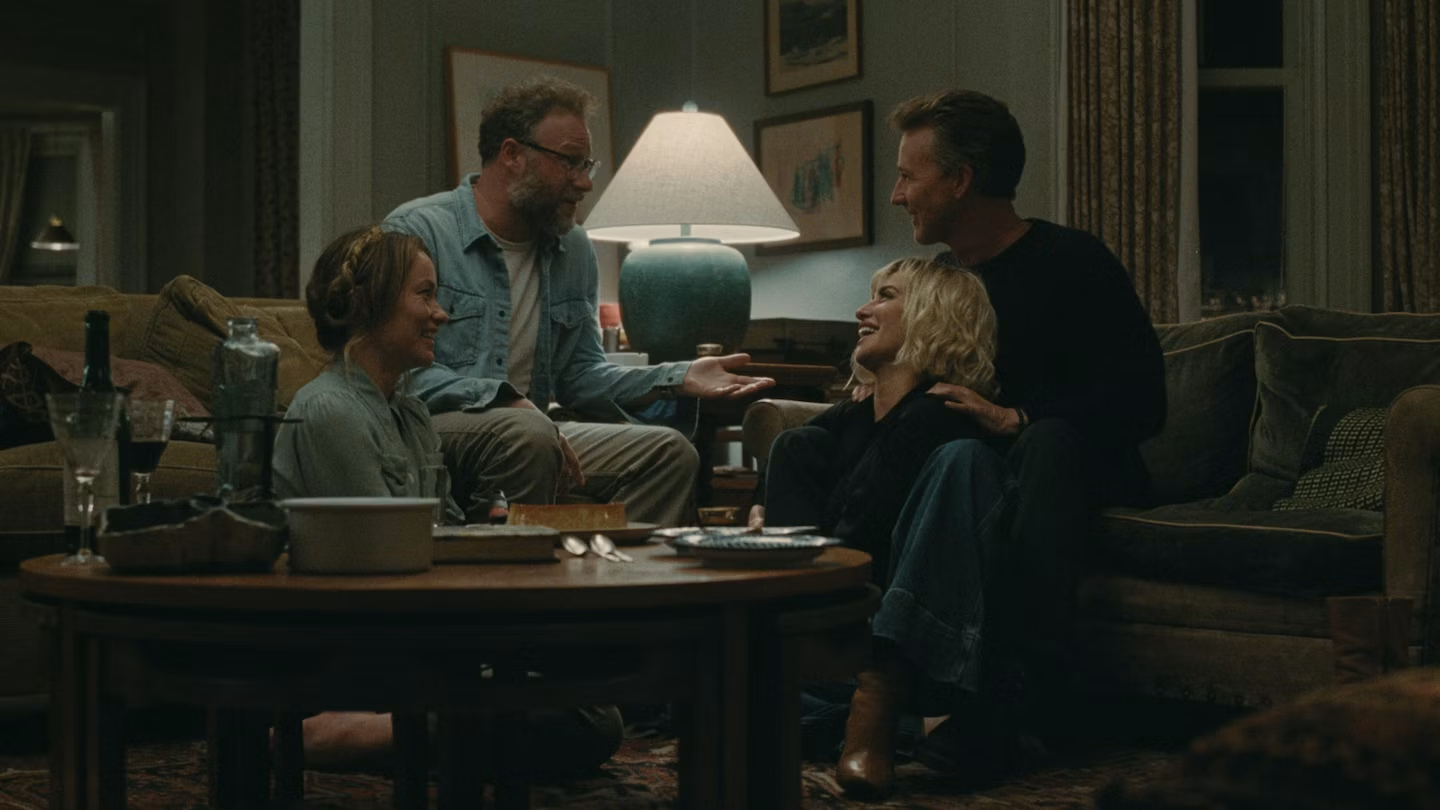
Joe and Angela have been together since 2008, since Joe’s band had their one hit, since he was the kind of person who seemed like he was going somewhere. They live in San Francisco in an apartment that Joe’s parents left him, one that is now worth millions and that they have renovated extensively, joining two units into one. Angela has put her identity into that renovation. Joe has put nothing into anything for years.
When the film opens, Joe is watching his students in an orchestra rehearsal and cannot be less interested. He bikes home across San Francisco’s hills, nearly dead on arrival, collapses on the floor with his shoes on, and Angela immediately tells him to take his shoes off. They argue about how he is folding his bike. The vibe between them is established in about ninety seconds, and it is airtight.
Angela has planned a dinner party with their upstairs neighbors, Pinya and Hawk, without, she insists, telling Joe. Joe insists she never told him. The film will later reveal, via Pinya casually mentioning she was only invited this morning, that Angela is lying. This detail, small, funny, devastating, tells you everything about the dynamics of this marriage in a single moment.
The upstairs neighbors arrive. Pinya is played by Penelope Cruz, a psychotherapist and sexologist who is warm, disarming, slightly unpredictable, and wearing a blonde bob that two reviewers spent considerable time expecting to be revealed as a disguise or dominatrix prop. It is not. That is just her gig. Hawk is Edward Norton: a retired fire captain who has reinvented himself, is passionate about interior design, speaks Spanish imperfectly but enthusiastically, and carries a backstory that the film deploys with more emotional weight than its setup suggests.
The neighbors acknowledged immediately that they could hear Joe and Angela arguing before they knocked. Joe confirms things are contentious. Hawk says they love contention.
From here, the film moves through a series of escalating revelations: the neighbors apologize for the noise they have been making upstairs, which turns out to be from hosting orgies. An invitation is extended. Angela walks past the windows naked each morning because it makes her feel good, which Hawk has noticed, which Joe did not know, which Pinya weaponizes when she reveals to everyone that Joe spends every elevator ride staring at her chest. Joe hurts his back. A foursome attempt goes sideways.
Pinya puts on her therapist hat, begrudgingly, and delivers a verdict on Joe and Angela’s relationship that the film handles with extraordinary precision. None of this is really about sex. All of it is about two people who have stopped seeing each other, and what it takes to force them to look again.
The Invite Ending Explained
By the end of the evening, Pinya, who, despite being the one person with professional tools to assess what she is seeing, has also had her own buttons pushed by the night, delivers a diagnosis: the relationship before her is done. What she means, clarified just slightly too late for Joe and Angela to avoid the gut punch of misunderstanding it, is not that the marriage is over.
What she means is that the version of this relationship they are currently carrying on cannot continue. The dynamic is broken. But you can end a relationship without ending the marriage; you can build a new one with the same person if both of you are willing. Hawk and Pinya leave without saying goodbye. Joe and Angela are left with the pieces.
Joe says he will sleep in the office. He suggests cancelling the summer holiday. It feels like goodbye. And then, alone in his cluttered office, surrounded by the detritus of the musical life he shut down, the record from his band’s one hit that he could not let Hawk play without getting aggressive about it, Joe sits at the piano and begins to play. For the first time in years.
Angela hears it. She comes out. She sits beside him. She plays alongside him.
The final shot is from outside, through the window, we observe them from the courtyard, as if we are one more neighbour who does not know the full story but can see, from a distance, that something real is happening in there. It is, multiple reviewers agreed, a perfect ending. Simple, earned, and lit with exactly the right amount of hope.
The Invite Performances
Seth Rogen as Joe
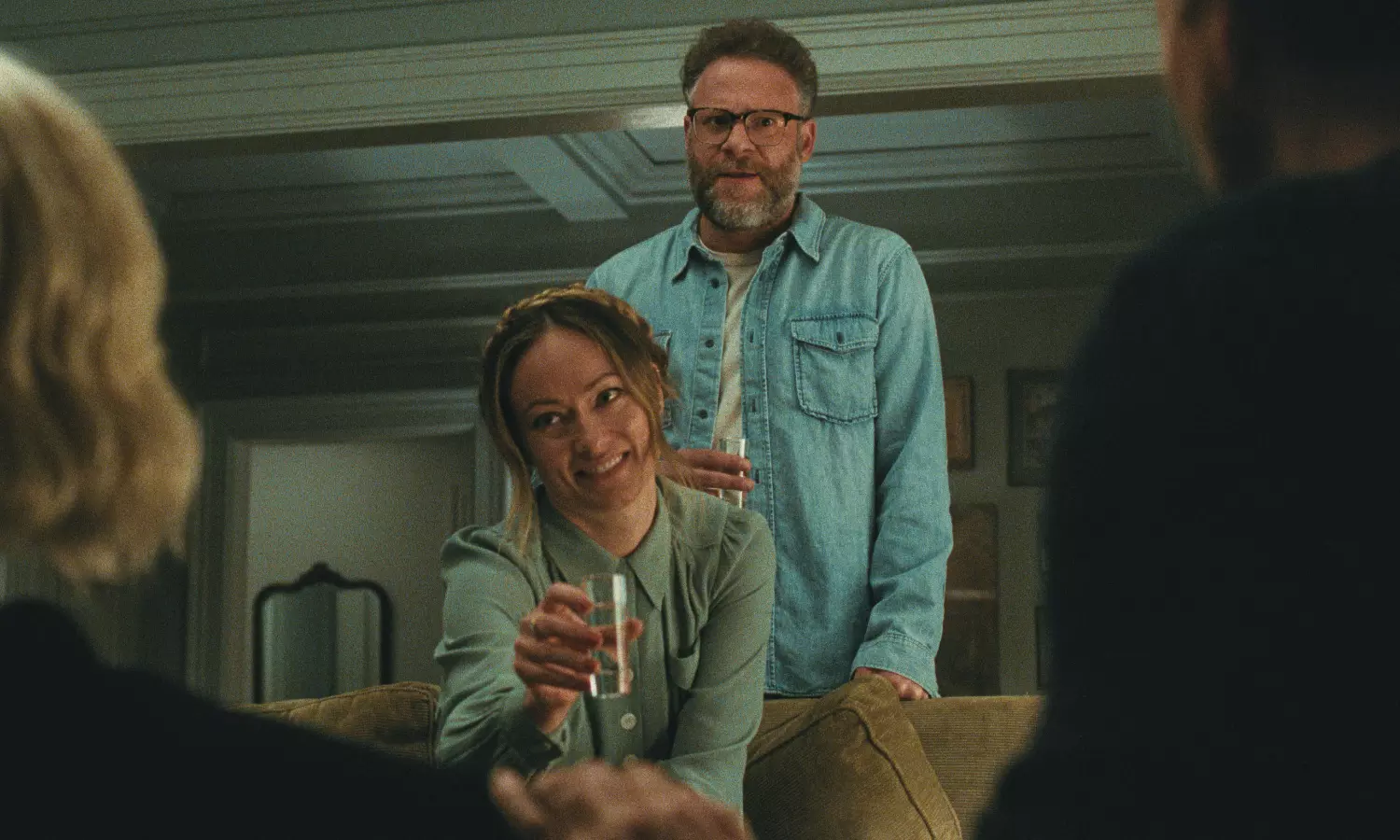
Rogen gets all the best lines and uses every single one of them. He functions as the film’s conduit, the person saying, with escalating incredulity, exactly what the audience is thinking as the evening unravels around him. His Joe is miserable in a way that is specific and readable: a man who shut down his creative self because the alternative was continued failure, and now resents the life he chose instead.
The moment he snaps at Hawk for wanting to play the band’s record is the film’s emotional hinge, petty on the surface, genuinely painful underneath. His physical comedy is also sharp. The bike-riding scenes alone establish more character than most scripts manage in twenty minutes.
Olivia Wilde as Angela
Wilde is doing something more subtle and more difficult than Rogen’s role demands. Angela is a woman who has been so subsumed by her role, the apartment, the renovation, the dinner party, the performance of being fine, that she barely knows what she wants anymore. She stuffed it down so deep that it occasionally comes bursting out in moments she cannot control: a dark thought that slips out during an almost-intimate exchange with Hawk, delivered in a blurt that lands somewhere between alarming and heartbreaking.
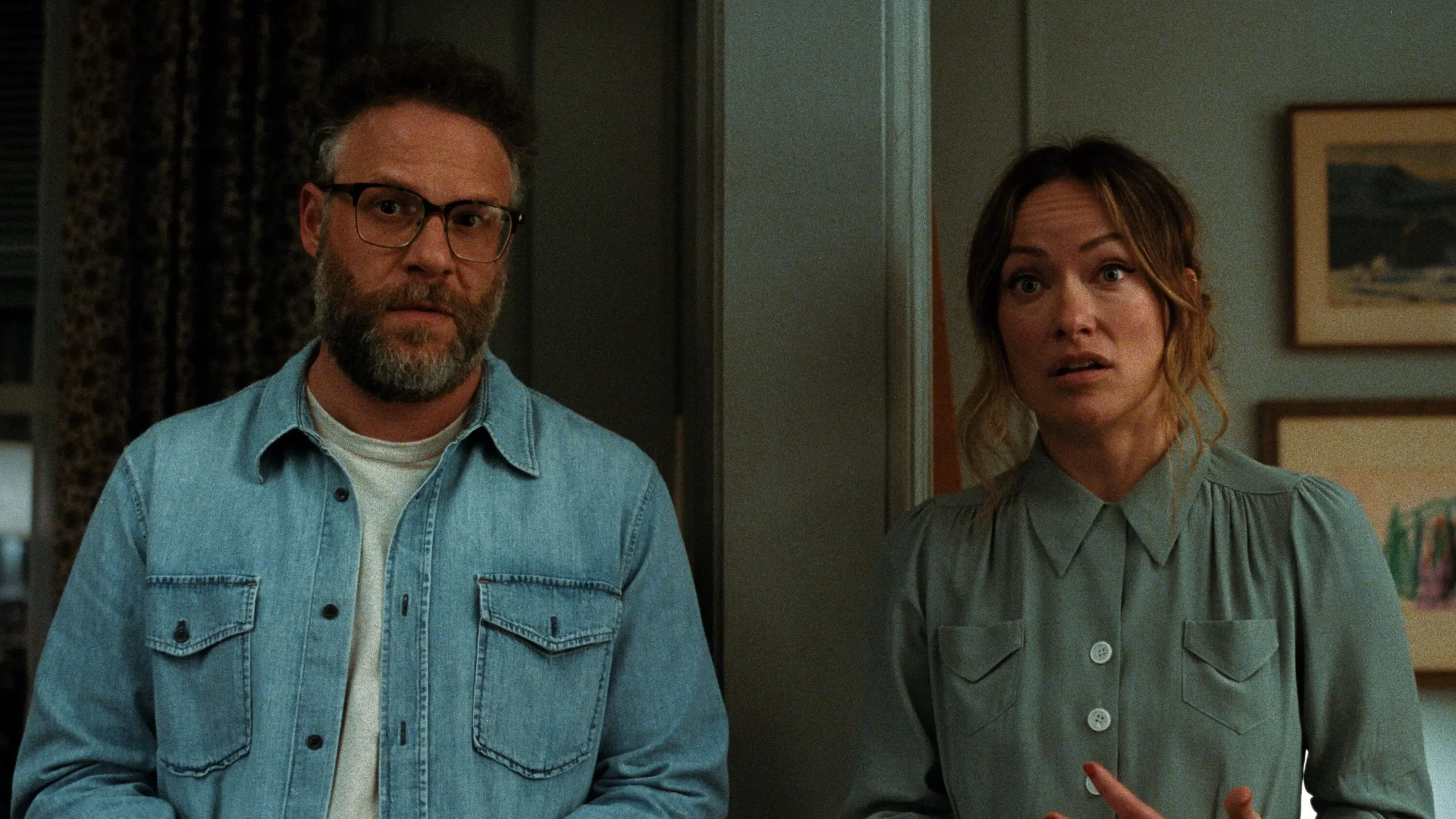
The wardrobe detail is not incidental: Angela’s blouse exactly matches the green of the apartment’s interior. She is in the apartment. She renovated herself into a fixture of the space she created. Wilde communicates this without a single line of dialogue about it. Her physical acting throughout, the eyes, the held smile that does not reach above her cheekbones, the controlled performance of the perfect hostess cracking at the seams, is some of the best work she has put on screen as an actor.
Penelope Cruz as Pinya
Cruz is the film’s scene-stealer and its most surprising performance. She plays Pinya as warm, sensual, unapologetically direct, and quietly feminist. The perimenopause scene is one of the film’s funniest moments and one of Cruz’s best in years. She has been in enough Almodóvar films to understand how to make a character feel like a force of nature without sacrificing specificity, and she brings all of that here. Her casting is an evident nod to the film’s Spanish-language source material, and it works in every register. The blonde bob, despite failing to reveal itself as a disguise, remains deeply suspicious. We are watching it.
Edward Norton as Hawk
Norton is playing a man affecting a reinvented version of himself, a man named Howard who gave himself the name Hawk because the man he used to be diminished the people around him, and he wanted the name change to signal something real had changed. Norton’s delivery of the monologue explaining this is moving in a way that slightly exceeds the scene’s somewhat clunky execution.
The emotional content lands regardless. Norton is also, crucially, very funny, something his filmography occasionally obscures. His enthusiasm for rugs, for interior design, for Olivia Wilde’s renovation choices, for speaking imperfect Spanish with Pinya while she decidedly does not correct him, all of it is played with a lightness that makes Hawk the most genuinely likable person in the room.
The Invite Direction: Olivia Wilde’s Best Work
Three films in, Wilde is demonstrating a directorial instinct for space that distinguishes her from her contemporaries. The apartment in The Invite is not just a set. It is the film’s argument. The way characters move through the kitchen, the living room, the office, the bathroom, who can see what from where, what is reflected in mirrors, who is standing in the light, and who has slipped into the corridor, is doing constant narrative work. Wilde uses the geography of this space the way stage directors use a set: every position means something, every crossing between rooms shifts the dynamic.
The film was shot entirely on a studio lot in Los Angeles, the San Francisco apartment, the courtyard, and the windows that connect the units, all built sets. You would not know it. The production design is exact in the way that only deliberate construction can be. The apartment looks lived-in by these specific people: cluttered in Joe’s office, obsessively curated in the main living spaces, with renovation choices that tell you about Angela’s eye and the money they do not quite have.
The score by Devonté Hynes (Dev Hynes of Blood Orange) is an active participant rather than a background presence. It is self-aware, heightened, and sometimes plainly comedic in the way it comments on what is happening on screen. It takes the film’s tonal swings with the characters, playful, then anxious, then quietly devastating, and it does this with enough lightness that it never tips into manipulation.
The tonal shift in the third act, where the film moves from screwball comedy into something rawer and more exposed, does not land with complete smoothness for every viewer. The mechanics of that transition are slightly abrupt, and there is a moment or two where the shift feels announced rather than arrived at. This is the film’s main structural weakness. It is real, and it is worth naming. It does not undermine the overall achievement.
The Invite Cinematography & Visual Language
The apartment layout is the film’s cinematographic subject. Wilde and her cinematographer use reflected surfaces, partial sightlines, and the courtyard windows to create a visual grammar of surveillance and exposure, appropriate for a film about people who are not fully seen by the people who should know them best. The shot of Hawk watching Angela walk past the window is shot from a perspective that makes the audience complicit in the observation.
The final shot, Joe and Angela at the piano, framed from outside through the window, reverses this: we are the outside observers now, watching something private that they are finally willing to let happen. The title sequence, which multiple reviewers praised specifically, uses a visual technique to establish the couple’s divided daily life efficiently and with a slightly retro formal elegance. It tells you who these people are before a single word of dialogue is spoken.
The Invite Screenplay Analysis: What Rashida Jones and Will McCormack Built
The screenplay’s primary achievement is the density of its detail. Every plant pays off. Angela insists she told Joe about the dinner party, and the scene plays as a typical marital dispute about communication. Pinya later casually reveals she was only invited that morning, and suddenly everything about Angela’s position in this marriage reads differently. She is not confused about who remembered and who forgot. She is lying because she wanted company and knew Joe would say no.
The paint swatches scene is the screenplay’s most elegant metaphor. Hawk looks at three blue paint samples that Joe has been dismissing as identical and constructs a different future for each one, three scenarios, three possible lives. Angela is euphoric. Someone is seeing what she sees. The scene initially plays as though Hawk is talking about her marriage, about choices. He is talking about paint colors. He is also talking about her marriage.
The Hawk/Howard monologue, in which he explains that he changed his name after his first wife died, partly in acknowledgement that he had diminished her throughout their relationship, does a significant amount of emotional work for what is ultimately a secondary character revelation. The execution is slightly clunky, as multiple reviewers noted. The content is genuinely moving regardless.
The film’s Pinya-as-therapist diagnosis is its most precise piece of writing. When she tells Joe and Angela, “this relationship is done,” she means something specific that the audience and the characters understand differently. The delay before clarification is perfectly calibrated.
The Invite vs. Who’s Afraid of Virginia Woolf — The Right Comparison
Multiple critics invoked Who’s Afraid of Virginia Woolf as a reference point for The Invite, and it is accurate in structure: two couples, one dinner, escalating revelations, spouse-swapping conversations, and the exposure of wounds beneath the social performance. The crucial difference is in register and intent. Albee’s play and Nichols’ film end in wreckage, there is catharsis, but the damage is thorough.
The Invite ends with the possibility of repair. Not guaranteed repair. Possible repair. That tonal distinction, choosing hope over devastation as the film’s final note, is what makes it feel, for lack of a better term, liveable.
Also worth mentioning: Bob and Carol and Ted and Alice (1969), Paul Mazursky’s own dinner-party-becomes-sexual-exploration comedy, is an equally useful comparison and has been cited by reviewers who have seen it. The Invite occupies a similar space: grown adults, genuine emotions, genuine comedy, genuine discomfort, genuine intimacy, no villains.
What The Invite Gets Right
The ensemble chemistry. All four performers are on different wavelengths, different registers, different comic temperatures, different emotional vocabularies, and that difference is the film’s central source of humor and tension. They do not feel like they were cast to harmonize. They feel like two couples who would probably orbit each other in the way these two couples do.
Seth Rogen is saying what we are all thinking. His deadpan incredulity as the evening escalates is the film’s comic engine. The “condoms? Oh, like pre-9/11” joke is objectively stupid and objectively funny.
Olivia Wilde’s physical performance. The burnt soufflé. The look when Joe is about to say something she needs him not to say. The moment she grabs the anniversary wine from the shelf, the calculation on her face is about whether she is willing to open it. All of this is done without dialogue, and all of it is excellent.
The ending. Piano. Window. Angela sat down beside him. The shot from outside. It is the right ending, executed with the right restraint.
Penelope Cruz in this role. Full stop.
What Could Be Better In The Invite
The tonal shift into the film’s dramatic third act arrives slightly abruptly. Multiple critics flagged this, not as a dealbreaker, but as a moment where the machinery of the screenplay briefly becomes visible. One more scene of transition, or one less jarring execution of the pivot, might have smoothed this into something seamless.
Angela’s interiority is somewhat underserved compared to Joe’s. We understand his failures, his embarrassments, his closed-off relationship to music in specific detail. Angela’s inner life is communicated primarily through subtext, wardrobe, and the odd unbidden dark thought that escapes her. The subtext is excellent. More text would have made the film even stronger.
The apartment layout, as described in the film, does not entirely cohere spatially. The windows that allow Hawk to observe Angela walking naked appear to look across a courtyard rather than downward from above. For most viewers, this will not register as a problem. For viewers who start thinking about it, it becomes mildly distracting.
The Invite Pros & Cons
✓ Pros
- All four lead performances are excellent, Cruz and Rogen especially
- Screenplay by Rashida Jones and Will McCormack is precise, layered, and generous
- The apartment set design communicates character without dialogue
- Devonté Hynes’ score is an active, comedic, and emotionally intelligent participant
- The ending is earned, hopeful without being saccharine, and visually perfect
- The film is genuinely very funny for most of its runtime
- Olivia Wilde uses the apartment’s geography as narrative architecture
- Long-term relationship audiences will recognize themselves in uncomfortable and productive ways
✗ Cons
- Tonal shift into the dramatic third act is slightly abrupt
- Angela’s interiority is somewhat less developed than Joe’s
- The apartment layout does not quite cohere spatially as described
- The Hawk/Howard backstory monologue is slightly clunky in execution, despite landing emotionally
How The Invite Compares With Olivia Wilde’s Previous Films
| Film | Year | Rating |
|---|---|---|
| Booksmart | 2019 | ★★★★½ (4.5/5) |
| Don’t Worry Darling | 2022 | ★★½☆☆ (2.5/5) |
| The Invite | 2026 | ★★★★☆ (4/5) |
The Invite sits comfortably as Wilde’s second-best film and her most accomplished piece of direction. Booksmart remains the most purely enjoyable, with the kind of effortless comic energy that is harder to manufacture than it looks. Don’t Worry Darling had real visual ambition undermined by tonal inconsistency and a third act that did not pay off its setup. The Invite is the film where Wilde’s instincts as a director of actors and a manager of space come together most fully. She is three films in and improving with each one.
The Invite Box Office & Release
The Invite premiered at the 2026 Sundance Film Festival, where it received a strong critical response across multiple outlets. A24 acquired it for theatrical release, a vote of confidence from the distributor with arguably the sharpest track record in contemporary adult-skewing prestige comedy and drama.
It opened in New York and Los Angeles on June 26, 2026, going wider the following weekend. For an A24 adult comedy with no action sequences, no franchise attachment, and a premise that requires the audience to care about a married couple’s dinner party, the Sundance reception significantly improves its commercial prospects. Word of mouth from couples who leave the theatre with things to talk about, which multiple critics predicted explicitly, is the most reliable engine for a film like this.
Is The Invite Suitable for Kids? Age Rating
No. The film is rated R and earns it. The sexual content, including explicit discussion of orgies, partner swapping, and specific sexual practices, is verbally frank. The film also contains adult themes of marital breakdown, repressed desire, and relationship failure that would not be meaningful to younger viewers and that parents would reasonably want to navigate independently of their children. This is a film made specifically for adults who have been in long-term relationships, and it rewards that audience specifically.

Where to Watch The Invite?
The Invite is currently in theatrical release via A24, expanding to wide release in early July 2026. As an A24 theatrical release, its streaming home post-theatrical window is most likely to be one of A24’s streaming distribution partners. Historically, A24 films have landed on services including Prime Video and Max, depending on deal arrangements. A confirmed streaming date and platform have not been announced at publication.
For current showtimes and theatre listings, check A24’s official website or Fandango.
Final Verdict
| Category | Score |
|---|---|
| Story / Screenplay | ★★★★☆ |
| Direction | ★★★★☆ |
| Performances | ★★★★★ |
| Cinematography | ★★★★☆ |
| Score / Music | ★★★★☆ |
| Production Design | ★★★★★ |
| Comedy | ★★★★☆ |
| Emotional Resonance | ★★★★★ |
| Overall | ★★★★☆ (4/5) |
The Invite is a relationship comedy that knows something most films in the genre refuse to admit: that long-term love is not a destination you arrive at and park in. It is a structure you have to keep rebuilding, sometimes with the same person, after dismantling whatever version of it stopped working.
Olivia Wilde has made a film that is funny, adult, specific, and genuinely moving, one that earns the right to its hopeful ending by being honest about everything that makes that hope uncertain. See it in theatres if you can. It is the kind of film that plays best with other people in the room, people you can turn to afterward and not quite say what you are thinking, because you are not sure yet if it applies to you.
If you enjoyed The Invite, you might also like our reviews of Jackass: Best and Last Review, Little Brother Review, and Supergirl Review, each offering a unique take on relationships, drama, or unforgettable performances. At NexaFeed, we cover everything from honest movie reviews and spoiler-free recommendations to streaming guides, box office updates, and cast breakdowns, helping you find your next great watch.
The Invite Frequently Asked Questions
Q. Where can I watch The Invite movie?
Ans. The Invite is currently in theatrical release via A24, opening wide in late June 2026. It opened in New York and LA on June 26, 2026, expanding to more cities the following weekend. A streaming release date has not been confirmed. Based on A24’s typical distribution patterns, it is expected to land on a major streaming platform within 3 to 4 months of theatrical release. Check A24’s official website or Fandango for current showtimes near you.
Q. Is The Invite a scary movie?
Ans. No. The Invite is a relationship comedy-drama, not a horror film. It is funny, emotionally honest, and occasionally uncomfortable in the way that great adult comedies about marriage tend to be, but it contains no horror elements, no suspense of a genre kind, and no jump scares. The discomfort it generates is entirely from recognizing your own relationship dynamics on screen. If you are looking for the 2022 horror film also titled The Invite, that is a different film entirely.
Q. What is The Invite movie based on?
Ans. The Invite is a remake of the 2020 Spanish-language film The People Upstairs, also known as Sentimental. This A24 version is notably the seventh of eight remakes of that original film, with versions existing in Russian, French, Czech, German, South Korean, and Italian as well. The screenplay adaptation was written by Rashida Jones and Will McCormack.
Q. What is The Invite movie rating?
Ans. The Invite is rated R. The R rating is for sexual content and language; the film contains frank verbal discussion of orgies, partner swapping, and specific sexual practices, as well as adult themes of marital breakdown and relationship failure. Our critical rating is 4 out of 5 stars.
Q. Is The Invite movie good?
Ans. Yes. The Invite is one of the stronger adult comedies of 2026, smart, funny, well-performed, and more emotionally resonant than its dinner-party-farce premise suggests. All four lead performances are excellent. The screenplay is layered and precise. Olivia Wilde’s direction uses the apartment’s geography as narrative architecture. The ending earns genuine emotion. It is the kind of film that leaves couples with a lot to talk about on the way home.
Q. Who is in the cast of The Invite movie?
Ans. The Invite stars Seth Rogen and Olivia Wilde as Joe and Angela, a married San Francisco couple hosting a dinner party. Their upstairs neighbors are played by Penelope Cruz (as Pinya, a psychotherapist and sexologist) and Edward Norton (as Hawk, a retired fire captain). All four lead performances have received strong critical praise.
Q. Does The Invite have a post-credits scene?
Ans. No. The Invite ends with its final shot, Joe and Angela at the piano, framed from outside through the apartment window, and that is the film. There is no mid-credits or post-credits scene.
Q. How does The Invite end?
Ans. By the end of the evening, the upstairs neighbors (Penelope Cruz and Edward Norton) have left without saying goodbye. Joe and Angela are left alone. Joe retreats to his office, the cluttered space full of the musical history he has been refusing to engage with, and begins playing the piano for the first time in years. Angela hears it, comes out, and sits beside him, playing alongside him. The film ends on a shot from outside the apartment window: two people who may be starting something new with each other, watched from a respectful distance.
The Invite is in theatres now via A24. Wider release from early July 2026. Streaming date to be confirmed.