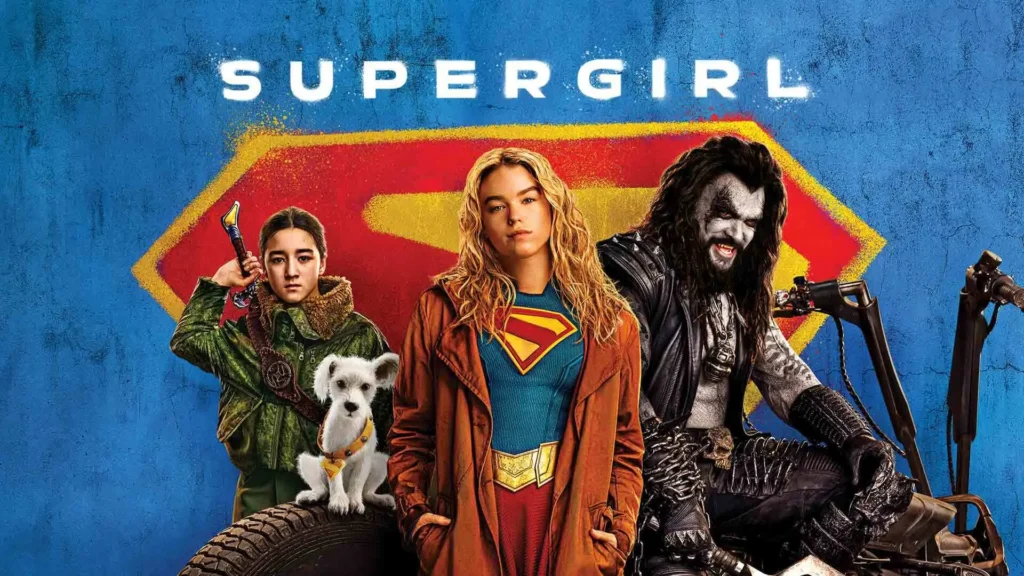
Supergirl Review Verdict: Supergirl arrives with a genuinely compelling premise, Jason Momoa perfectly cast as Lobo, and enough thematic ambition to suggest a great film was in reach. What made it to screen is a generic sci-fi buddy quest that never earns its emotional climax, burdened by a forgettable villain and a protagonist whose arc the screenplay never quite builds the foundation for.
I watched Supergirl during its opening theatrical weekend and cross-referenced impressions from multiple early audience reactions to evaluate where the film succeeds and where it falls short. What follows is an honest assessment of both.
Quick Verdict
Supergirl arrives as one of the first major follow-ups in DC Studios’ new era under James Gunn. The film introduces an emotionally conflicted Kara Zor-El finally given room to be complicated, and it delivers Jason Momoa in the role he was always meant to play. But inconsistent writing, a villain who evaporates from memory before the third act ends, and a protagonist arc that never builds the scaffolding its climax demands prevent it from reaching the heights the premise deserved.
It is not a disaster. It is something more frustrating than a disaster, a film that had everything it needed and couldn’t find the heart of it.
Supergirl (2026) — Movie Info
| Detail | Info |
|---|---|
| Title | Supergirl |
| Release Date | June 26, 2026 |
| Universe | DC Studios (DCU) |
| Preceded by | Superman (2025) |
| Lead Cast | Milly Alcock, Jason Momoa |
| Genre | Superhero, Sci-Fi, Action |
| Studio | DC Studios / Warner Bros. Pictures |
| Post-Credits Scene | None |
| Runtime | 1h 47m |
| Rating | ★★☆☆☆ (2.0/ 5) |
Supergirl Story & Plot Summary
The premise, on paper, is one of the stronger setups DC has built in years.
Following Superman (2025), Kara Zor-El has been escaping to a Red Sun solar system, a place where the yellow sun’s radiation cannot reach her, which means her Kryptonian powers disappear, which means she can finally get drunk. She is not sightseeing. She is running away from who she is supposed to be, one solar system at a time.
The backstory matters here more than the film gives it credit for. Unlike Clark Kent, who was rocketed off Krypton as an infant and has no memories of a life before Earth, Kara left as a teenager or young adult. She had a family. She had a home. She was old enough to understand exactly what she was losing when her father put her on a ship and sent her away.
That is a different kind of trauma than Clark’s, more conscious, more specific, more raw. The idea of a Kryptonian who remembers enough to grieve is legitimately rich material for a superhero film.
When Krypto gets poisoned by a dart from a villain in pursuit of a young girl whose family he murdered, Kara is pulled back into purpose. The girl is on a revenge quest. Kara needs an antidote. Same target, entirely different motivations. They team up. The adventure begins.
The prodigal child arc at the center, someone who ran from greatness, forced by circumstance back toward who they were always meant to be, is one of the oldest and most reliable frameworks in storytelling. It works when the emotional infrastructure is built carefully enough that the return feels earned rather than plotted.
Supergirl does not build that infrastructure. The first two acts establish Kara as a hot mess and position her as a reluctant moral authority without ever giving you a clear enough sense of who she is underneath the damage. By the time the third act asks you to feel the shift, there is nothing to anchor it to. The arc exists on paper. On screen, it never quite arrives.
Supergirl Cast
| Actor | Role |
|---|---|
| Milly Alcock | Kara Zor-El / Supergirl |
| Jason Momoa | Lobo |
| David Corenswet | Clark Kent / Superman (cameo) |
| Matthias Schoenaerts | Primary Antagonist |
| Eve Ridley | Revenge-quest girl |
Supergirl Cast & Performances
Milly Alcock as Kara Zor-El
Alcock is not the problem. She commits fully to a version of Kara that the screenplay keeps undercutting, a self-destructive woman who knows she should be better and cannot bring herself to be, yet. The physicality is there, the frustration is there, the moments of almost-heroism are there.
What is missing is the written interiority that would make us root for her even while she is behaving badly. The best performances in reluctant-hero films work because we feel what the character could be, even when they are at their worst. Alcock reaches for that. The screenplay does not always give her the handholds she needs.
Jason Momoa as Lobo
The only full-score performance in the film, and it earns every point. It has been an open secret since Momoa was cast as Aquaman that DC had misidentified the character. The physicality, the chaotic grin, the energy of a man who has clearly done something irreversible and has absolutely no intention of apologizing — that is Lobo, not Aquaman, and it always was.
The layup has finally been converted. Momoa is an absolute wild card in every scene he inhabits, unpredictable and occasionally hilarious in ways that feel at least partially unscripted, with enough genuine menace underneath the comedy that he never tips into parody. Every frame he is in has an energy that the rest of the film cannot replicate.
He is also, interestingly, the easiest character to analyse: Lobo works because he has no arc to fail at. He is entirely himself — chaotic, bounty-hunting, unbothered. In a film where the main character’s arc keeps stalling, the character, under no pressure to grow, becomes the most watchable thing on screen.
The Villain
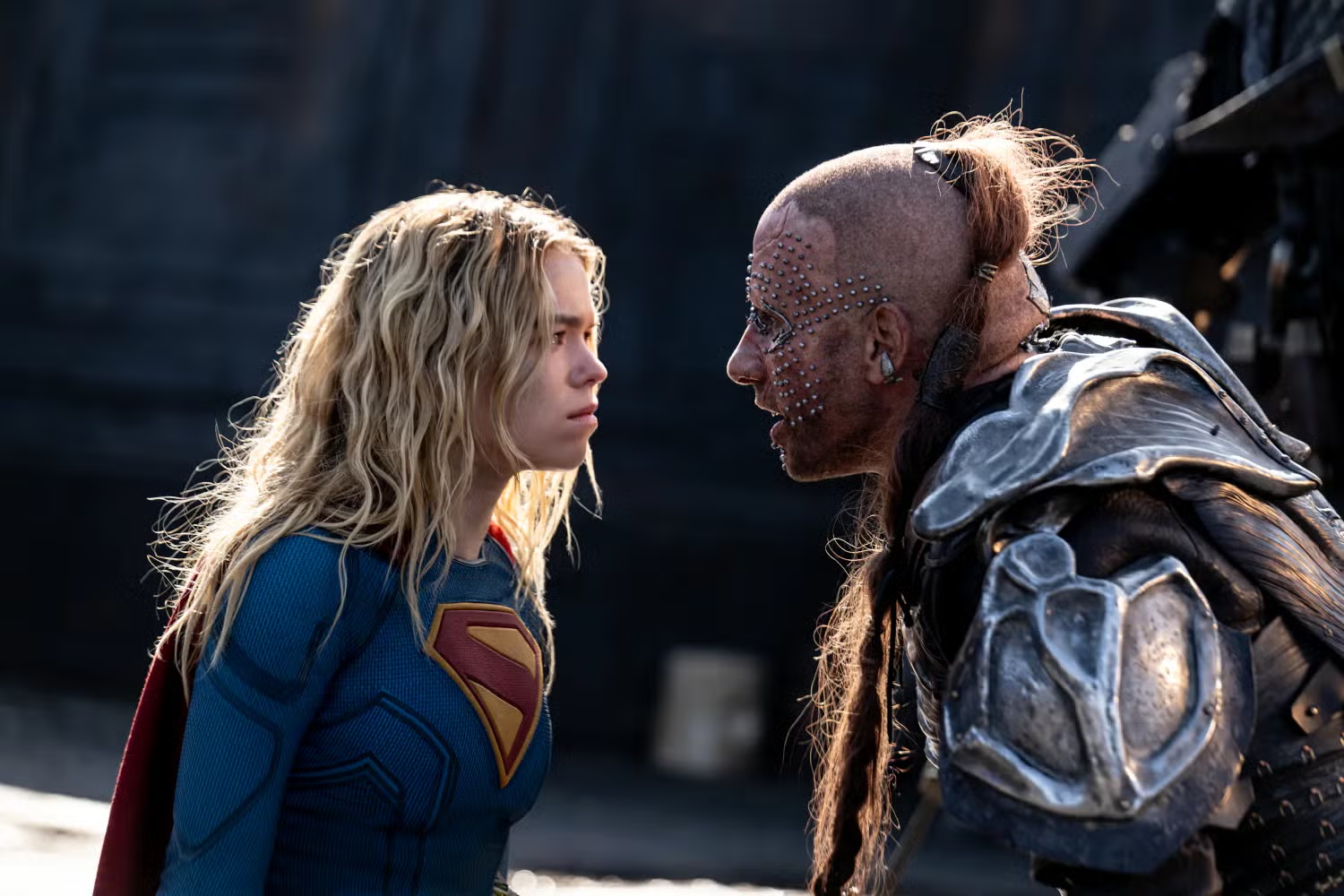
This is, by a serious margin, the weakest villainous performance and character in any superhero cinematic universe film since Iron Man (2008) set the modern template. Not because the actor is bad, but because the character is so underwritten that there is nothing to perform. He kidnaps women, poisons a dog, runs goons who look like Mad Max extras — all the procedural boxes for audience hatred are checked.
None of them land because the character has no texture, no quotable lines, no memorable visual identity, and no scene that makes you feel actual dread. He is cold-blooded in ways the film tells you about rather than shows you. Audiences at multiple screenings reportedly lost track of which figure on screen was the main villain versus one of his interchangeable lieutenants. That is the most damning possible data point.
Supporting Cast
The young girl on the revenge quest has a cleaner emotional through-line than Kara does in most of the film, which creates an ironic dynamic where the supporting character carries more audience investment than the protagonist. The performances are committed. The material is serviceable without being more than that.
Supergirl Direction & Visuals Review
The directorial intent is visible throughout and occasionally admirable. The Red Sun opening establishes Kara’s exile with visual clarity. The buddy-quest structure is navigated competently. There are action sequences that demonstrate genuine choreographic thinking, a punch that lands with real impact, a flight moment that briefly captures what the Kryptonian scale should feel like.
But the film never finds a tonal identity it commits to. It borrows freely, Guardians of the Galaxy’s alien-world vibrancy, The Mandalorian’s bounty-hunter register, Mad Max’s dust-and-chrome villain aesthetic, Predator’s predatory pacing, without subordinating any of these influences to a singular vision. The result is a film that constantly asks the audience to decide what kind of movie they are watching. That is not a question a director should be leaving to the audience.
The fundamental directorial failure is not technical. It is the inability to build the emotional architecture that the climax needs. A great third-act transformation requires a first and second act that secretly, patiently prepare the ground for it. Supergirl’s first two acts are busy rather than purposeful. When the climax arrives, asking for emotional payoff, there is no account to draw from.
Supergirl Cinematography Review
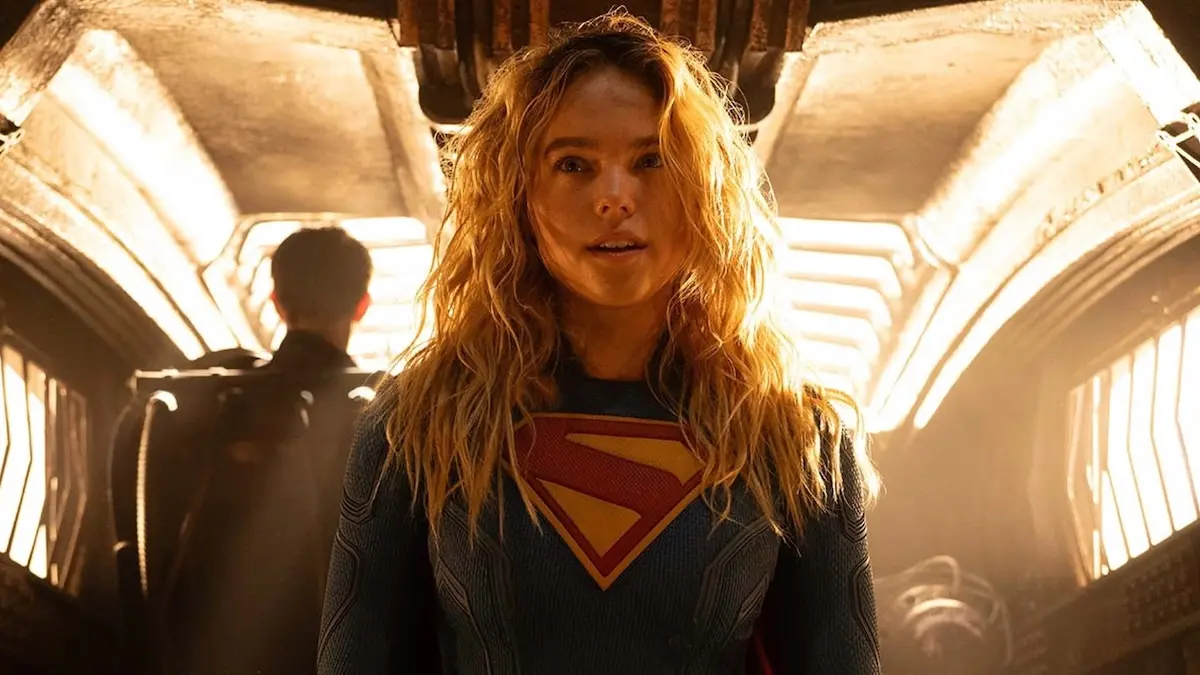
The visual presentation is the film’s most discussed technical problem, and it is a real one. Multiple scenes, not isolated shots, but a recurring pattern, place bright light sources in the background while the characters in the foreground are significantly underexposed. The result is a muddy visual register where you can read the environment but not the faces of the people in it. For a character study built around a protagonist’s internal journey, being unable to see your lead actress’s face is not a minor issue.
Whether this was a deliberate no-lighting-rigs aesthetic choice or a technical oversight is unclear from the outside. What is clear is that it registers as a flaw, repeatedly, and pulls viewers out of scenes at moments when immersion should be total. Some exterior and action sequences look significantly better; the film is not consistently muddy, which makes the problem sequences more noticeable by contrast.
Supergirl CGI & Visual Effects Review
Inconsistent, with a few shots that received audible audience reactions at early screenings, and not positive ones. The green screen work is occasionally obvious in ways that feel like release-date pressure rather than considered aesthetic decisions. At least two specific effects moments have been widely flagged across early audience responses as looking unfinished.
The standard for superhero visual effects has been set high enough by both Marvel and DC’s own best work that audience tolerance for visible seams is low. Supergirl does not clear that bar consistently.
Supergirl Background Score & Music Review
Functional and occasionally effective, without being memorable. The score supports the scenes it is assigned to without elevating them. There are no musical moments that become associated with the film the way great superhero scores earn those associations, no theme that returns at a climactic moment and carries the emotional weight the scene needs. The music does not hurt Supergirl. It also does not help that it becomes something larger than its screenplay.
Supergirl Costume Design & Production Design Review
Kara’s suit has been noted by multiple observers as faithful to the source material in its construction. The alien worlds, particularly the Red Sun setting in the opening act, demonstrate real production design ambition, with colour palettes that distinguish the off-world locations from Earth effectively. The villain’s faction has a Mad Max-adjacent aesthetic that would be more interesting if it were more original. The goons are visually interchangeable in ways that compound the villain’s identity problem.
Supergirl Editing & Pacing Review
The first act moves well enough. The second act is where pacing becomes a problem, scenes accumulate without clearly building toward something, and the mid-film section loses narrative urgency in ways that had audience members at opening weekend screenings noting they were ready to leave before the third act arrived. The editing does not disguise the screenplay’s structural issues. By the third act, the cuts arrive more frequently in the way action films use rhythm to generate excitement, but the emotional foundation is not there to give those cuts something to work against.
Supergirl Ending Explained (Spoilers)
The ending attempts to cash the cheque, which the first two acts spent without depositing anything.
Kara’s arc resolves in her stepping up to be the hero she was always supposed to be, the prodigal daughter returned, the potential finally claimed. The villain is dispatched. Krypto’s fate is addressed. The young girl’s revenge quest reaches its conclusion. Supergirl is a hero now.
The problem is that the transformation does not feel inhabited. It feels announced. The film tells you Kara has arrived at heroism; it does not make you feel the arrival. The emotional scaffolding that makes this kind of climax work, the careful accumulation of small moments throughout the film that prime the audience for the larger one, was never built. When the moment comes, it plays as a narrative beat checked off rather than a character truth revealed.
What the ending gets right: it is not gimmicky. There is no forced dramatic reunion, no speechifying, no moment that feels designed to manufacture feeling rather than earn it. The restraint is genuine. The film just needed more than restraint. It needed the first two acts to have done more work.
Does Supergirl Have a Post-Credits Scene?
No. There is no mid-credits scene and no post-credits scene. For a film in a cinematic universe actively building toward future projects, that absence is notable. The decision may be confidence, the story is complete without a tease, or it may be an acknowledgment that the film’s box office performance did not justify setting up a sequel. Either way, audiences can leave as soon as the credits roll.
What Supergirl Gets Right
The Kryptonian Backstory. The idea of a Kryptonian who remembers what she lost, who was old enough to grieve Krypton consciously, is one of the most interesting pieces of character foundation DC has introduced. It is genuinely different from Clark’s origin and deserves a film that builds from it more deliberately.
Jason Momoa as Lobo. Already fully discussed. The character and casting are the film’s one unconditional success. A standalone Lobo film has real potential: a morally ambiguous bounty hunter, an intergalactic scope, no obligation to be a hero, and Momoa doing what Momoa does best.
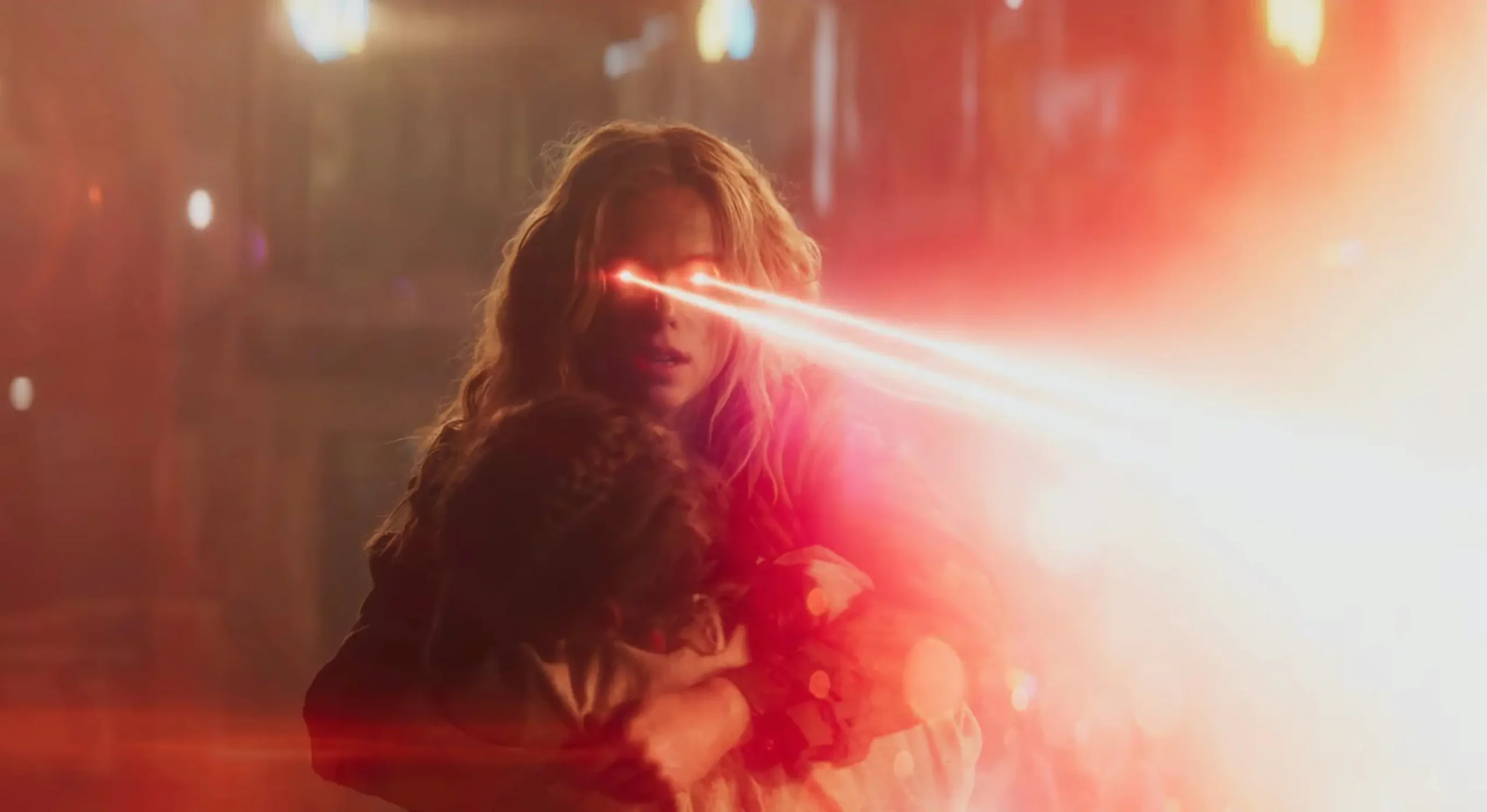
Scattered Action Moments. A small number of action beats land with genuine impact, a specific punch, a flight sequence or two, and choreography that briefly captures the scale of Kryptonian power it should suggest. They are sparse, but they exist.
Thematic Ambition. The film wants to say something real about running from identity and the cost of refusing who you are. That ambition is present even when execution fails it. Better material, or a braver commitment to the theme over the plot mechanics, could have produced something genuinely memorable.

Supergirl Pros & Cons
✓ Pros
- Jason Momoa’s Lobo is exactly right and steals every scene
- Emotionally distinctive Kryptonian premise (a Kara who remembers)
- A few action beats with real impact
- Restrained, non-gimmicky climax
- World-building that has visual ambition in its better moments
✗ Cons
- Villain is the weakest superhero antagonist in modern cinematic universe history
- Kara’s character arc never builds the foundation it needs
- Lighting problems render multiple scenes visually muddy
- CGI inconsistency with several noticeably unfinished effects shots
- No tonal identity, borrows from too many sources without committing to any
- Superman’s cameo adds nothing and costs nothing, which is its own failure
- No post-credits scene in a franchise-building universe film
- Background score is functional but entirely forgettable
How Supergirl Compares With Other DC Movies
| Movie | Rating |
|---|---|
| Man of Steel (2013) | ★★★★½ (4.5/5) |
| Superman (2025) | ★★★★☆ (4/5) |
| The Flash (2023) | ★★½☆☆ (2.5/5) |
| Supergirl (2026) | ★★☆☆☆ (2/5) |
Supergirl sits at the bottom of the new DCU’s early releases, not in the catastrophic territory of some franchise missteps, but clearly behind the momentum Superman (2025) generated. The comparison with The Flash is instructive: both films had compelling lead characters, significant production challenges, and a gap between their potential and their execution. Supergirl has the advantage of not carrying The Flash’s off-screen baggage, which means its failure is more purely a creative one.
Supergirl Box Office Collection ( Hit Or Flop )
Specific box office figures for Supergirl are still developing at the time of publication. What is clear from opening weekend patterns and early tracking data:
The film is not performing at the level a DCU follow-up to Superman (2025) would typically project. Word of mouth from opening weekend audiences, including reactions like those captured at screenings where audiences were ready to leave before the third act, does not suggest the kind of strong audience score that drives second and third-week holds.
For context: Superman (2025) established a commercial baseline for the new DCU that Supergirl was expected to build on. Early indicators suggest it is not doing so. Whether this leads to course-correction in upcoming DCU films (Lanterns is the next anticipated major release) or is treated as an acceptable performance for a character introduction will be visible in how DC Studios responds publicly over the coming weeks.
The no post-credits scene is also relevant here commercially: post-credits tags drive repeat viewings and social media discussion. Their absence removes one of the genre’s most reliable engines for box office longevity.
Is Supergirl Suitable for Kids?
The film carries a superhero action rating appropriate for the genre. The violence is in line with other DCU and MCU entries, action-movie combat without graphic content. Parents familiar with Superman (2025) will find Supergirl in a similar register. Younger children who respond to the Krypto the dog storyline will have a clear entry point; the villain’s actions (kidnapping, implied threat to women) are present but not depicted graphically.
Where Can You Watch Supergirl After Theatres?
Supergirl is a Warner Bros. Pictures release, which means its streaming home after the theatrical window will be Max. A specific streaming date has not been announced at publication. Based on typical Warner Bros. theatrical windows, an OTT release on Max can be expected within 45 to 60 days of theatrical release, though DC tentpoles have occasionally extended this window.
Should You Watch Supergirl in Theatres?
For Jason Momoa fans and anyone committed to following the new DCU from its beginning: yes, the theatrical experience adds something, particularly to the action sequences that land well.
For general audiences, the film does not have a visual scale that demands a large screen. There are no set pieces or sequences where theatrical presentation is significantly superior to a home viewing experience. Waiting for Max is a reasonable choice. The emotional experience of the film, such as it is, does not require a cinema to deliver it.
For DC completists tracking the new universe’s continuity, Supergirl appears to be a chapter that establishes Kara and Lobo for future films rather than advancing a larger arc dramatically. Knowing what happens does not require watching it in theatres, but watching it will keep you current on where these characters stand heading into Lanterns and whatever follows.
Final Verdict Of Supergirl
| Category | Score |
|---|---|
| Story | ★★☆☆☆ |
| Action | ★★★☆☆ |
| Emotion | ★★☆☆☆ |
| Villain | ★☆☆☆☆ |
| Visuals / CGI | ★★☆☆☆ |
| Background Score | ★★★☆☆ |
| Performances | ★★★☆☆ |
| Direction | ★★☆☆☆ |
| Overall | ★★☆☆☆ (2/5) |
Supergirl is not a franchise-ending failure. It is a franchise-stalling one, a film that had a genuinely interesting character at its center, the perfect casting for its best role, and a thematic premise with real emotional potential, and consistently chose the safer, blander, more generic version of every decision available to it. The prodigal daughter story deserved a film that trusted it. The Kryptonian trauma backstory deserved a script that built from it. Lobo deserved, and will hopefully get more.
Lanterns is next. Fingers crossed they learned something from this.
Supergirl Frequently Asked Questions
Q. Is Supergirl worth watching?
Ans. For Jason Momoa fans and DCU completists, yes. For general audiences, waiting for the Max streaming release is a reasonable call. The film has bright spots, particularly Momoa as Lobo and a handful of strong action beats, but it does not deliver the kind of theatrical experience that demands an immediate cinema visit.
Q. Is the new Supergirl movie any good?
Ans. It falls short of what a DCU follow-up to Superman (2025) should deliver. Strong casting in the wrong places, a weak villain, and an emotionally unearned protagonist arc keep it from reaching its potential. Rating: 2 out of 5.
Q. Does Supergirl have a post-credits scene?
Ans. No. There is no mid-credits scene and no post-credits scene of any kind. You can leave when the credits begin.
Q. Who plays Lobo in Supergirl?
Ans. Jason Momoa plays Lobo, the intergalactic bounty hunter. He is the film’s best element by a wide margin, and the character most audiences are likely to remember.
Q. Is Supergirl connected to Superman (2025)?
Ans. Yes. Supergirl is a direct follow-up within the new DC Studios universe. Events from Superman (2025) are referenced, and the 2025 Superman (David Corenswet) appears in a cameo, though his appearance is minimal and does not meaningfully affect the story.
Q. Where does Supergirl fit in the new DCU timeline?
Ans. Supergirl takes place after Superman (2025), establishing Kara Zor-El and Lobo as active figures in the new DCU. It appears to function as a character-introduction chapter rather than a major universe-advancing event, setting these characters up for future appearances in Lanterns and beyond.
Q. Is Supergirl suitable for kids?
Ans. Generally, yes, in line with other DCU and MCU action films. The violence is action-movie standard without graphic content. The villain’s actions include kidnapping and implied threat, present in the story but not depicted explicitly. Suitable for families comfortable with Superman (2025).
Q. Where can you watch Supergirl after theatres?
Ans. Supergirl will stream on Max after the theatrical window closes, likely within 45 to 60 days of theatrical release. A specific date has not been announced.
Q. Who is the main villain in Supergirl?
Ans. An unnamed warlord-type antagonist who kidnaps women, kills a family (triggering the young girl’s revenge quest), and poisons Krypto. He commands a crew of Mad Max-styled goons. Both critical and audience reaction has consistently identified him as one of the weakest superhero film villains in modern franchise history.
Q. Is Supergirl 2026 Milly Alcock’s film debut?
Ans. No. Milly Alcock is known for her role in House of the Dragon (HBO), where she played the young Rhaenyra Targaryen in Seasons 1 and 2. Supergirl is her major Hollywood theatrical debut in a lead role.
Supergirl is currently in theatres worldwide. Streaming release on Max to follow. Lanterns is the next announced major DCU production.
Enjoyed this review? Take a look at our Leviticus Review, House of the Dragon Season 3 Episode 1 Review, and Toy Story 5 Review for more honest movie and TV coverage from NexaFeed.