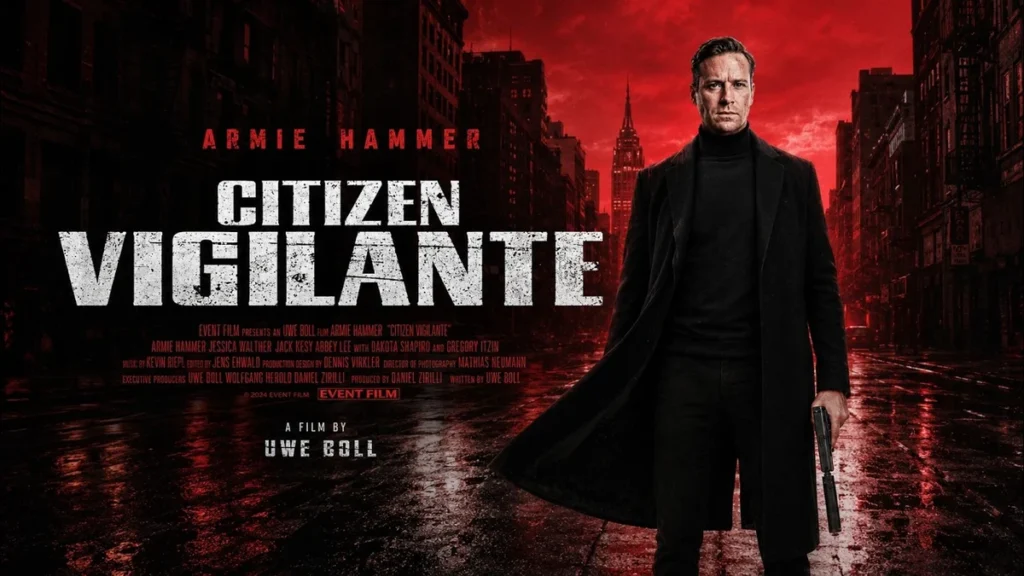
Citizen Vigilante Review Verdict: Citizen Vigilante is a film that generates far more heat outside the cinema than inside it. As a piece of filmmaking, it is amateurish, poorly paced, and structurally broken. As a cultural flashpoint, banned in Germany, promoted by Elon Musk to 240 million followers, and currently one of the most discussed films of 2026, it has achieved a reach no conventional release strategy could have manufactured. The controversy is the product. The film itself is barely a film.
Citizen Vigilante was released theatrically and digitally on June 19, 2026. It was subsequently posted to X by Elon Musk for 48 hours from June 25. It is now available to rent or buy on Amazon, iTunes, Fandango, and Google Play, and is currently streaming free on IMDb TV. Runtime: 1 hr 29 min. This review covers the film’s cinematic qualities and its distribution controversy.
Quick Verdict: Is Citizen Vigilante Worth Watching?
It depends entirely on what draws you to it. As pure cinema, as a vigilante action film measured against the genre standards it openly invokes, it falls well short of its inspirations. Both reviewers whose footage forms the basis of this analysis reach the same conclusion from different angles: the filmmaking is weak, the acting is flat, the pacing drags, and the film frequently feels less like a movie and more like a 90-minute YouTube documentary stitched together with B-roll.
What the film does have, and what has driven its remarkable controversy-powered distribution, is a topic people are talking about regardless of whether the film handles it well. If you are the kind of viewer who prioritises message over execution, Citizen Vigilante will likely hold your attention. If you are looking for a well-crafted thriller in the Death Wish or Dirty Harry tradition it aspires to join, it will disappoint.
Citizen Vigilante (2026) — Movie Info
| Detail | Info |
|---|---|
| Title | Citizen Vigilante |
| Original Working Title | The Dark Knight (renamed after Warner Bros. cease-and-desist) |
| Release Date | June 19, 2026 (US theatrical and digital) |
| Runtime | 1 hr 29 min |
| Director / Writer / Producer | Uwe Boll |
| Cinematographer | Mathias Neumann |
| Filming Location | Zagreb, Croatia |
| Budget | Approximately $2 million USD |
| Gross (as of late June 2026) | $600,000 USD (streaming) |
| Our Rating | ★★☆☆☆ (2/5) |
Citizen Vigilante Story & Plot
Sanders is a wealthy American living in Zagreb who has inherited a massive real estate empire from his late father. Intelligent, isolated, and emotionally scarred, he begins a violent campaign against criminals, rapists, and corrupt judges who have escaped meaningful punishment through the legal system. As his vigilante actions spread across social media and news outlets, Sanders becomes both a wanted criminal and a public hero. But Interpol Chief Henry sees him not as a savior, but as a dangerous threat, launching an aggressive international pursuit to stop him before his influence spirals out of control.
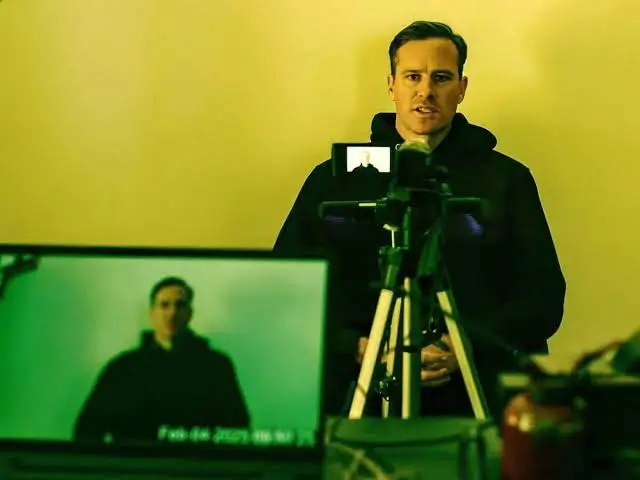
The film is set in an unnamed European city, implied to be Zagreb, where it was shot, and unfolds across a non-linear timeline that cuts between Sanders carrying out vigilante missions, recording video confessions to the camera, and planning future operations. The structure is borrowed from found-footage and mockumentary traditions, though the film does not fully commit to either approach, leaving it in an awkward middle ground that two of our source reviewers independently described as feeling more like a documentary or YouTube video essay than a feature film.
The film was inspired by a notorious case in Hamburg in 2016, when a group of teenagers gang-raped a 14-year-old girl and left her for dead, only for the perpetrators to walk free with suspended sentences.
Citizen Vigilante Cast — Full Lineup
| Actor | Character |
|---|---|
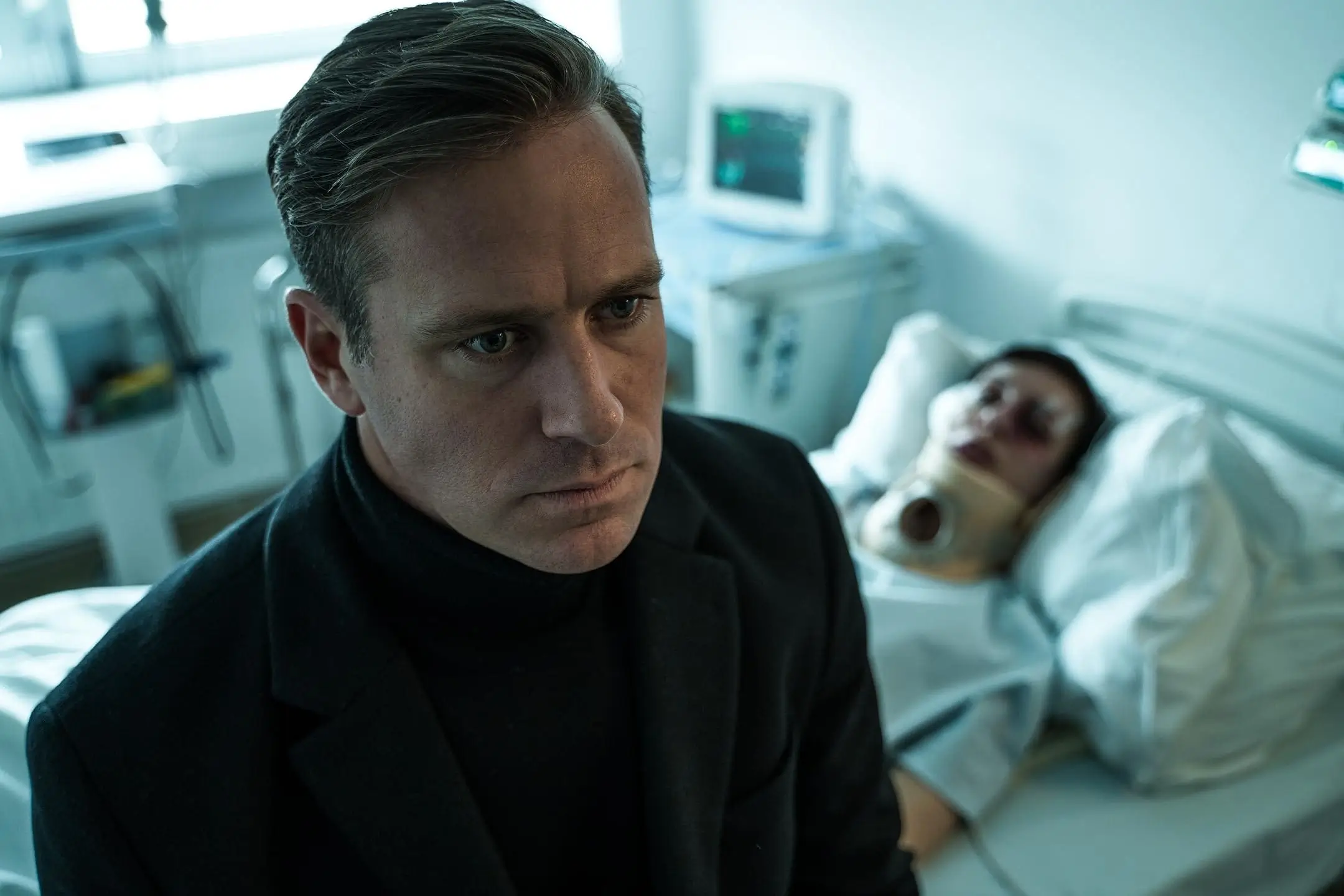
| Armie Hammer | Sanders — the vigilante protagonist |
| Costas Mandylor | Interpol Regional Chief Henry — primary antagonist |
| Neb Chupin | SWAT Leader Pierre |
| Vjekoslav Katusin | Arab Mafia Boss |
| Dora Dimic Rakar | Raped Girl |
| Désirée Giorgetti | Elsa |
| Helen Al-Janabi | Sarna |
| Steffen Mennekes | Manager Owen |
| Roni Lepej | Judge Reinhold |
| Elizabeth Zacero | News Anchor |
| Benjamin Schnau | Jack |
| Lennart Betzgen | Rick |
| Tvrtko Juric | Raped Girl’s Father |
| Dino Keric | Bus Driver |
| Uwe Boll | Cameo appearance |
Citizen Vigilante Review: The Filmmaking
Direction
Uwe Boll is a filmmaker with a long and specifically controversial career; his name is effectively a genre marker at this point, signalling low-budget, aggressively provocative content that prioritises impact over craft. Citizen Vigilante is consistent with that reputation, and Boll himself has been candid about it: when Variety called the film a “violent, incoherent, morally bankrupt slice of exploitation,” Boll responded that he was a fan of exploitation movies and that he was not trying to be Tarkovsky.
What the direction delivers is a film that frequently mistakes length for weight. Scenes that could be resolved in two minutes are stretched to five. Boll seems to use every second of footage he recorded on the film, often multiple times, to pad it to feature length, as if he had decided that following actors through every single moment of an activity somehow imbues it with the meaning his script clearly lacks.
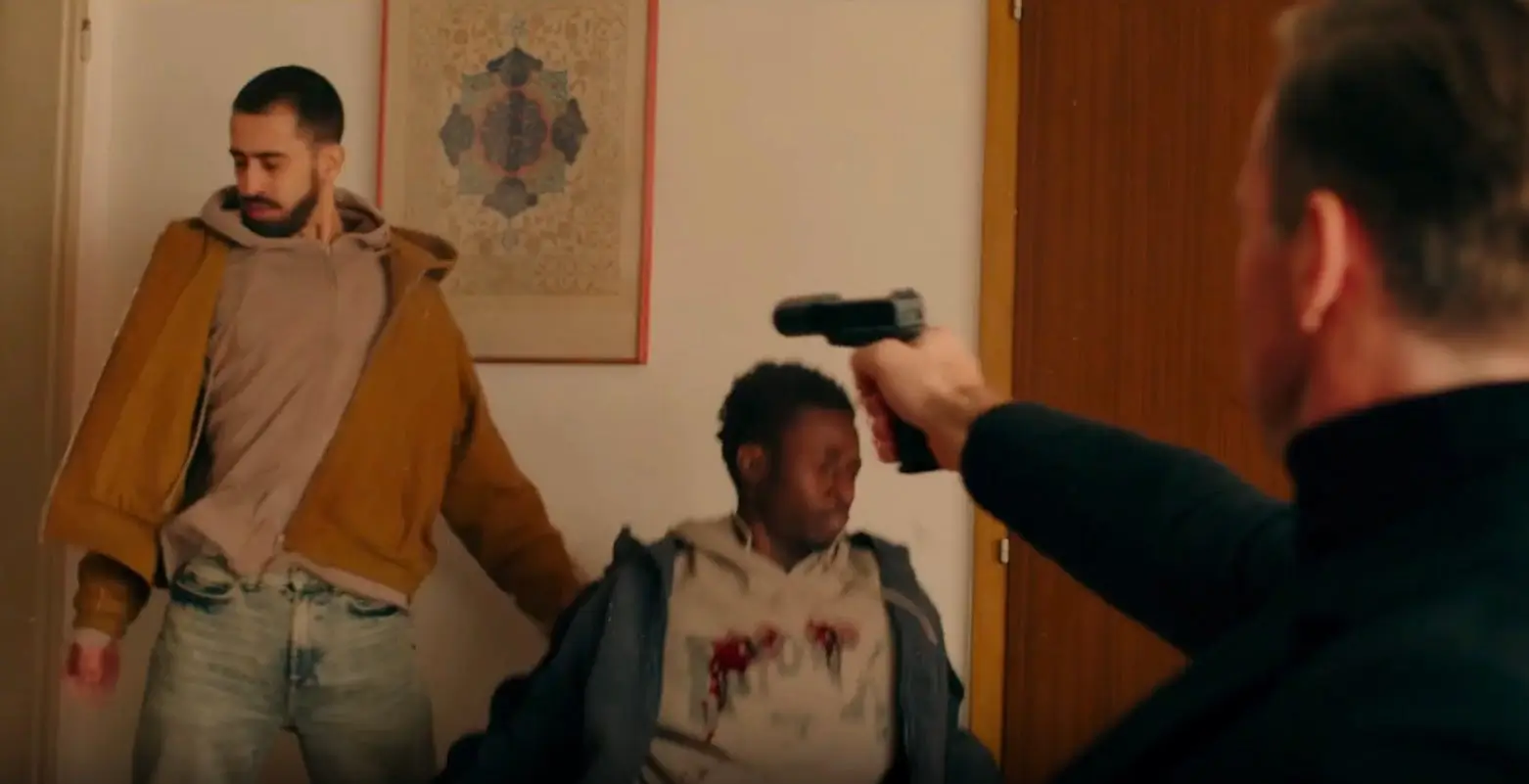
The POV shots scattered throughout are competently executed individually, but run far too long; a convoy sequence in particular, which both our source reviewers flagged, extends a simple march into an approximately five-minute sequence that drains rather than builds tension. The Dutch angle camera work, intended to add visual unease, appears too infrequently and too randomly to function as a coherent stylistic choice.
One of our source reviewers made an observation that captures the film’s directorial problem neatly: it does not feel like a movie. It feels like a documentary assembled from separate video shoots, or a long-form YouTube video in which someone is confessing their actions directly to the camera throughout. That feeling is partly by design; the film’s non-linear structure is built around Sanders’ on-camera monologues, but it is also partly a symptom of craft limitations that work against the material.
Screenplay and Structure
The film is pointlessly nonlinear, and really has no plot except for Sanders to persuade victims of violent crimes that his form of punishment will be more cathartic than what the legal system can provide, and then enact it with as much firepower and brutality as possible.
The non-linear timeline cuts between three or four parallel sequences: Sanders on active missions, Sanders recording confessional video messages to the camera, and Sanders planning future operations. The structure is not inherently problematic; non-linear vigilante narratives have a workable precedent, but here it creates a specific issue that both our source reviewers raised: the film’s confession sequences, which run throughout the runtime, conclude without providing clear narrative closure. Who Sanders is confessing to, and why, is eventually answered, but the answer does not land with the weight the film has spent 90 minutes building toward.
The screenplay’s other major weakness is character. Sanders has no meaningful backstory beyond a few lines of self-narrated biography; he had a father, he inherited money, and no supporting characters are developed beyond their function as plot devices. Almost every character other than Sanders and the Interpol chief has roughly five to fifteen minutes of screen time and zero arc. Our source reviewers put it directly: the film could have been a 15-minute short film without losing any meaningful content. The choice to stretch it to 90 minutes creates a story-per-minute ratio that works against the film’s own momentum.
There are also specific logical failures that stand out even within the film’s genre conventions. A key action sequence involving a metal shield and a SWAT team is described by one reviewer as funny rather than tense, because trained officers with firearms are depicted as unable to overcome an improvised shield. A hospital scene in which a detective requests a hand-drawn sketch of a suspect in a 2025-set film, apparently unaware of CCTV, prompted a similar reaction. These are genre-film contrivances, but they are handled with less craft than genre convention requires.
Performances
Armie Hammer returns to screens in his most prominent role since his 2021 career derailment, a story that has generated as much discussion as the film itself. Hammer had a solid acting career throughout the 2010s in films like The Social Network, J. Edgar, The Man from U.N.C.L.E., and Call Me By Your Name. However, Hammer’s career derailed in 2021 after allegations emerged on social media. Police investigations failed to end with any charges laid against Hammer, but he was dropped by his agent, had jobs cancelled, and was reportedly reduced to working as a restaurant manager.
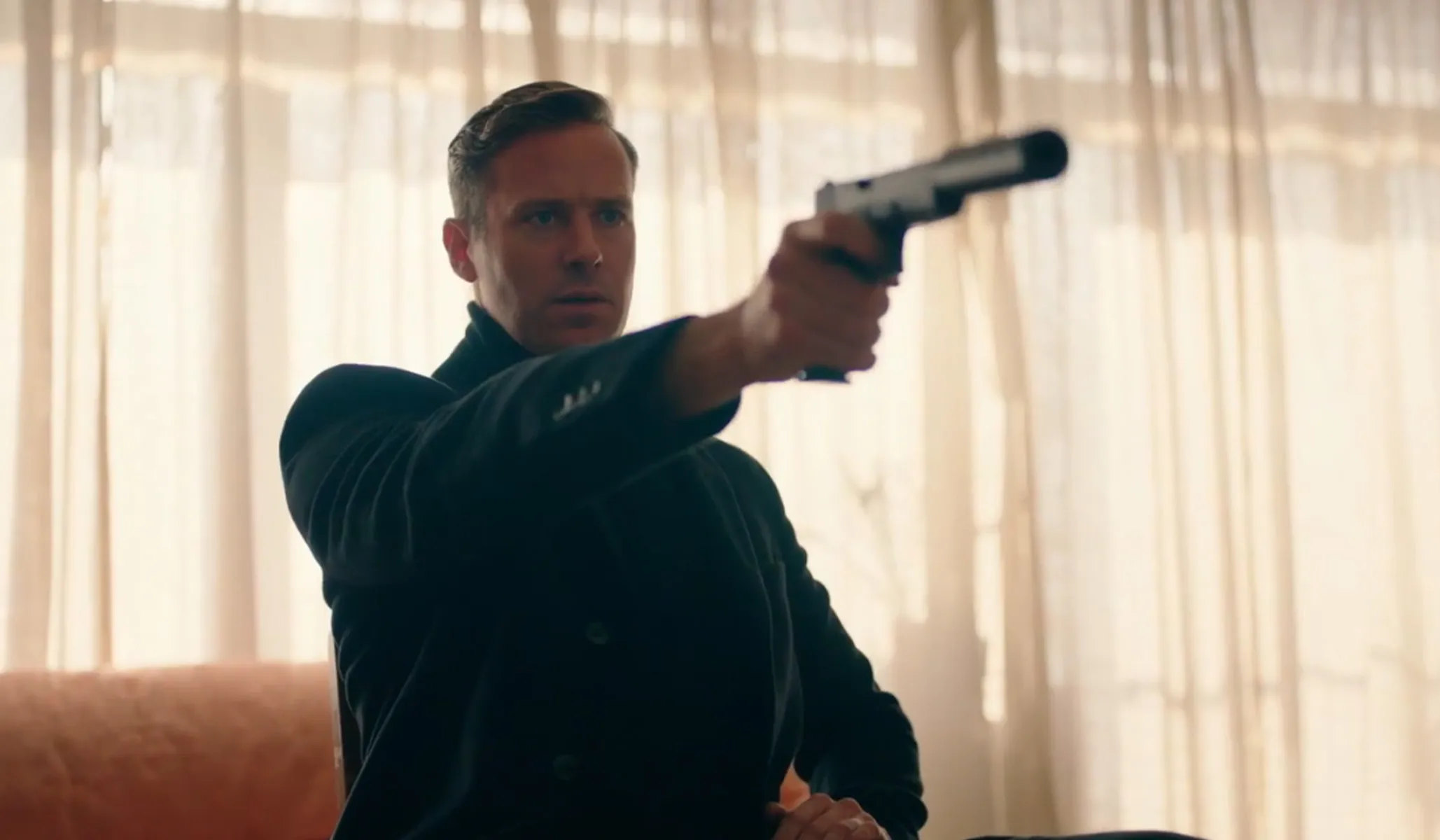
As Sanders, Hammer’s approach is notably restrained, almost entirely flat in affect. Very little emotional range is on display: no joy, no visible grief, no conventional signalling of interiority. Whether this is a deliberate character choice for a man who has emotionally shut down or a limitation of the role as written is a genuine interpretive question, and the two reviewers in our source material land on different sides of it.
One reads the flatness as appropriate embodiment, a man so scarred and isolated that expressionlessness is the correct performance. The other, echoing Variety’s Todd Gilchrist, finds that Hammer displays “little of that spark” of his earlier charisma, leaving the character without the magnetism a vigilante protagonist needs to hold audience investment for 90 minutes.
What both perspectives share is the acknowledgement that the material itself does not give Hammer much to work with. The dialogue is thin, the character backstory is underdeveloped, and the script provides few scenes that could have showcased whatever range Hammer retains from his peak work. Variety described Boll’s script as giving the character “prejudiced screeds” and commented that the film felt “like the writer-director-producer is deliberately sabotaging his star Armie Hammer, whose intended comeback can only be harmed by this project.”
Costas Mandylor as Interpol Chief Henry is the film’s most substantive supporting performance. His 10–15 minutes of screen time represent the largest presence after Hammer, and within those constraints, he brings more energy and screen presence than the material demands. As the film’s primary antagonist, a law enforcement chief who sees Sanders not as a hero but as a dangerous destabiliser, Mandylor provides the clearest articulation of the film’s counter-argument to its protagonist’s methods.
Neb Chupin as SWAT Leader Pierre gets the next-largest supporting role, which our source reviewer assessed as fine given its limited scope, not an acting showcase, but functional within what it is asked to do.
The news anchor character is a specific outlier that both sources single out independently: a role written and performed in a way that reads as off-brand even for a low-budget production, with stilted delivery and expressions that break the film’s own naturalistic tone. It is a minor role with limited screen time, but its awkwardness is distracting in a film that otherwise maintains reasonable consistency in its supporting cast performances.
Cinematography
Zagreb’s mix of historic Upper Town cobblestone streets, communist-era apartment blocks, and modern commercial districts made it an ideal, and cost-effective, backdrop for the film’s action-heavy sequences.
The location choice is one of the film’s genuine assets. Zagreb provides a distinctly European visual texture, neither generically Western nor obviously Eastern European, that suits a story set in an unnamed European city and gives the action sequences a grounded, unglamourised quality that expensive studio productions often fail to achieve.
The cinematography itself is competent without being distinguished. Boll’s longtime collaborator Mathias Neumann handles the camera, and his work is functional throughout. The POV sequences are the most technically assured passages, though as noted, they frequently run longer than necessary. The Dutch angle attempts are the least successful, appearing too infrequently to constitute a visual language and too conspicuously to read as natural. The overall visual texture can be described as documentary-adjacent: gritty in a practical rather than stylistically intended sense.
Score and Sound Design
The background score is the film’s weakest technical element. Both our source reviewers arrive at the same assessment independently: thumping, repetitive, and in the action sequences sounding less like composed music and more like algorithmically generated tension cues. One reviewer described it as sounding as though it were made by AI rather than professional composers. Rodolfo Matulich is credited for the music, but the result does not suggest significant resources or creative attention were directed toward the sonic design.
The SWAT and police march sequences have functional suspense scoring, but it is described as merely okay, neither good enough to elevate scenes nor bad enough to actively undercut them. In several quieter scenes, the score is simply absent rather than replaced by any ambient sound design, leaving passages that feel sonically unfinished.
Why Is Citizen Vigilante Banned? The Distribution Controversy Explained
This is the question driving most of the film’s current search traffic, and the answer is more legally specific than the word “banned” implies.
The film did not receive an age rating in Germany, meaning it cannot be shown in theatres, advertised, or sold in most stores. This is a regulatory classification outcome rather than a government-imposed ban. Germany’s content classification system requires films to receive an age rating before distribution, and without one, the film cannot legally operate in the mainstream German market. The film is currently in its third round of the classification process.
Quiver Distribution has taken worldwide rights, excluding the UK, German-speaking territories, South Korea, and Taiwan. The UK and those additional territories present their own regulatory or distributor-level obstacles, making the global release patchwork rather than universal.
The film was released on X on June 25, 2026, for 48 hours and was reposted by Elon Musk. Musk made several posts praising the film and suggested that efforts to ban it had instead boosted its reach, specifically mentioning the “Streisand Effect.” This assessment proved commercially accurate; Musk’s promotion of the film led to Quiver Distribution getting the rights to expand it to a worldwide release.
According to Boll, as of late June 2026, the film has earned US$600,000 from streaming services against its US$2 million budget. It has not yet recouped its costs, but the worldwide distribution deal changes the economic picture significantly.
Where Was Citizen Vigilante Filmed?
Citizen Vigilante was shot entirely in Zagreb, Croatia. Principal photography started on January 27, 2025, and wrapped on April 3, 2025. Croatia offered a combination of cost-effective production infrastructure, experienced local crew, and architecture well-suited to the film’s European crime-thriller aesthetic. Zagreb’s streets, back alleys, and public architecture feature prominently, giving the film a distinctly Eastern European character that sets it apart from generic action productions shot on Los Angeles or London back lots.
The story is explicitly set in Zagreb as well, and Sanders is depicted as an American expatriate based there, meaning the location doubles as its own setting rather than standing in for somewhere else, which is an economically efficient choice that gives the production a coherent geographic identity.
What Happened With the Title the Dark Knight?
In January 2025, it was announced that a thriller film produced, written, and directed by Uwe Boll titled The Dark Knight was in pre-production, with Armie Hammer cast in the lead role. Principal photography began on January 27, 2025. Warner Bros. sent Boll a cease-and-desist letter regarding the use of the title. In April 2025, the title had been changed to Citizen Vigilante.
The rename is notable not only for the legal reason but for the creative implication: Boll’s original framing of the film as his own version of The Dark Knight, the Christopher Nolan film widely considered the gold standard of morally complex vigilante cinema, sets a bar the finished film does not come close to reaching by any critical measure.
Citizen Vigilante vs. the Vigilante Genre: How Does It Compare?
The vigilante film as a genre has a long and genuinely rich tradition. Death Wish, Dirty Harry, Taxi Driver, Rolling Thunder, and, more recently, the John Wick series have all explored the question of what happens when an individual decides the legal system cannot or will not deliver justice, and the best of them have done so with real moral complexity, strong central performances, and craft-level filmmaking.
No matter how much affection one may have for vigilante films, from genre standard-bearers like “Dirty Harry,” “Taxi Driver,” and “Rolling Thunder” to any of a dozen Jason Statham actioners, Boll makes it extremely difficult to be charitable to “Citizen Vigilante,” even as the cheapest grindhouse fare.
What separates the best vigilante films from their weaker counterparts is not the ideology of their protagonist but the craft with which the director presents and complicate that ideology. Dirty Harry was genuinely disturbing in its implications precisely because Siegel directed it with enough moral intelligence to make Callahan’s methods feel dangerous rather than simply heroic. Taxi Driver worked because Scorsese kept Travis Bickle’s perspective consistently unreliable. Citizen Vigilante lacks the directorial intelligence to interrogate its own premise, and without that layer, it functions as wish-fulfillment rather than drama.
Is a Citizen Vigilante Sequel Coming?
A sequel is in development, which Boll hopes for a release in 2027. No script has been completed for the proposed sequel as of June 2026. Boll has said he has developed some concepts for the project, but added that a screenplay does not yet exist. When asked about Hammer’s possible return, he expressed confidence that the actor would be interested in reprising the role.
The commercial viability of a sequel depends significantly on whether the worldwide distribution deal generates enough revenue to close the budget gap on the first film. At $600,000 against a $2 million budget as of late June, the financial case for a sequel remains unproven.
Citizen Vigilante Review Pros & Cons
✓ Pros
- Zagreb filming location gives the film a genuine European atmosphere on a tight budget
- Costas Mandylor provides the film’s most functional supporting performance
- The topic is genuinely being discussed across Europe and America, giving the film contextual relevance beyond its execution
- The non-linear confessional structure is an interesting formal idea even if the execution falters
- The film is short enough at 89 minutes that it does not demand an excessive time commitment
- Now available to watch free on IMDb TV
✗ Cons
- The filmmaking is amateurish, and pacing, structure, and scene economy are all significantly below genre standards
- Armie Hammer’s performance is flat and underpowered; the script gives him too little to work with
- The score is the film’s worst element, repetitive, tonally misjudged, and sounding algorithmically produced
- No character depth or backstory for any character except the most surface-level self-narration
- Key action sequences are logically incoherent even by genre-film standards
- The confessional narrative structure does not provide closure when it concludes
- The film disguises its exploitation roots behind the pretense of exploring an important topic, even as it proceeds to treat that subject completely inappropriately.
Final Verdict
| Category | Score |
|---|---|
| Direction | ★★☆☆☆ |
| Screenplay / Structure | ★★☆☆☆ |
| Armie Hammer’s Performance | ★★☆☆☆ |
| Supporting Cast | ★★½☆☆ |
| Cinematography | ★★½☆☆ |
| Score | ★½☆☆☆ |
| Pacing | ★★☆☆☆ |
| Controversy / Cultural Reach | ★★★★★ |
| Overall | ★★☆☆☆ (2/5) |
Citizen Vigilante is a more interesting story as a distribution and cultural phenomenon than as a film. The filmmaking is weak across almost every technical dimension, pacing, character, score, and action choreography all fall below the standards of the exploitation genre it is explicitly trying to inhabit. Armie Hammer brings presence but not the charisma or emotional range needed to carry a one-character study for 90 minutes on writing this thin.
What the film does achieve, and it is nothing, is placing a specific conversation in front of millions of viewers who sought it out specifically because it was being discussed, restricted, and promoted by one of the world’s most followed social media figures. Whether that kind of controversy-fuelled reach constitutes success is a question the sequel development will ultimately answer.
As a vigilante film for viewers who have seen and enjoyed Death Wish or Dirty Harry, look elsewhere. As a cultural document of a specific moment in the political debate about law, justice, and immigration policy in the West, it is at least a genuine artifact of that conversation, even if the craft with which it engages that conversation is far below what the topic deserves.
If you enjoyed our Citizen Vigilante Review, don’t miss our latest reviews of the biggest movies and TV shows making headlines around the world. From blockbuster superhero films and Netflix originals to acclaimed dramas and controversial releases, we cover everything with spoiler-free reviews, ending explained guides, cast breakdowns, Rotten Tomatoes updates, and honest verdicts. You can also explore our reviews of Enola Holmes 3, The Bear Season 5, Minions and Monsters, Silo Season 3, Supergirl, Elle, and many more trending releases to help you decide what’s worth watching next.
Frequently Asked Questions
Q. What is Citizen Vigilante about?
Ans. Citizen Vigilante is a 2026 vigilante action thriller directed by Uwe Boll and starring Armie Hammer. Sanders is a wealthy American living in Zagreb who has inherited a massive real estate empire from his late father. Intelligent, isolated, and emotionally scarred, he begins a violent campaign against criminals, rapists, and corrupt judges who have escaped meaningful punishment through the legal system. As his vigilante actions spread across social media and news outlets, Sanders becomes both a wanted criminal and a public hero.
Q. Where can I watch Citizen Vigilante?
Ans. In North America, the film is available on iTunes, Amazon, Fandango, and Google Play. It is also currently available to watch for free on IMDb TV. Following Elon Musk’s promotion of the film on X and the resulting worldwide distribution deal, it is available in most global territories, excluding Germany, the UK, South Korea, and Taiwan.
Q. Is Citizen Vigilante banned?
Ans. Not in a straightforward sense. The film did not receive an age rating in Germany, meaning it cannot be shown in theatres, advertised, or sold in most stores. This is a regulatory classification outcome rather than a direct government ban. The film is also not currently distributed in the UK, South Korea, or Taiwan due to separate regulatory or distributor-level decisions.
Q. Where was Citizen Vigilante filmed?
Ans. Citizen Vigilante was shot entirely in Zagreb, Croatia. Principal photography started on January 27, 2025, and wrapped on April 3, 2025. Zagreb also serves as the film’s story setting.
Q. Who is in the Citizen Vigilante cast?
Ans. The film stars Armie Hammer as Sanders, the vigilante protagonist, and Costas Mandylor as Interpol Regional Chief Henry, his primary antagonist. Supporting cast includes Neb Chupin, Vjekoslav Katusin, Dora Dimic Rakar, Désirée Giorgetti, and Helen Al-Janabi, among others.
Q. What is the next movie with Armie Hammer?
Ans. As of this writing, Citizen Vigilante is Armie Hammer’s most prominent 2026 release. Boll expressed confidence that Hammer would return for a planned sequel, though no script has been completed as of late June 2026. No other confirmed Hammer projects have been announced.
Q. Is Citizen Vigilante a good movie?
Ans. The film has received very negative reviews from major publications. Variety called it “astonishingly bad” while receiving strong audience support from viewers who responded to its subject matter. As a piece of filmmaking, its craft limitations are significant. As a topic-driven experience for viewers who find its premise compelling, it is more watchable than the critical consensus suggests, provided expectations about production quality are adjusted accordingly.
Q. Who directed Citizen Vigilante?
Ans. Citizen Vigilante was written, produced, and directed by Uwe Boll, a German filmmaker known for a long career in low-budget, often controversial productions. Boll is unfazed by the negative critical reception, saying he personally likes exploitation movies and that he is not against this kind of film in general.
Q. Is Citizen Vigilante a true story?
Ans. The film is fictional, though it was inspired by a real case in Hamburg in 2016, when a group of teenagers gang-raped a 14-year-old girl and left her for dead, with the perpetrators walking free with suspended sentences.
Citizen Vigilante is now available to rent or buy on Amazon, iTunes, Fandango, and Google Play, and is streaming free on IMDb TV.