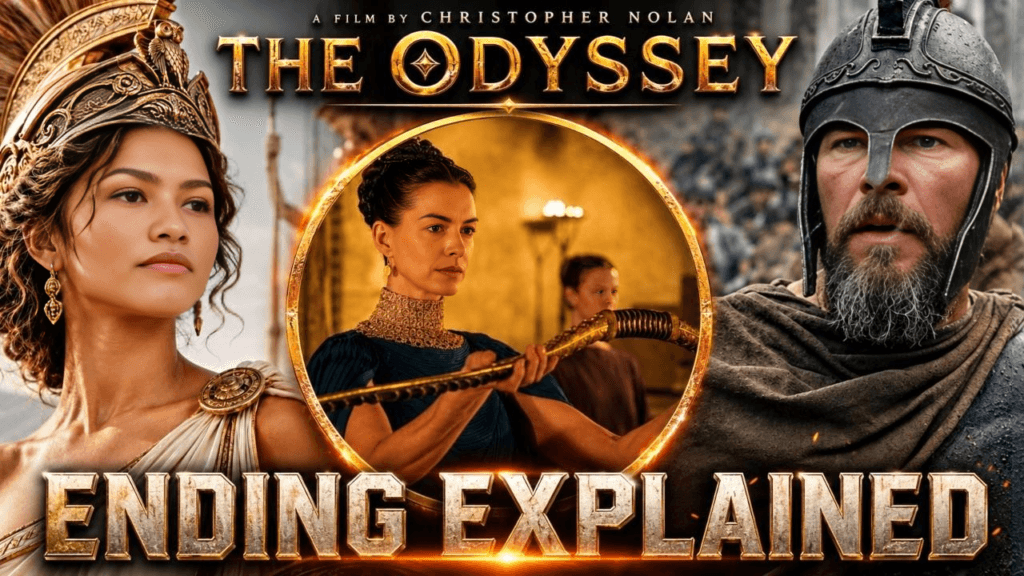
Spoiler Warning
Everything below discusses the complete plot of Christopher Nolan’s The Odyssey (2026), including its final act, its closing scene, and the meaning behind it. If you haven’t seen the film yet, bookmark this and come back; the ending genuinely works better cold.
Why Audiences Are Talking About This Ending
Nolan’s The Odyssey isn’t a straightforward action-adventure retelling of Homer’s epic. It’s a film about the cost of cleverness, about a man whose most famous trick, the Trojan Horse, doesn’t just win a war but breaks something sacred that can never be fully repaired. Viewers are leaving theaters with questions that go beyond “did Odysseus make it home?” They want to know what the horse’s final flame-lit image actually means, why Athena appears in human form only to Odysseus, what Penelope’s closing line is really saying, and whether the movie has a genuinely happy ending at all.
This guide answers all of it, the plot mechanics, the mythology, the symbolism, and the interpretation debates, in one place.
Quick Answer: How Does The Odyssey End?
Odysseus returns to Ithaca in disguise, slaughters the suitors who have occupied his home, and reunites with Penelope, who has spent decades faking devotion to a burial shroud to buy time. But the film’s real ending is emotional, not just narrative: Odysseus finally admits that the Trojan Horse, his greatest triumph, broke Zeus’s sacred law of hospitality and effectively ended the Bronze Age.
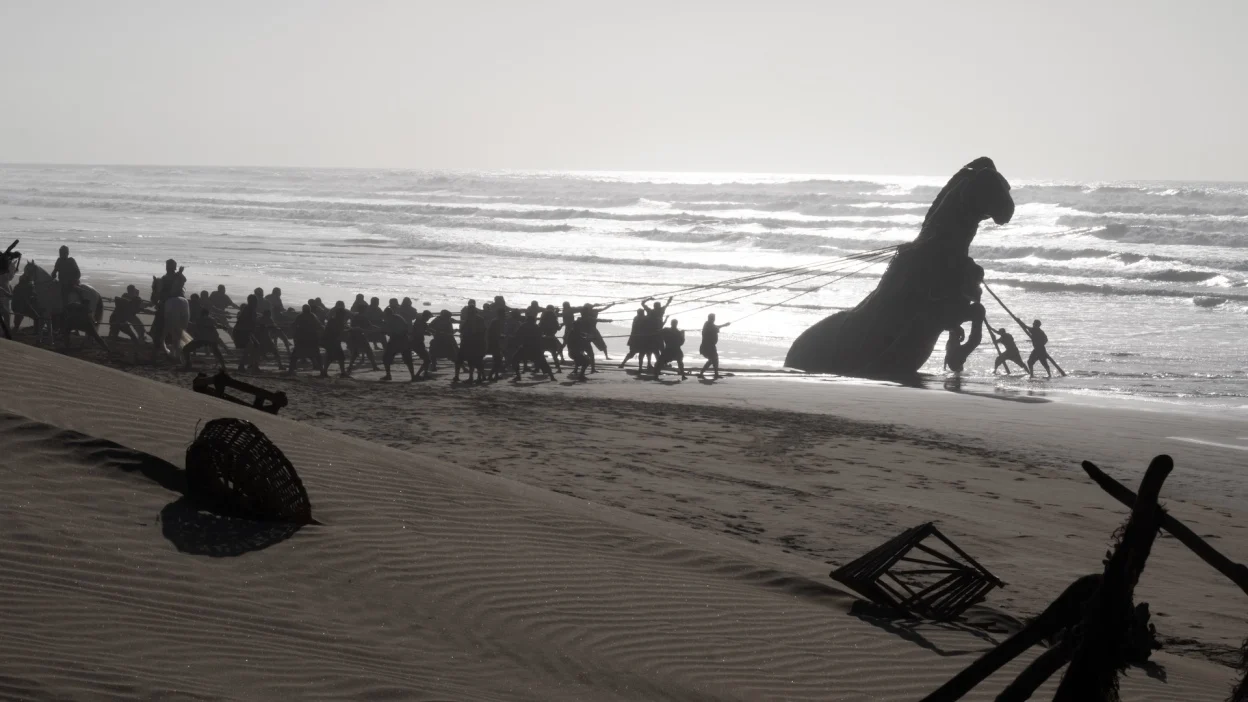
Penelope tells him plainly that he and his men are the mysterious “people from the sea” blamed for civilization’s collapse. The film closes on Odysseus and Penelope preparing to leave again, hand in hand, chasing one more voyage, while the Trojan Horse burns one final time in his memory, a symbol of glory that can never be separated from the horror it caused.
Movie Recap: What You Need to Remember Before the Ending Of The Odyssey
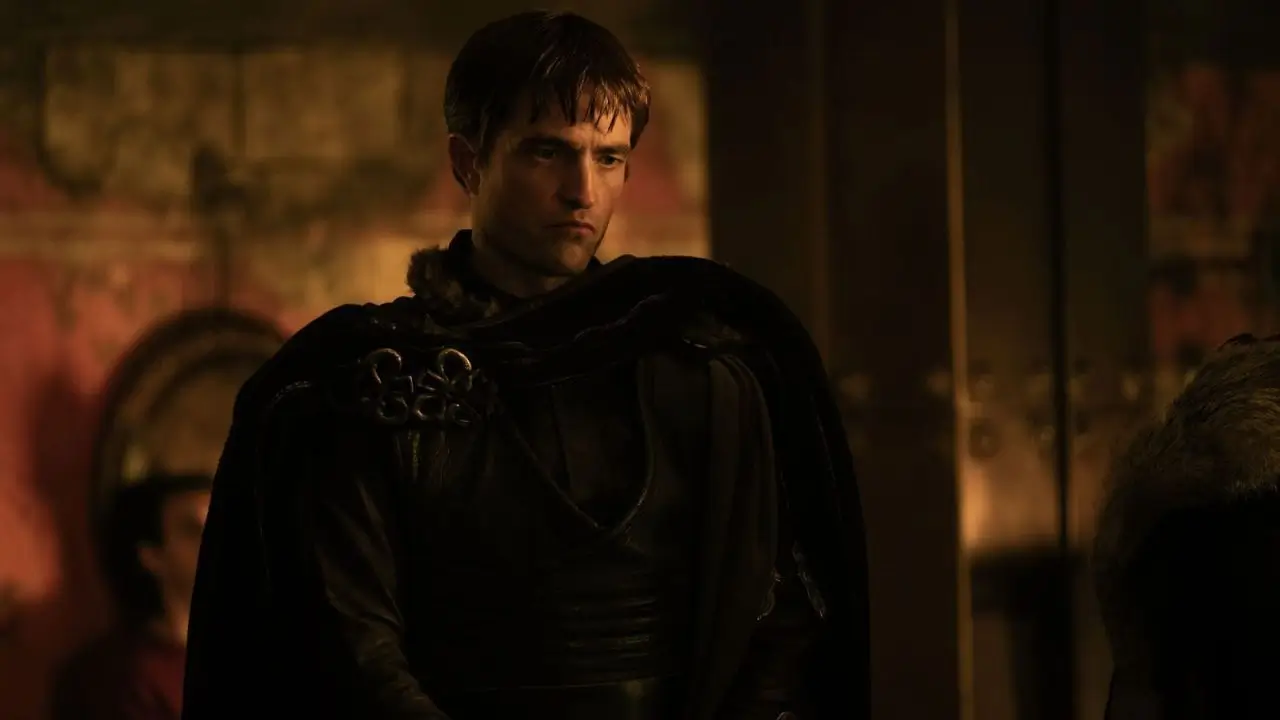
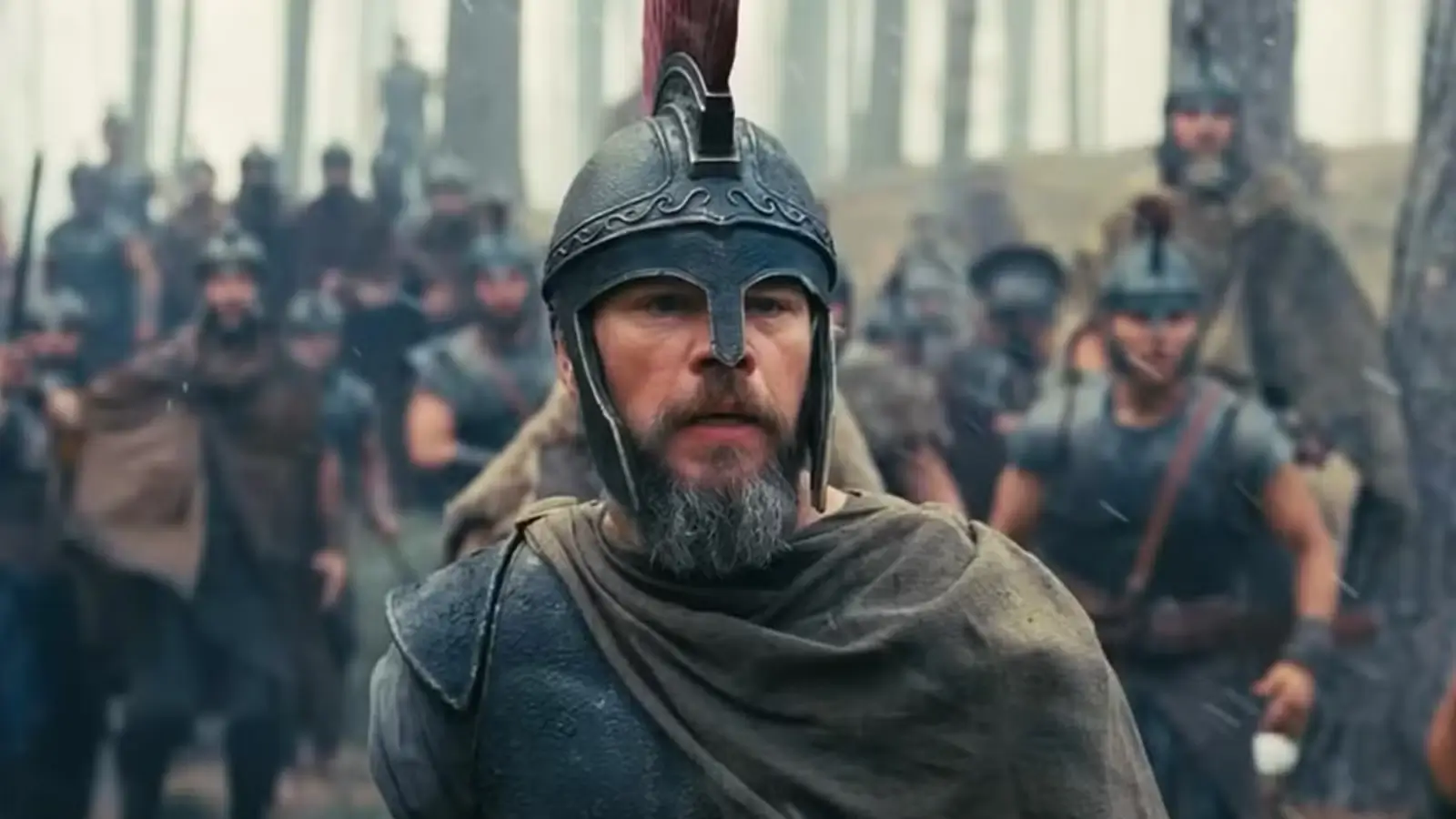
The film opens years after the Trojan War. Odysseus (Matt Damon) hasn’t come home, and his wife Penelope (Anne Hathaway) is fending off more than a hundred suitors camped in their hall, each hoping to marry her and claim the throne of Ithaca. Their son Telemachus (Tom Holland) is humiliated by the suitors’ leaders, Antinous and Polybus, and sets off to find news of his father, guided by Mentor, who Telemachus suspects, and Odysseus later denies, is the goddess Athena in disguise.
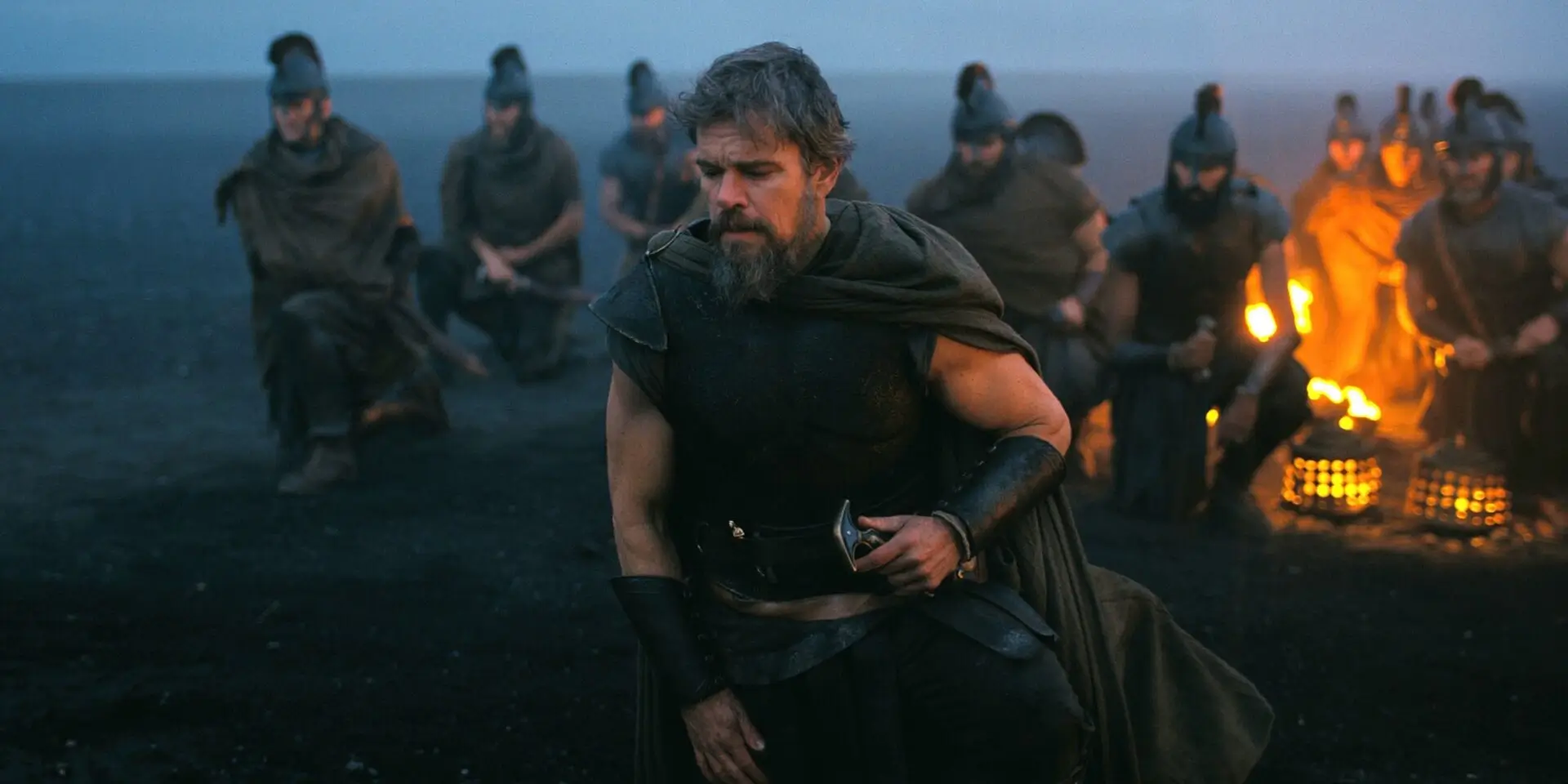
Odysseus himself is stranded, first on Calypso’s island and, in flashback, recovering his fractured memory of everything that happened after Troy fell: the horrific decade of monsters, mutiny, and loss that turned a celebrated war hero into a broken man clinging to a token from his wife.
The film structures its mythology as flashback and testimony rather than a straight chronology, much like Homer’s original poem. We get the Trojan Horse story told three different ways by three different people: as a triumphant legend from a bard, as a grim war story from Menelaus, and finally as a confession of horror from Odysseus himself. That repetition is deliberate, and it’s the emotional key to the ending.
The Odyssey Ending Explained (Scene by Scene)
Telemachus Returns and the Suitors Close In
By the time Telemachus comes home from Sparta, Antinous is plotting to ambush him. Odysseus, having washed ashore on Ithaca in disguise as a beggar, reconnects with his old swineherd Eumaeus and learns of the plot in time to intervene. This section matters because it re-establishes the film’s core moral framework: Zeus’s law of hospitality, the ancient code that every stranger should be treated as a possible god in disguise. The suitors have violated it for years. Odysseus is about to violate it too, just in a different direction, through deception rather than intrusion.
Why it matters: Nolan spends the whole film asking who actually breaks divine law worse, invaders who overstay their welcome, or a “liberator” who tricks his way into a city under the guise of a peace offering. The suitors and Odysseus are mirror images of the same sin.
The Reunion in Disguise
Odysseus doesn’t reveal himself to Penelope right away, even once he’s home. He sits across from her, separated by a thin woven screen, still playing the beggar. This isn’t cowardice, it’s the film’s version of the “noble lie” theme that runs through nearly all of Nolan’s filmography, from The Prestige to Inception to Interstellar. Odysseus has learned, through Agamemnon’s ghost in the underworld, that walking through the front door expecting parades gets you murdered. He has to earn his way back in slowly, in disguise, on his own terms.
Character motivation: Odysseus isn’t testing Penelope’s loyalty here so much as testing whether he’s still capable of belonging in the world he broke to get home to.
Penelope’s Challenge — The Bow and the Axes
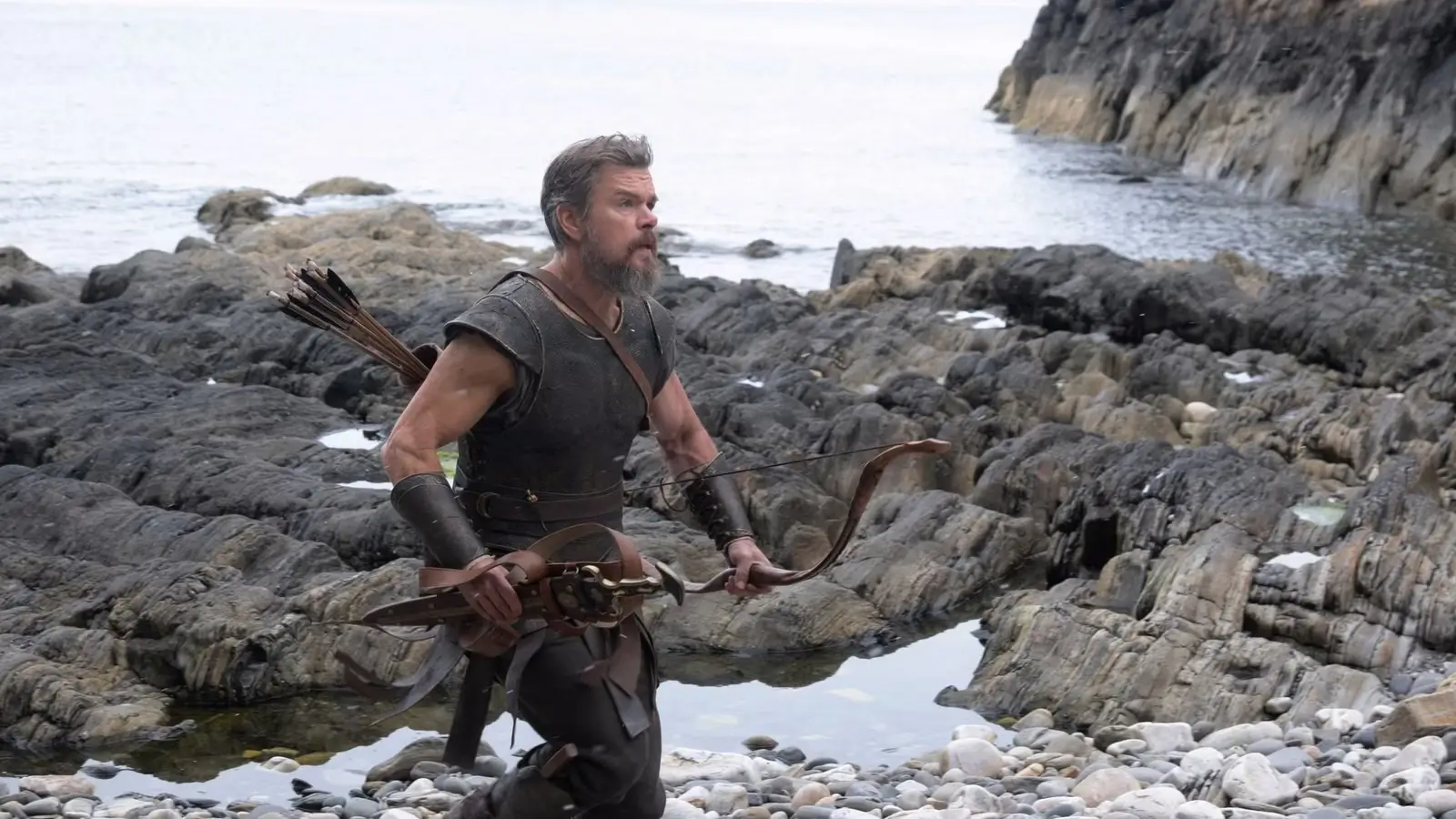
Penelope sets a contest: whoever can string Odysseus’s old hunting bow and shoot an arrow clean through twelve axe heads gets her hand. No suitor can even bend the bow. The disguised beggar steps up, deliberately fumbles at first to make Penelope turn away, and then, using the exact same motion she’d recognize instantly if she saw it, strings the bow and fires a perfect shot.
Hidden meaning: The recognition isn’t visual. It’s tactile and sonic, the sound and motion of the bowstring. Nolan plants this all the way back in a flashback of a young Odysseus stringing the same bow to hunt a boar. The film argues that real intimacy isn’t about appearances; it’s about knowing someone’s body, their habits, their signature movements, even after decades apart.
The Slaughter of the Suitors
Chaos erupts. Antinous is killed almost instantly (an arrow to the neck), followed by the rest of the suitors as Odysseus, Telemachus, and their allies cut them down in the hall. Melanthius, a servant loyal to the suitors, tries to arm them from a locked storeroom before Telemachus defeats him in a duel and drops a sword down to his father to finish the fight.
Story significance: This isn’t shot or scored like a triumphant action climax. It’s brutal and claustrophobic. Nolan is deliberately denying the audience a clean catharsis, because the film has spent two hours establishing that righteous violence and unrighteous violence look identical from the inside. Odysseus becomes, for a few minutes, the same kind of invader the Greeks were at Troy.
Odysseus Kills Antinous and Honors Sinon
Before killing Antinous, Odysseus stuffs the drafting lot, the token that once sent an innocent boy named Sinon to war in Antinous’s place, into his mouth, telling him to carry the truth of his cowardice to the underworld. This closes a subplot invented specifically for this adaptation: the Antinous/Sinon backstory doesn’t exist in Homer’s poem. Nolan built it to physically tie the suitors back to the Trojan Horse and the theme of broken sacred law.
Why it happened: It’s poetic justice on two timelines at once, punishing Antinous for exploiting Sinon years earlier, and punishing him now for exploiting Ithaca’s hospitality in Odysseus’s absence.
The Confession
Once the suitors are dead, the ending shifts from action to reckoning. Odysseus, finally alone with Penelope, tells her the real story of the Trojan Horse, not the bard’s triumphant version, not Menelaus’s war story, but the truth: soldiers trapped inside a wooden animal for days, sitting in their own filth, one of them stabbed by a testing Trojan blade and silenced by his own comrades so the trick wouldn’t be discovered. He admits the horse wasn’t a clever war-winning maneuver so much as a violation that shattered a peaceful, trusting civilization.
Director’s intent: This is the emotional center of the whole film. Nolan is using the “Ending Explained” moment itself as the character’s arc, Odysseus’s homecoming isn’t complete until he stops performing the hero and admits what the trick actually cost.
Penelope’s Answer: “You Are the People From the Sea”
The film has been quietly building toward one mystery: the identity of the “people from the sea,” a real historical enigma blamed for the collapse of Bronze Age civilization. When Odysseus admits what the Horse cost, Penelope tearfully gives the film’s answer: you are the people from the sea. Not marauding foreign invaders, Odysseus and men just like him, whose cleverness and violence unmade the world they were trying to protect.
Story significance: This line reframes the entire film. It’s not a war epic celebrating a homecoming. It’s a film about how the “heroes” of one story are the destroyers in someone else’s.
The Final Image: The Burning Horse
The film’s very last shot returns to the Trojan Horse consumed by flame, the image that opened the movie in the bard’s telling, now recontextualized as Odysseus’s personal, haunted memory rather than a legend. Odysseus and Penelope, hand in hand, prepare to sail west together one more time, chasing “the escaping sun,” leaving Telemachus behind to rule Ithaca.
Hidden meaning: Ending on the burning horse rather than on the couple’s embrace is the clearest possible authorial statement: glory and atrocity are the same object in this film. You cannot separate the ingenuity that won the war from the horror it caused.
The Odyssey Final Scene Breakdown: Dialogue, Color, and Camera
The reunion and confession scene is staged through the same translucent woven screen that separated Penelope from the suitors throughout the film. As the fire crackles behind it, the screen’s vertical and horizontal lines glow, visually echoing the transparent bookcase-tesseract construct from Interstellar. Nolan is drawing a direct line between two of his most emotional “homecoming” images: a man who has traveled through impossible distance (time, in one film; the wine-dark sea, in the other) trying to reach a family he can see but can’t yet fully touch.
The lighting throughout Ithaca in this stretch is warm and firelit, a deliberate contrast to the cold, purplish “wine-dark” grays used for Odysseus’s sea voyages and the stark white light of Iceland’s Hades sequence. Color in this film consistently tracks emotional safety: warm and gold for home and memory, cold and desaturated for danger and moral compromise.
The Aulos pipe theme — the ancient double-reed instrument sound first heard on Odysseus’s last night with Penelope before the war, returns here, closing an aural loop the film has been running since its opening minutes. Musically, the reunion isn’t a new theme; it’s the return of an old one, reinforcing that this is a homecoming in the fullest sense, not a new beginning.
The Odyssey Character Analysis
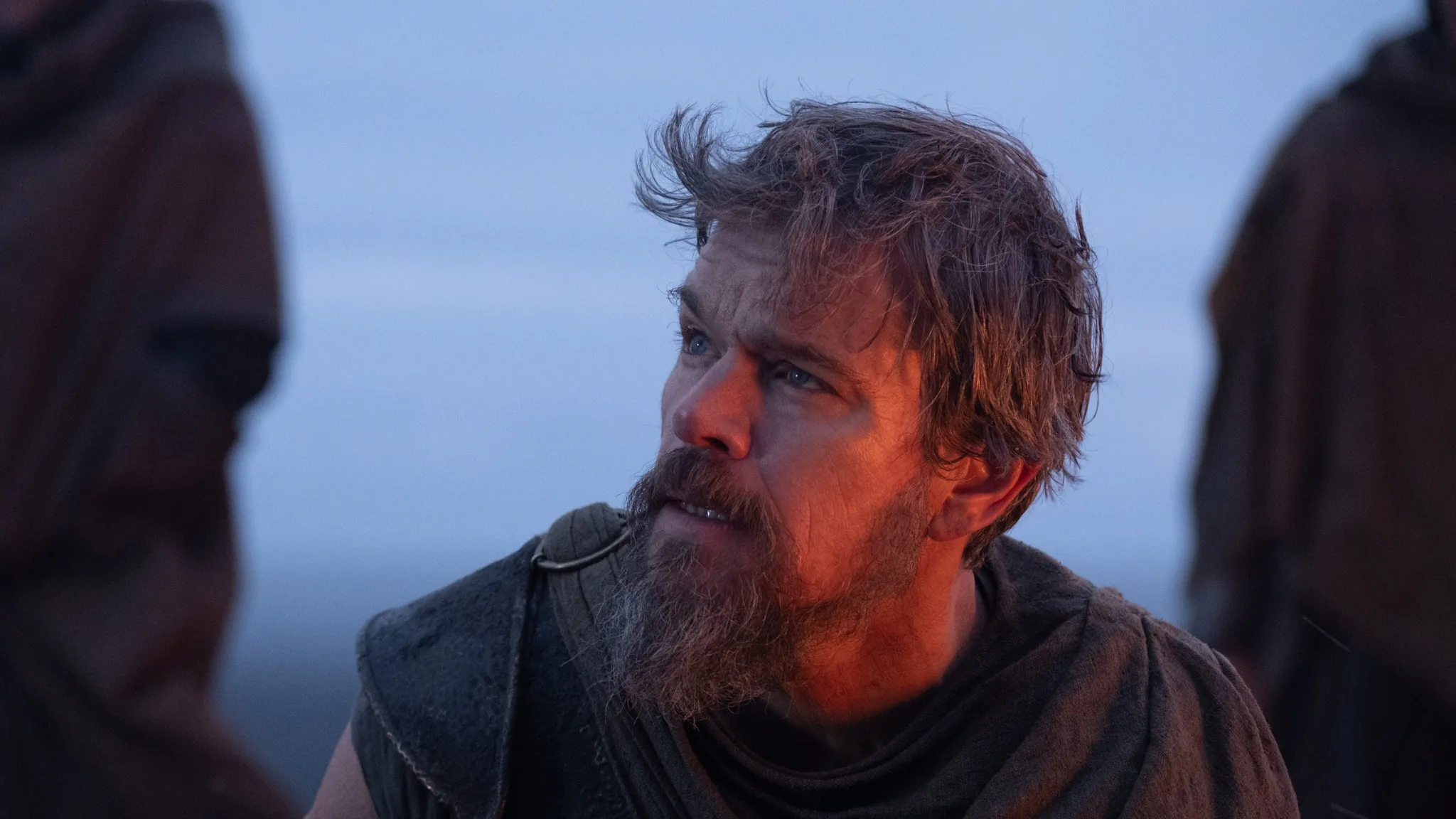
Odysseus (Matt Damon)
Odysseus’s arc in this adaptation is less about the physical journey home and more about confronting the cost of his own cleverness. Nolan noticeably strips away much of the trickster/liar characterization Homer gives him, framing him instead as an honorable man tortured by regret, a pattern consistent with how Nolan tends to write his protagonists across his filmography. His psychological throughline is guilt: every monster and setback on the voyage home reads as consequence for the Horse, culminating in his final, unguarded confession to Penelope.
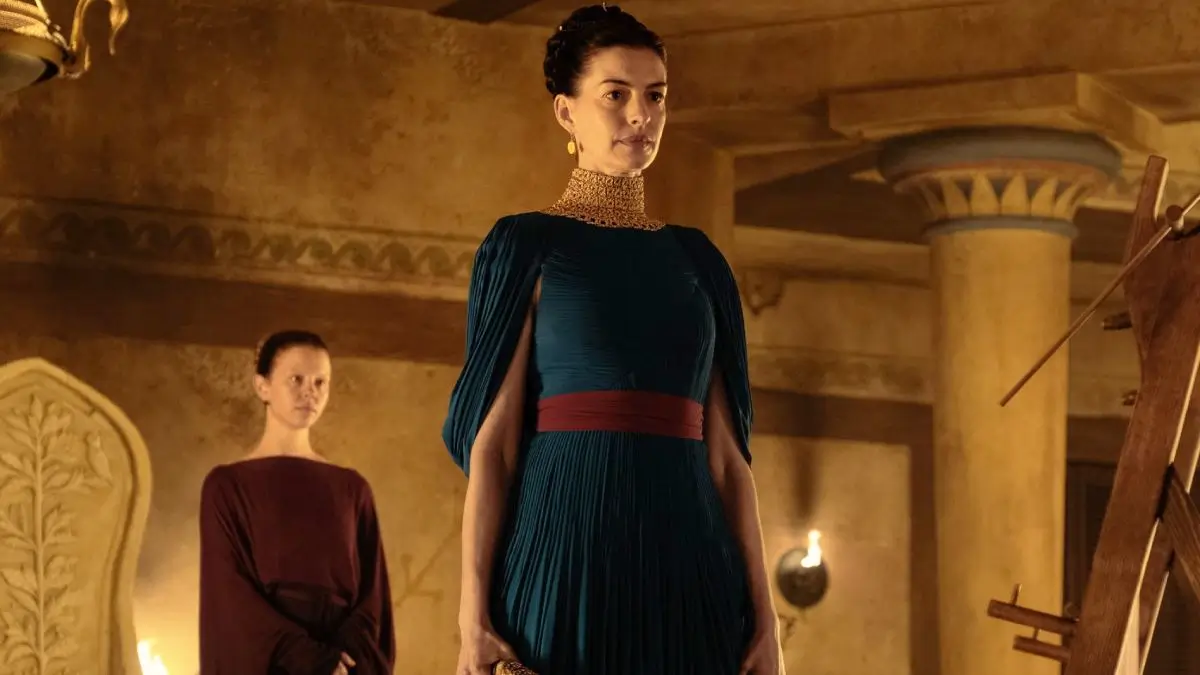
Penelope (Anne Hathaway)
Penelope isn’t a passive figure waiting at home. Her unpicked burial shroud is an active, ongoing act of resistance and control, she’s buying herself decades of agency inside a system that gives her almost none. Her closing lines to Telemachus (“I’ve been sitting on an empty throne for 28 years”) reframe her not as a symbol of fidelity but as the film’s most clear-eyed political mind. She’s also the one who names the film’s central theme out loud, which makes her, narratively, the moral center of the ending.
Telemachus (Tom Holland)
Telemachus’s arc is a coming-of-age story that runs in parallel to his father’s homecoming. He starts the film humiliated and powerless against the suitors, and ends it having fought and defeated one of them directly, earning the throne his father chooses to hand to him rather than reclaim for himself. His repeated description of Mentor as having “wise eyes, Athena’s eyes” plants the Athena-in-disguise theory that Odysseus explicitly rejects, a small but pointed disagreement between father and son about how much to trust the divine.
Athena (Zendaya)
Athena is the only god the film shows in full human form, and only to Odysseus. The reveal recontextualizes every one of her appearances: she is, in fact, the ghost of a young Trojan woman slaughtered on the steps of her own temple during the sack of the city. Odysseus has been haunted, quite literally, by a victim of his own war crime, mistaking his guilt for divine guidance the entire film.
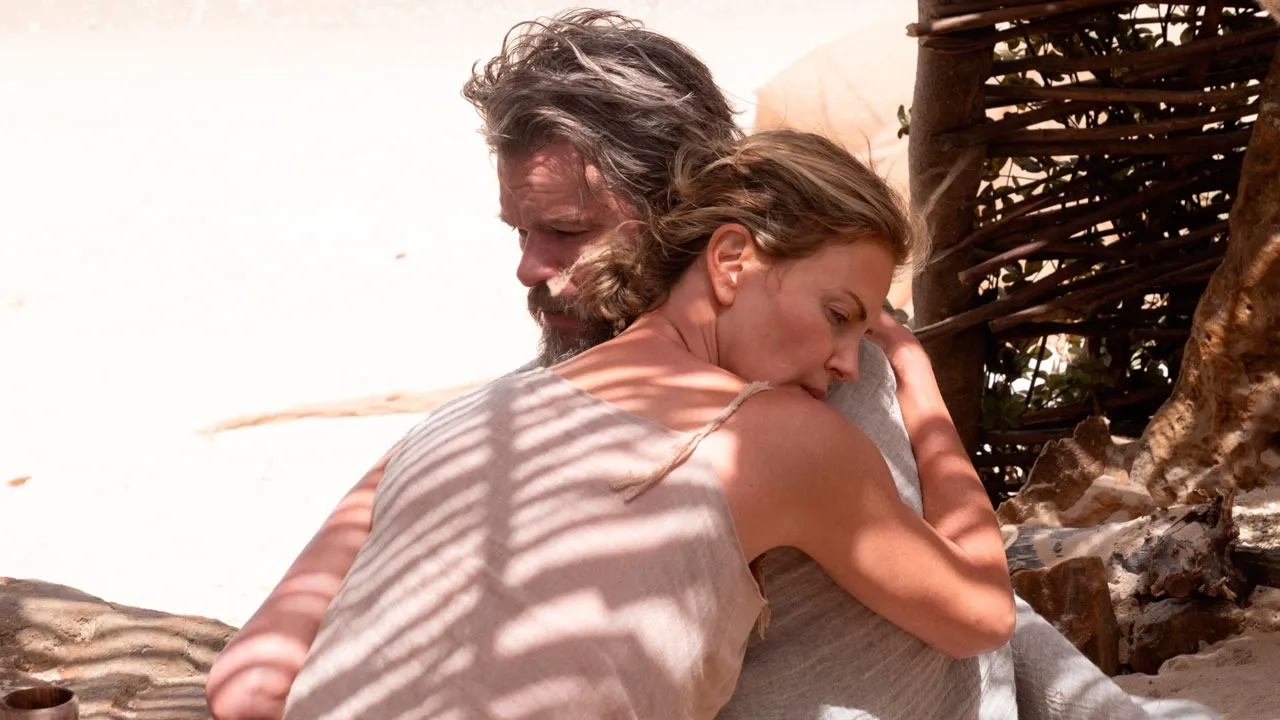
Calypso (Charlize Theron) and Circe (Samantha Morton)
Both women function as way-stations of arrested development for Odysseus, Calypso numbs his trauma with the lotus flower, and Circe forces him to confront what his men actually are underneath their armor (“primal, disgusting, invading beasts”). Circe in particular voices one of the film’s sharpest thematic lines, framing soldierly honor itself as a disguise for something far uglier.
Helen (Lupita Nyong’o)
Helen’s scarred face, inflicted by her husband Menelaus as punishment, and her closing apology to Penelope (“I’m sorry for Troy and for all the things done in my name”) make her the film’s other major voice of guilt. She and Penelope form a quiet parallel: two women left to absorb the emotional wreckage of a war fought, in different ways, in their names.
The Odyssey Themes breakdown
Guilt and the noble lie. Nearly every character is protecting someone through deception: Penelope with her shroud, Odysseus with his disguise, the entire mythology of the Horse itself. The film asks whether a lie can ever really be “noble” once you account for its victims.
Hospitality and its violation. Zeus’s law, treat every stranger as a possible god, structures almost every relationship in the film, from the suitors’ abuse of Penelope’s home to the Trojans welcoming the Horse as a gift. Nearly every tragedy in the film traces back to someone breaking this law.
Home as an unreachable ideal. Like much of Nolan’s other work, The Odyssey is fundamentally about the gap between wanting to go home and being capable of actually living there once you arrive.
Civilization’s fragility. The “people from the sea” mystery gives the film’s greatest tragedy a mythic scale, the idea that an entire era of trade, language, and peace can be undone by one act of clever violence.
The Odyssey Symbolism breakdown
The Trojan Horse. More than a war trophy, it’s treated visually throughout the film like a fragile, dangerous object, carried carefully, revered, and ultimately consuming everything in flame. It stands in for the seductive danger of brilliant ideas divorced from their consequences.
Penelope’s unpicked shroud. A private, cyclical act of resistance, building and unbuilding the same thing every day, that mirrors Odysseus’s own stalled homecoming, stuck in loops of memory and delay.
The woven screen. Physically separates Penelope from outsiders throughout the film, and later separates her from her own disguised husband. It represents both her protection and the emotional distance homecoming has to cross.
The bowstring. A private, physical signature between husband and wife that succeeds where sight and words fail, intimacy as muscle memory rather than recognition.
Fire and cold water. Warm firelight consistently marks home, memory, and honesty; cold, gray, “wine-dark” seas mark danger, distance, and moral compromise.
The Odyssey 20+ Hidden Details You Might Have Missed
- The film’s studio logo sequence quietly traces the exact Mediterranean route Odysseus’s crew will sail, foreshadowing the geography before the story even begins.
- The opening title card reads “a time of apparent magic”, signaling that everything supernatural in the film may be filtered through unreliable memory and myth-making, not literal fact.
- The bard’s staff has a gold-tipped cattle head, quietly foreshadowing the sacred sun-god cattle Odysseus’s crew is forbidden to eat later.
- Young Odysseus, completing his hunting bow ends on the exact three-note motif that recurs as the film’s main musical theme, meaning the “theme song” is literally the sound of his bowstring.
- The wound Odysseus receives from the boar hunt as a young man is the same scar his old nursemaid recognizes decades later when washing the disguised beggar’s feet.
- Telemachus sleeping, facing away from his parents during the war-planning scene, echoes a similar visual choice in Nolan’s Inception, symbolizing a father slowly losing the specific memory of his child’s face.
- Penelope’s pin of Athena, given to Odysseus before he leaves, functions almost exactly like a “totem” object, a physical anchor back to a specific memory, similar to devices in Inception.
- Agamemnon’s armor is designed to look like blackened, exposed vertebrae, subtly marking him as a dead man walking before his on-screen death is even revealed.
- Every appearance of Athena is shot as an in-camera “Texas switch,” with the camera panning away and back so she appears to materialize beside Odysseus without a visible cut.
- Trojan soldiers are costumed in lighter tones while the Greek army wears darker armor, an inversion of “good guy/bad guy” color coding that signals who the film actually considers the villains.
- The soldier stabbed while hiding inside the horse is a small, easy-to-miss detail; his death, and Odysseus wiping the blade clean afterward, is the film’s first visual proof of the Horse’s true cost.
- Odysseus fires one extra, unnecessary arrow at the fleeing Cyclops, a small act of cruelty that the film frames as the real trigger for Poseidon’s wrath, not the blinding itself.
- Antinous and Sinon’s backstory involving a swapped war draft is invented entirely for this adaptation and doesn’t exist in Homer’s poem — it exists purely to connect the suitors’ plot to the Horse’s guilt.
- The Cyclops’ cave contains hanging bags of cheese, a direct nod to the historical theory that this section of the myth is tied to the ancient origins of feta cheese production.
- The film’s Hades sequence was deliberately shot in Iceland’s constant midsummer daylight to make the underworld feel eerie and endless rather than simply dark.
- Sinon’s ghost physically returns the drafting lot to Odysseus in the underworld, an object that reappears in Odysseus’s hand during the suitor slaughter to close the story loop.
- Argus the dog is played by one of the rarest living dog breeds, and his death scene is timed to trigger Telemachus’s realization of his father’s true identity.
- Circe’s “pets” include lions, panthers, and leopards, not native to the region, a visual cue, confirmed later, that they are transformed men rather than animals.
- The horse in the film’s final flame-engulfed shot is staged with the same careful, reverent handling used throughout, deliberately visually rhyming with the bomb casing in Nolan’s Oppenheimer.
- Helen’s whispered apology to Penelope (“I’m sorry for Troy”) never appears in Homer’s poem and was written specifically for this film to give Helen agency in the story’s guilt.
- The suitors’ mocking reference to Odysseus’s “bad mind” for the way he “strung his cattle” is a subtle callback to the myth of Odysseus feigning madness to avoid being drafted for the war.
- Odysseus’s refusal to confirm Mentor is Athena in disguise is a deliberate departure from Homer, signaling that this version of Odysseus distrusts divine explanations for his own guilt.
The Odyssey Foreshadowing: 15+ Clues and Their Payoffs
- Clue: The bard’s staff has a golden cattle head. Payoff: The crew’s fatal decision to eat the forbidden sun-god cattle later in the voyage. Meaning: Divine punishment is seeded from the film’s opening minute.
- Clue: Odysseus strings his hunting bow as a young man, producing the film’s main musical motif. Payoff: He strings the same bow to win the archery contest and reclaim his home. Meaning: Identity and homecoming are tied to a physical, repeatable act.
- Clue: The boar wound scars his leg in the flashback. Payoff: His old nursemaid recognizes him by that exact scar decades later. Meaning: True recognition comes from intimate physical knowledge, not appearance.
- Clue: Penelope’s pin of Athena is given as a keepsake before Odysseus leaves. Payoff: He’s later shown clutching it as his one link to memory and home while trapped by Calypso. Meaning: Small tokens outlast grand heroics.
- Clue: Telemachus repeatedly calls Mentor’s eyes “Athena’s eyes.” Payoff: Odysseus flatly denies that Mentor is Athena, creating unresolved tension about faith versus guilt. Meaning: Sets up the father-son disagreement about how to interpret the divine.
- Clue: A goatherd on an early island says his village fled because they feared the crew were “the people from the sea.” Payoff: Penelope’s closing line confirms this fear was correct all along. Meaning: The film is telling you the answer to its own mystery in act one.
- Clue: Odysseus fires an extra arrow at the fleeing, blinded Cyclops. Payoff: This act of unnecessary cruelty, more than the blinding itself, is framed as the true offense against Poseidon. Meaning: Excess violence, not necessity, is the real sin.
- Clue: Agamemnon’s armor is designed like exposed black vertebrae. Payoff: His ghost later recounts his own murder at home. Meaning: He was visually “already dead” the entire time we see him alive.
- Clue: Odysseus gives his ring to Eurylochus after they can’t properly bury the soldiers killed by Polyphemus. Payoff: That ring later proves to Odysseus that his transformed, pig-shaped crew are still his men. Meaning: Loyalty markers outlast physical transformation.
- Clue: Menelaus scars Helen’s face early in the film. Payoff: Helen later takes ownership of the war’s guilt in her apology to Penelope. Meaning: Physical and emotional punishment for the war falls disproportionately on women.
- Clue: Athena tells Odysseus the gods speak through natural forces like thunder and a child’s smile. Payoff: Her true identity as a slaughtered Trojan girl reframes every one of her “wise” appearances as guilt, not guidance. Meaning: What looked like divine wisdom was always personal trauma.
- Clue: Circe tells Odysseus’s transformed men are “primal, disgusting, invading beasts” underneath their armor. Payoff: Odysseus becomes exactly that during the suitor slaughter. Meaning: Heroism and savagery share the same body.
- Clue: Antinous lies about swapping war-draft lots with Sinon. Payoff: Sinon’s ghost corrects the story in the underworld, and Odysseus later exposes the lie to Antinous’s face before killing him. Meaning: Lies eventually collapse under their own weight.
- Clue: Tiresias prophesies Odysseus’s entire remaining route home, including a promise to return and honor his fallen men. Payoff: The film’s closing minutes show Odysseus and Penelope beginning exactly that journey. Meaning: The ending is a fulfillment of a promise made in the underworld, not a spontaneous choice.
- Clue: Penelope tells young Telemachus to invoke Zeus’s law of hospitality against the suitors. Payoff: The entire final act is Odysseus enforcing that same law violently against those same suitors. Meaning: The rules established early aren’t abstract, they’re the literal justification for the ending’s violence.
The Odyssey Unanswered Questions
Is Mentor really Athena in disguise?
The film never confirms it. Telemachus believes it; Odysseus rejects it. This is left as deliberate ambiguity rather than an unresolved plot hole, one possible interpretation is that Odysseus’s denial says more about his guilt than about Mentor’s actual identity.
What happens to Ithaca politically after the ending?
The film doesn’t show it. Telemachus is left to rule, but the fallout of an entire generation of noble suitors being slaughtered in the hall is left unaddressed on screen. This is theory territory, not a confirmed plot.
Does Odysseus ever complete the final journey Tiresias prophesied?
The ending shows him and Penelope beginning that voyage, but the film ends before it’s completed. This is intentionally left open as a coda rather than a resolution.
Was Calypso’s love for Odysseus ever reciprocated?
The film complicates this by showing Odysseus clutching Penelope’s pin the entire time he’s with Calypso. It reads as one-sided on his end, though this is an interpretation rather than a stated fact.
The Odyssey Timeline of the Ending (Chronological)
| Stage | Event |
|---|---|
| 1 | Telemachus returns to Ithaca; Odysseus learns of the ambush plot from Eumaeus |
| 2 | Odysseus, disguised as a beggar, reunites with Telemachus and reveals himself |
| 3 | Odysseus observes the suitors’ cruelty firsthand while still in disguise |
| 4 | Penelope announces the bow-and-axes contest |
| 5 | The disguised Odysseus strings the bow and wins the contest |
| 6 | The suitor slaughter begins; Antinous is killed first |
| 7 | Melanthius is defeated by Telemachus after arming the suitors |
| 8 | The remaining suitors are killed or surrender |
| 9 | Odysseus confesses the true, horrific story of the Trojan Horse to Penelope |
| 10 | Penelope names Odysseus and his men as “the people from the sea” |
| 11 | Odysseus and Penelope prepare to sail west together, leaving Telemachus as ruler |
| 12 | Final image: the Trojan Horse burning in Odysseus’s memory |
The Odyssey Post-Credit Scene
The Odyssey does not have a post-credit scene. The film closes on the image of the burning Trojan Horse and rolls credits with a dedication to IMAX collaborator David Keighley, who worked with Nolan on the film’s custom silent IMAX camera rig before passing away shortly after production wrapped. There is no additional footage after the credits.
Book vs. Movie: What Nolan Changed From Homer’s Odyssey
- Structure: Like the poem, the film is told out of chronological order through flashback and testimony, but Nolan splits the Trojan Horse story into three separate retellings for three different emotional effects, a structural choice not present in Homer.
- The Cyclops trick: Homer’s Odysseus escapes by telling Polyphemus his name is “Nobody,” a pun the other Cyclopes misunderstand. The film drops this joke entirely in favor of a straw-and-wool disguise trick, largely because the wordplay doesn’t translate cleanly and would require other Cyclopes on screen.
- Antinous and Sinon: This entire subplot, including the swapped war-draft lots, is invented for the film and does not exist anywhere in Homer’s text.
- Argus the dog’s death: Present in both, but the film adds direct visual proximity between the dog’s death and Telemachus realizing his father’s identity.
- The bed test: Homer’s poem includes Penelope’s famous final test, where she asks servants to move the marriage bed to confirm Odysseus knows it’s built around a living olive tree and therefore cannot be moved. The film does not depict this scene.
- Circe: Homer’s version includes Hermes warning Odysseus and a sexual bargain to free his men. The film removes both, replacing them with Odysseus threatening Circe’s sister-crow instead.
- Agamemnon’s murder: Homer credits Aegisthus, Clytemnestra’s lover, as the actual killer. The film simplifies this to Clytemnestra alone.
- Athena’s identity: Homer’s Athena is a divine ally with no hidden backstory. The film’s invented twist, that “Athena” is the ghost of a slaughtered Trojan girl haunting Odysseus’s guilt, has no basis in the source poem at all.
- The ending itself: Homer’s poem doesn’t depict Odysseus’s life after the homecoming, only prophesying a future journey. The film chooses to visually stage the beginning of that journey rather than end purely on the reunion.
The Odyssey Ending Interpretations
Interpretation 1: A war-crime confession dressed as an epic. Under this reading, the entire “homecoming” structure is really a long, delayed act of accountability. Odysseus spends the whole film being punished by monsters and grief until he’s finally capable of admitting what the Horse actually cost. This appears to be the film’s most strongly supported reading, given how directly Penelope’s closing line states it.
Interpretation 2: A meditation on the impossibility of truly coming home. One possible interpretation ties this film into Nolan’s broader body of work, from Inception to Interstellar, as another story about a man who sacrifices his family time chasing a goal, only to discover home was never a fixed destination he could simply return to. The ending’s choice to send Odysseus and Penelope back out to sea together supports this reading.
Interpretation 3: A cyclical warning about civilization. This interpretation treats the burning horse as a symbol that repeats rather than resolves, the implication being that “clever” acts of violence like the Horse are what always precede a civilization’s collapse, not an isolated historical event. This is theory rather than confirmed textual meaning, but it’s consistent with the film’s opening emphasis on the historical “dark age” that followed the Bronze Age’s fall.
The Odyssey Sequel Possibility
Nolan and the studio have not announced a sequel, and the film is structured as a self-contained story rather than a franchise setup. That said, several loose threads leave room for future stories if Nolan or the studio wanted to pursue them: Tiresias’s prophecy of Odysseus’s final journey is left unresolved on screen, Telemachus’s reign in Ithaca is untested, and the fate of the “people from the sea” mystery on a wider historical scale is only addressed through Odysseus and Penelope individually, not the world at large. As of now, any continuation is speculation, not confirmed development.
Final Verdict: What The Odyssey’s Ending Ultimately Means
Stripped of its monsters and mythology, The Odyssey‘s ending is a story about a man forced to stop performing heroism and start owning the damage it caused. The reunion with Penelope isn’t the emotional climax; the confession is. Nolan uses the audience’s built-in expectation of a triumphant homecoming to deliver something closer to a reckoning: the horse that won the war is also the thing that broke the world, and no amount of archery contests or slaughtered suitors changes that. It’s a homecoming built on honesty rather than glory, which is what separates this adaptation from a straightforward action epic.
If you’re deciding which movie to watch next, explore our latest reviews of The Odyssey Review, The Westies Review, Moana Live-Action Review, Ikka Review, Evil Dead Burn Review, Dhamaal 4 Review, and Night Nurse Review. At NexaFeed, we publish spoiler-free movie reviews, OTT series reviews, ending explained articles, hidden details, and streaming guides covering Disney, Pixar, Marvel, Netflix, Prime Video, Apple TV+, HBO Max, and the biggest theatrical releases from around the world.
The Odyssey Frequently Asked Questions
Q: What is the ending of The Odyssey?
A: Odysseus returns to Ithaca in disguise, wins an archery contest to prove his identity, kills the suitors occupying his home, and finally confesses the true, horrific story of the Trojan Horse to Penelope, who identifies him and his men as the legendary “people from the sea.”
Q: What happens at the end of The Odyssey?
A: The suitors are slaughtered, Odysseus reunites with Penelope and Telemachus, and the couple prepares to leave Ithaca together on one more voyage, leaving their son to rule in their place.
Q: What happens to Odysseus at the end?
A: He reclaims his home, reunites with his family, and chooses to leave again with Penelope rather than settle permanently, fulfilling a prophecy given to him in the underworld.
Q: What does The Odyssey ending mean?
A: It reframes the entire film as a story about guilt rather than triumph, Odysseus’s homecoming is only complete once he admits that his most celebrated victory, the Trojan Horse, caused real horror and helped unmake civilization.
Q: Does Odysseus survive?
A: Yes. He survives the entire journey and the final confrontation with the suitors.
Q: Do Odysseus and Penelope end up together?
A: Yes. They reunite, reconcile, and the film ends with them choosing to sail off together.
Q: Did Odysseus and Penelope have a happy ending?
A: It’s a bittersweet one. They’re reunited and clearly still in love, but the ending is shadowed by Odysseus’s guilt over the Trojan Horse and the fact that they choose to leave home again rather than settle into an easy resolution.
Q: Does Penelope marry after Odysseus dies?
A: No, the film ends with Odysseus alive, so this doesn’t occur on screen.
Q: Did Odysseus sleep with Calypso willingly?
A: The film implies a complicated, years-long relationship rather than outright captivity, but shows Odysseus emotionally checked out, still clutching a memento of Penelope the whole time.
Q: Who is Achilles in The Odyssey?
A: Achilles is referenced as a legendary fallen warrior from the Trojan War but does not appear as an on-screen character in this film.
Q: Is there a post-credit scene in The Odyssey?
A: No. The film ends on the image of the burning Trojan Horse, followed by a dedication to IMAX collaborator David Keighley, with no additional footage after the credits.
Q: Does The Odyssey have a sequel?
A: None has been announced. The film is self-contained, though it leaves some prophecies and character arcs open-ended.
Q: Why does The Odyssey end the way it does?
A: Nolan structures the ending around confession rather than celebration, using the reunion as a vehicle for Odysseus to finally admit the cost of the Trojan Horse.
Q: Why does The Odyssey end so abruptly?
A: The film deliberately withholds a traditional “happily ever after” beat, choosing instead to end on an unresolved journey and a haunting image, which some viewers read as abrupt but is a consistent thematic choice.
Q: How many endings does The Odyssey have?
A: There’s one central ending sequence, the suitor slaughter and reunion, followed by a coda showing Odysseus and Penelope departing again.
Q: Who dies in The Odyssey?
A: Antinous, Polybus, Melanthius, and the rest of the suitors are killed in the final act, along with numerous crew members lost earlier in the voyage.
Q: Who survives in The Odyssey?
A: Odysseus, Penelope, Telemachus, Helen, Menelaus, and Athena (in her mysterious human form) all survive to the film’s end.
Q: What happens after The Odyssey ends?
A: The film doesn’t show it directly, but it implies Odysseus and Penelope begin a new voyage together, fulfilling a prophecy from the underworld about one final journey.
Q: What does the final scene symbolize?
A: The burning Trojan Horse represents the inseparability of triumph and destruction, a reminder that Odysseus’s greatest achievement is also the source of his deepest guilt.
Q: Is The Odyssey based on Greek mythology?
A: Yes. It’s a film adaptation of Homer’s epic poem, blended with historical theories about the Bronze Age collapse and the mysterious “Sea Peoples.”
Q: Who is Achilles in The Odyssey?
A: He’s mentioned as a legendary fallen hero of the Trojan War but isn’t a physical character in the film.
Q: Why is Odysseus called a hero?
A: Because of his role in ending the Trojan War through the Horse and his long, mythic journey home, though this film complicates the label by showing the human cost behind it.
Q: Is The Odyssey ending faithful to the original poem?
A: Partially. The broad strokes, the disguise, the bow contest, the suitor slaughter, the reunion, follow Homer closely, but several major elements, including the Athena reveal and the Antinous/Sinon subplot, are original to this adaptation.
Q: Why did Penelope test Odysseus?
A: To confirm his identity and protect herself and her household from a potential impostor, consistent with her cautious, strategic characterization throughout the film.
Q: What is the olive tree bed secret?
A: It’s a detail from Homer’s poem, Odysseus and Penelope’s marriage bed is carved from a living olive tree and cannot be moved — that ultimately does not appear as a scene in this film adaptation.
Q: Who are the suitors?
A: A group of over a hundred men, led by Antinous and Polybus, who occupy Odysseus’s home in his absence hoping to marry Penelope and claim the throne of Ithaca.
Q: Why does Odysseus kill the suitors?
A: To reclaim his home, protect his family, and punish what the film frames as a years-long violation of sacred hospitality law.
Q: What happens to Telemachus?
A: He proves himself in combat against Melanthius, helps his father defeat the suitors, and is left to rule Ithaca as his parents depart on another voyage.
Q: What happens to Athena at the end?
A: Her true identity as the ghost of a slaughtered Trojan girl is revealed, recontextualizing her guidance throughout the film as a manifestation of Odysseus’s guilt.
Q: Why does Athena stop the battle?
A: The film keeps her involvement in the final confrontation limited and ambiguous, consistent with its choice to frame her as a psychological presence rather than an active divine force.