Little Brother Review Verdict: Little Brother is not a great film. It is a reliably entertaining one, a loud, crude, cheerfully formulaic odd-couple comedy that earns its laughs through two actors at the top of their comedic game rather than through any ambition at the script level. Expectation management is the key. Bring none, and you will have a good time. Bring any, and you will feel every predictable beat.
Little Brother is now streaming on Netflix. This review is based on the full theatrical cut, cross-referenced with multiple early audience and critic accounts, and is spoiler-light on plot specifics.
Little Brother Review: Quick Verdict (No Spoilers)
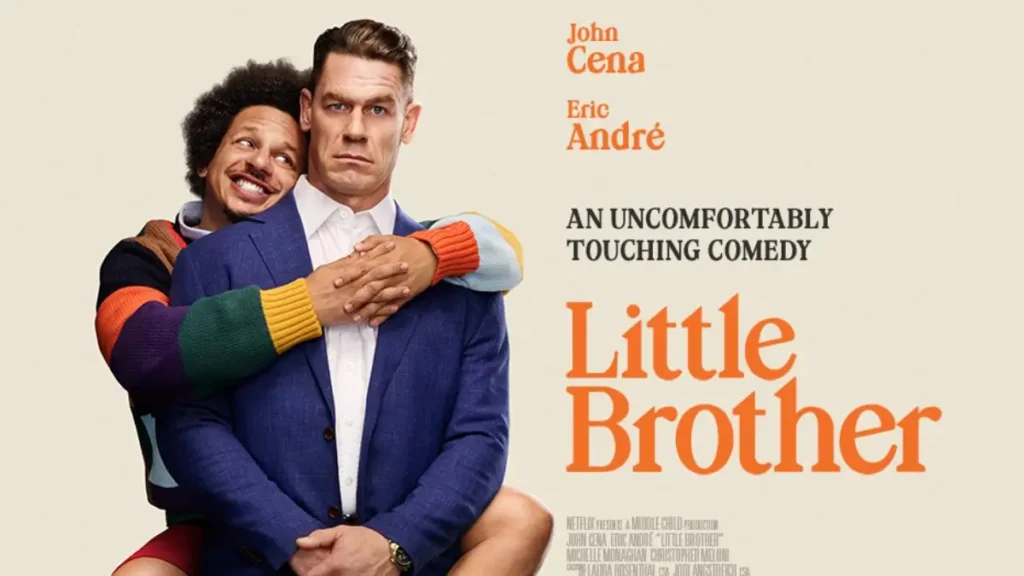
Little Brother arrives as one of Netflix’s bigger original comedy bets of 2026, an R-rated, star-driven buddy film directed by Matt Spicer (best known for Ingrid Goes West) and headlined by John Cena and Eric Andre. The premise is familiar enough to summarize in a sentence: an eccentric man-child re-enters his strait-laced brother’s carefully ordered life and causes spectacular chaos until something resembling emotional growth arrives in the final fifteen minutes.
You have seen this before. You will see it again. The question is never originality, it is chemistry, commitment, and how many times the comedy lands versus how many times it reaches. Little Brother lands more than it misses, which puts it ahead of most entries in this genre, even if it never transcends it.
Recommended. With caveats. On a Friday night, with low expectations and a tolerance for crude humor, it is a thoroughly enjoyable Netflix watch.
Movie Info
| Detail | Info |
|---|---|
| Title | Little Brother |
| Release Year | 2026 |
| Director | Matt Spicer |
| Lead Cast | John Cena, Eric Andre, Michelle Monaghan, Chris Maloney |
| Genre | R-Rated Buddy Comedy |
| Studio / Platform | Netflix Original |
| Rating | ★★★☆☆ (3.0/5) |
Little Brother Netflix Full Story & Plot Summary
The setup is simple. John Cena plays a real estate agent, a buttoned-up, slightly insecure, status-obsessed man trying to close deals, keep his marriage intact, and step out from under the shadow of his more successful brother. Eric Andre plays the other brother: a man who has spent time in a mental health facility, escapes, and arrives unexpectedly in Cena’s life with a wrecking-ball personality and the uncanny ability to win everyone over except the one person he is trying to help.
The community element, a big brother/little brother mentorship program, gives the film its structural backbone, such as it is. Cena’s character gets assigned a young mentee. Andre’s character attaches himself to the arrangement. The domestic, professional, and social chaos that follows is the film’s second act. And the predictable emotional reconciliation is its third.
What makes the premise mildly interesting is the reversal it performs on recent Cena filmography. In Ricky Stanicky, a few years ago, Cena was the anarchic wild card, the human tornado dropped into someone else’s ordered world. Here, he plays the straight man: the wound-tight realist watching his life unspool because of someone who operates entirely on impulse and charm. The role reversal works, and it provides the film with a structural hook that slightly elevates it above a pure genre exercise.
Little Brother Netflix Cast
| Actor | Role |
|---|---|
| John Cena | Marcus — real estate agent, older brother, straight man |
| Eric Andre | Danny — the eccentric younger brother, catalyst for chaos |
| Michelle Monaghan | Marcus’s wife — principled, underwritten |
| Chris Maloney | Competing brother — roided, intimidating, mostly decorative |
| Sherry Cola | A supporting character drawn into Danny’s orbit |

Little Brother Performances
John Cena
The most consistent argument Little Brother makes in its own favour is John Cena’s willingness to play small. He is not a natural comedian in the technical sense; he did not come up through stand-up, sketch, or improv, but what he has developed over his comedy career is something arguably more useful for this type of film: comic instinct through reaction. His ability to register disbelief, mortification, and barely suppressed panic in real time, with a physical frame that makes those reactions funnier through sheer contrast, is the film’s most reliable engine.
What separates his work here from his broader catalogue is the emotional register he brings to the film’s quieter moments. The character’s insecurity, the sense that Marcus is a man performing success without actually feeling it, gives Cena something to play beyond the straight-man mechanics. He does not have many scenes to work with, but he uses them. His comedic partnership with Andre is not just a tolerant coexistence. It is genuine chemistry, two performers calibrating in real time to each other’s rhythms.
Eric Andre
Eric Andre is the film’s chaos engine, and for audiences who find his particular brand of humor appealing, Little Brother will feel like an extended showcase of what he does better than almost anyone working in comedy right now. He is willing to go places that actors who are primarily concerned with likability will not. His Danny is not just eccentric; he is genuinely strange, physically unpredictable, and capable of producing the kind of cringe-laugh discomfort that is extremely difficult to manufacture and nearly impossible to sustain.
The comparison to Sacha Baron Cohen is not accidental. What both performers share is a willingness to commit to a bit past the point where most actors would pull back, to stay in a scene until it becomes something other than comfortable. Andre does this consistently throughout Little Brother. His physical comedy in particular, the film draws comparisons to Jackass in terms of its willingness to go for bodily humor, is executed with genuine skill.
What elevates his performance above being merely a stunt is a handful of scenes where Danny’s behaviour shifts from chaos to something quieter and more perceptive. The film is not particularly interested in exploring these moments in depth, but Andre makes them land when they arrive. His character is designed to compel you not to judge a book by its cover, in the words of one early review, and the moments when that register surfaces are the film’s most unexpectedly affecting.
Eric Andre and John Cena — Chemistry
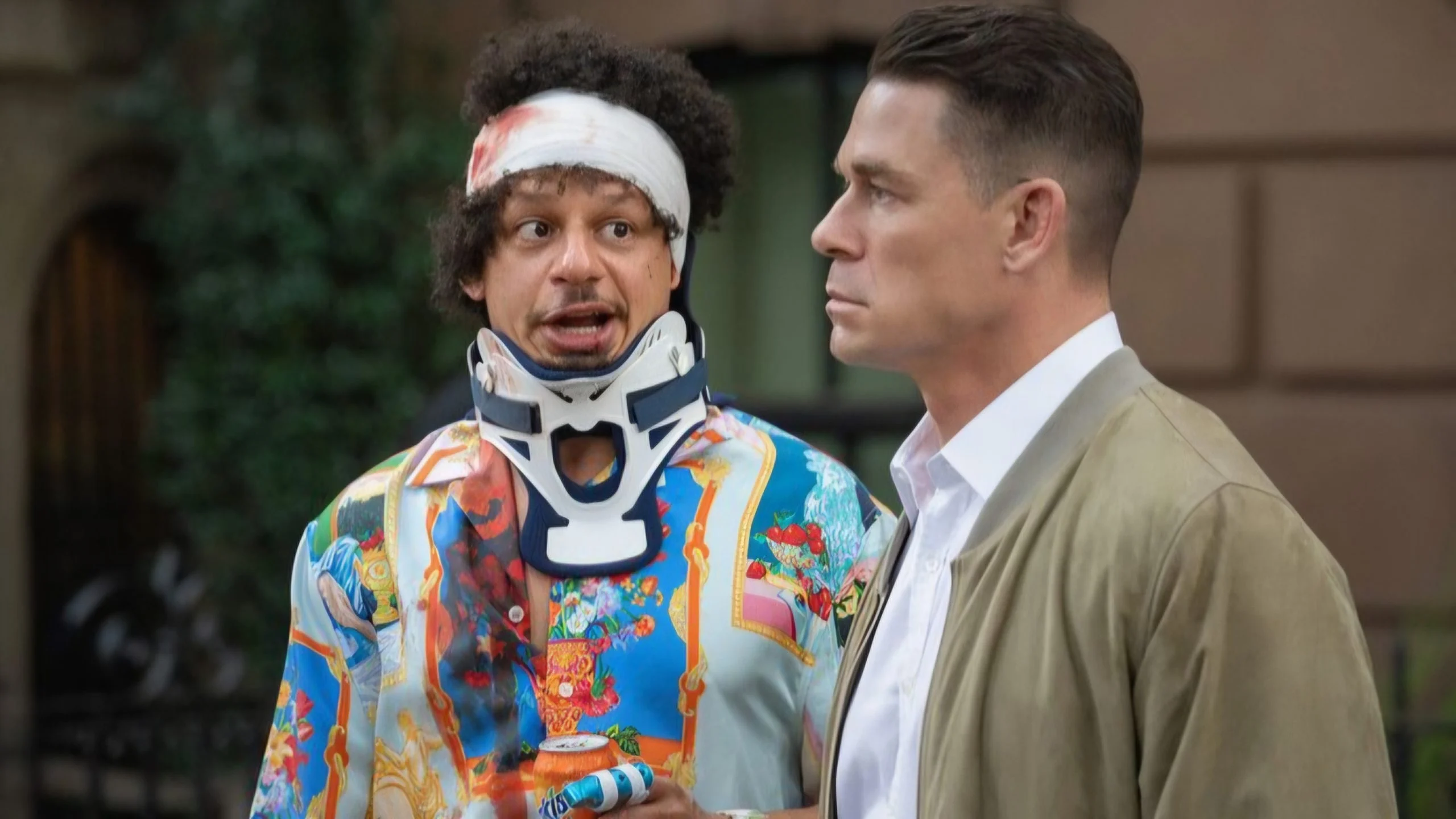
The pairing works better than it has any structural right to. Two performers this different in energy, background, and comedic mode should theoretically struggle to share a scene without one drowning the other. Instead, they find a rhythm that makes their mismatched dynamic feel genuinely generative rather than simply staged. Cena reacts to Andre. Andre escalates in response to Cena’s reactions. The loop repeats. It is a reliably funny engine for a comedy that, on script alone, does not have enough to carry itself.
Michelle Monaghan
Michelle Monaghan is a genuinely skilled actress who has done excellent work in films that gave her genuine work to do. Little Brother does not. Her character, the wife who gradually becomes charmed by Danny while her husband maintains a healthy skepticism, is the film’s most underwritten major role, and Monaghan can do nothing with it except bring professionalism to scenes that do not give her anything to push back against. This is not a performance criticism. It is a screenplay criticism that happens to land on her.
Chris Maloney
Maloney’s character, physically imposing, significantly older than Cena, completely bald, roided beyond what even the film seems to intend, is simultaneously one of Little Brother’s most interesting choices and one of its most structurally problematic ones. As a visual presence, he is arresting. As a comedic counterpoint, he is effective.
The problem is that he and Eric Andre occupy a similar register of anarchic, unpredictable energy, and the film has not figured out what to do with both of them in the same space. The result is something resembling two chefs in a kitchen making the same dish with incompatible spices; you can see what each element is trying to accomplish, but they compete rather than complement.
Little Brother Direction — Matt Spicer
Matt Spicer directed Ingrid Goes West, a sharply observed dark comedy about social media obsession and identity performance. That film had a distinct visual language, a coherent tonal strategy, and a satirical intelligence that elevated its genre. Little Brother is not that film, and the gap between them is interesting to think about.
What Spicer brings to Little Brother is competence, a willingness to let his performers play, and enough craft sense to stage the film’s physical comedy set pieces with genuine effectiveness. The Jackass comparisons some reviewers have reached for are not entirely accurate, the film has more structural control than pure stunt comedy, but there is a shared spirit in its willingness to let gags run to their genuinely uncomfortable conclusion rather than cutting away at the safe moment.
Where Spicer is less effective is in the film’s mid-section, where the formula becomes most visible, and the direction offers no way around it. The second act hits generic studio comedy beats with such rhythmic predictability that even viewers who enjoy the film will feel the structure operating on them. It does not ruin the film. It does prevent it from becoming something more interesting than the best version of its genre.
The pairing of Spicer, a filmmaker with genuine satirical instincts, with this material is an interesting creative choice that yields mixed results. He makes a better version of this movie than most directors would. He does not make the version of this movie that his best work suggested he might be capable of.

Little Brother Screenplay
The screenplay for Little Brother makes a clear decision early and maintains it consistently: structure over surprise. Every beat arrives where you expect it to. The reconciliation is telegraphed from the first act. The secondary character arcs, Sherry Cola’s character orbiting Danny, Monaghan’s wife finding unexpected warmth in him, resolve exactly as constructed.
None of this is a failure, exactly. Genre filmmaking at its best knows how to make the inevitable feel earned. Genre filmmaking at its weakest makes the inevitable feel mechanical. Little Brother sits between these poles. The jokes are the best argument for the screenplay’s quality; there are enough of them that land, and enough of them that land through actual construction rather than pure performer improvisation, to suggest a writer who understood what this material required.
The emotional beats are the worst argument for it; they arrive on schedule, feel obligatory rather than earned, and are acknowledged by at least one reviewer as moments where the film’s warmth feels assembled rather than felt. The broader genre framework, odd couple, life disrupted, chaos reconciled, is executed without embarrassment and without innovation.
If you have seen Ricky Stanicky, Talladega Nights, Step Brothers, or any of the other R-rated buddy comedies, the film’s premise echoes; you have experienced the architecture Little Brother operates inside. What distinguishes any individual entry in this genre is the chemistry of its leads and the wit of its set pieces. On both counts, Little Brother is above average.
Is Little Brother Worth Watching on Netflix?
The two critical responses that have circulated since the film’s release bracket the experience cleanly. One reviewer scored it six to six-and-a-half out of ten, a film that makes you chuckle if you can overlook the predictability, but ultimately a Netflix title that will be forgotten by the time Cena’s next comedy drops. Another gave it three and a half out of five, calling it a sufficiently irreverent, eccentric, wild ride that does not aspire to classic status but delivers genuine entertainment within its chosen lane.
Both assessments are accurate, which tells you something about the film: it is good enough that its defenders can defend it with specificity, and flawed enough that its detractors can dismiss it without dishonesty.
The answer to whether Little Brother is worth watching on Netflix is yes, but only under the right conditions. Those conditions are: a Friday evening, no expectations of originality, a working tolerance for R-rated physical comedy, and an appreciation for two comedy performers who are committed completely to the material, regardless of whether the material fully deserves that commitment.
Little Brother Rating Compared to Similar Films
| Film | Lead Pairing | Our Comparable Rating |
|---|---|---|
| Step Brothers (2008) | Ferrell / Reilly | ★★★★☆ |
| Ricky Stanicky (2024) | Zac Efron / John Cena | ★★★☆☆ |
| Little Brother (2026) | John Cena / Eric Andre | ★★★☆☆ |
| The Rundown (2003) | The Rock / Sean William Scott | ★★★☆☆ |
| Talladega Nights (2006) | Ferrell / Cohen | ★★★★☆ |
Little Brother lands comfortably in the middle of this genre’s range. It is not the best version of what it is. It is a confident, entertaining execution of the formula that earns its runtime.
What Little Brother Gets Right
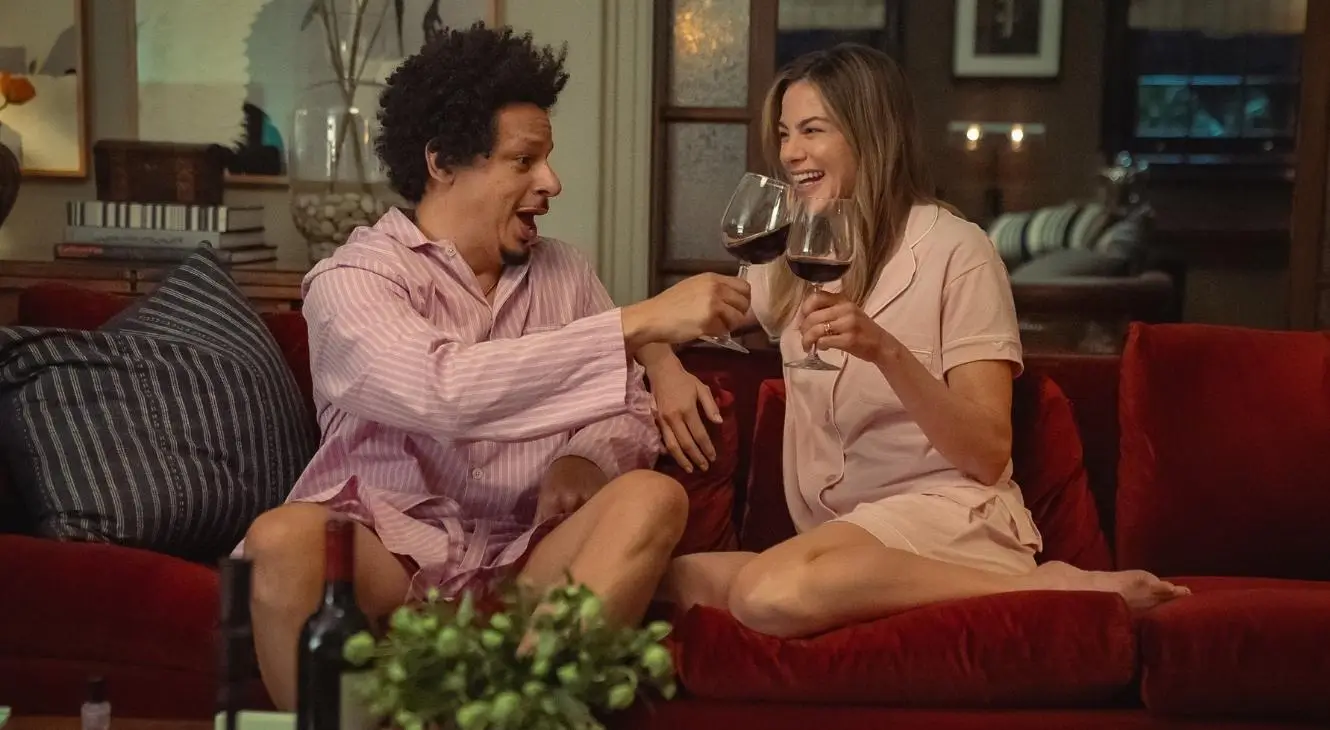
The central pairing. John Cena and Eric Andre have chemistry that the film clearly identified early and wisely decided to centre everything around. The mismatch between Cena’s contained, reactive performance style and Andre’s anarchic physical commitment generates consistent comedy.
Eric Andre’s commitment. He is one of the few performers in contemporary comedy willing to pursue a bit to its most uncomfortable conclusion. That willingness, which makes his TV work divisive, is an asset in a film that needs its chaos agent to feel genuinely unpredictable.
The role reversal. Putting Cena in the straight-man position rather than the wild-card position, after Ricky Stanicky positioned him opposite, adds just enough structural self-awareness to suggest the film knows what it is doing.
The set pieces. The film’s individual physical comedy sequences are staged well and executed with genuine craft. This is the Matt Spicer element, a director with better instincts than the material requires, visible in the moments when the gags work hardest.
Pacing in the first act. The film establishes its dynamic quickly, gets to the comedy fast, and does not waste significant time on setup. For an R-rated buddy film, this is not a given.
What Little Brother Gets Wrong
The second act. The film’s middle section is its weakest passage, the point at which the formula becomes most visible, and the direction offers no fresh angle on the familiar beats. Reviewers from both camps noted the brakes going on precisely when the film needs to maintain momentum.
Michelle Monaghan’s character. An actress of this quality deserves material that lets her act. The role as written functions primarily as a structural device, the wife who serves as evidence of the main character’s domestic pressure, and Monaghan can do nothing with it except be competent.
Chris Maloney’s tonal register. Two anarchic characters competing for the same space in a film is one too many. Maloney’s energy and Andre’s energy are complementary on paper and competitive in practice. The film needed to choose which one it was making the axis of its chaos, and it did not clearly choose.
The heartwarming moments. The emotional pivot in the third act, when the film shifts from comedy to the warmth that justifies the reconciliation, is mechanical rather than earned. Genre convention requires it. The screenplay delivers it without making you feel it.
The predictability. You will know how this film ends within fifteen minutes of it starting. This is not unusual for the genre. It is mentioned because audiences who have not made peace with that reality before pressing play will spend the runtime in a state of mild irritation that the film did nothing to deserve.
Little Brother Pros & Cons
✓ Pros
- John Cena and Eric Andre’s chemistry is the film’s genuine highlight
- Eric Andre executes physical comedy with skill and commitment
- Matt Spicer stages set pieces better than the genre average
- Role reversal from Ricky Stanicky adds light structural self-awareness
- Genuinely funny in the first act and in scattered set pieces throughout
- R-rating is used with genuine intent, not just for branding
✗ Cons
- The second act loses momentum and leans too hard on familiar beats
- Michelle Monaghan is wasted in an underwritten role
- Chris Maloney and Eric Andre compete for the same chaotic energy
- Heartwarming third-act moments feel assembled rather than earned
- Entirely predictable from setup to resolution
- Will almost certainly be forgotten once the next Cena comedy arrives
Little Brother Ending Explained
Without detailing specific plot points, the ending delivers exactly what the film’s genre framework requires. Characters who were at odds reach an understanding. The chaos agent is accepted rather than rejected. The emotional insight the straight man has been resisting throughout is articulated and received. Everyone ends up in a better position than where they started.
Whether this feels earned or obligatory will depend on how much goodwill the first two acts generated. For audiences who invested in the Cena-Andre dynamic, the reconciliation lands adequately. For audiences who spent the second act waiting for something surprising to happen, it will read as a contractual conclusion to a movie that ran its formula to completion.
Where to Watch Little Brother
Little Brother is a Netflix original and is available exclusively on Netflix in all regions where Netflix operates. No theatrical release. Stream immediately.
Final Verdict
| Category | Score |
|---|---|
| Story / Script | ★★☆☆☆ |
| Direction | ★★★☆☆ |
| Comedy | ★★★★☆ |
| Performances | ★★★★☆ |
| Chemistry (Cena / Andre) | ★★★★★ |
| Pacing | ★★★☆☆ |
| Originality | ★★☆☆☆ |
| Overall | ★★★☆☆ (3/5) |
Little Brother is a film that knows exactly what it is and executes that thing with more skill than its genre average. It is formulaic, predictable, and structurally creaky in its second act. It is also frequently funny, carried by two performers who give more than the material demands, and capable of producing the kind of cringe-laugh physical comedy that is significantly harder to manufacture than it looks.
The more interesting question Little Brother raises is what Matt Spicer is doing directing it. The filmmaker who made Ingrid Goes West, a sharp, uncomfortable comedy about parasocial obsession with real satirical intelligence, is clearly capable of more than this. And the best moments of Little Brother, where the direction finds something crisper than genre competence, suggest that capability is still there. It is simply not the film this is.
Watch it for Cena and Andre. Lower your expectations for everything else. You will probably laugh.
Little Brother Frequently Asked Questions
Q. What is Little Brother about on Netflix?
Ans. Little Brother is an R-rated Netflix original buddy comedy in which a strait-laced real estate agent’s carefully managed life is upended when his eccentric younger brother, recently out of a mental health facility, reappears and inserts himself into every corner of his domestic, professional, and social world. Directed by Matt Spicer and starring John Cena and Eric Andre.
Q. What is the Little Brother Netflix cast?
Ans. The principal cast is John Cena as Marcus, the straight-man older brother; Eric Andre as Danny, the chaotic younger brother; Michelle Monaghan as Marcus’s wife; Chris Maloney as a competing brother figure; and Sherry Cola in a supporting role.
Q. What is the Little Brother rating?
Ans. Little Brother is rated R. The content includes crude physical humor, adult language, and adult-themed situations. The film earns its rating consistently across the runtime.
Q. Is Little Brother worth watching on Netflix?
Ans. Yes, with expectations calibrated to the genre. If you enjoy R-rated buddy comedies and are willing to accept formulaic plotting in exchange for strong lead chemistry and committed physical comedy, Little Brother delivers. If you are hoping for something surprising or emotionally substantial, it will disappoint.
Q. How does Little Brother compare to Ricky Stanicky?
Ans. Both films feature John Cena in an odd-couple pairing. The key structural difference is that Ricky Stanicky positioned Cena as the chaotic wild card, while Little Brother flips him into the straight-man role opposite Eric Andre’s anarchy. Both films sit at a similar quality level for the genre, though the Cena-Andre chemistry in Little Brother is arguably the stronger lead pairing of the two.
Q. Who directed Little Brother on Netflix?
Ans. Matt Spicer, who previously directed Ingrid Goes West, a dark comedy with considerably more satirical ambition than Little Brother. The creative gap between the two films is one of the more interesting things about Little Brother from a career trajectory perspective.
Q. Is Little Brother funny?
Ans. Yes, frequently. Eric Andre and John Cena generate consistent comedy through physical performance and a well-calibrated mismatch dynamic. The film’s set pieces are staged with genuine craft. The second act loses momentum, and some jokes miss, but the hit rate is high enough to recommend the film to audiences who like this genre.
Little Brother is now streaming exclusively on Netflix.
If you’re looking for more entertainment coverage, don’t miss our latest movie reviews, including Welcome to the Jungle, Supergirl, and Main Vaapas Aaunga. We also cover the biggest Hollywood, Bollywood, OTT, and streaming releases with spoiler-free reviews, in-depth analysis, and honest recommendations to help you decide what’s worth watching next.