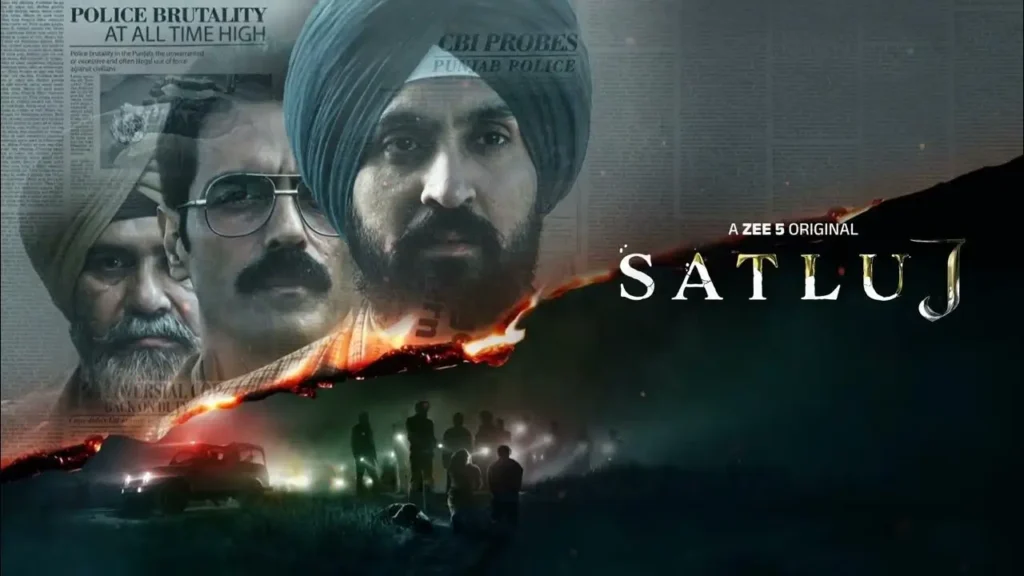
Satluj – Punjab 95 Review Verdict: Satluj is not entertainment. It is education. It is a page of this country’s history that the people who run the system do not want you to read, and the fact that it has now been pulled from ZEE5 India less than 48 hours after its premiere, three years after being denied a theatrical release, is all the proof you need that this film matters. Diljit Dosanjh gives the finest performance of his career. Honey Trehan directs with a restraint and an emotional intelligence that makes every frame feel like it was bled onto the screen. This film deserves to be seen by every Indian alive. Find a way to watch it.
Satluj , originally titled Ghallughara, then Punjab ’95 , premiered on ZEE5 on July 3, 2026, uncut and without any of the 127 modifications demanded by the CBFC. It was removed from ZEE5 India on July 5, 2026, within 48 hours of release. As of this writing, it remains available on ZEE5 Global for international audiences. Runtime: 2 hours 43 minutes. Language: Hindi and Punjabi. This review is based on a viewing of the complete, uncut film.
The Story Before the Story: Four Years of Suppression
I need to talk about what this film went through before I talk about what this film is, because the two things cannot be separated.
The project has carried three names on its way to release. It was originally titled “Ghallughara,” a historic term for the massacres of Sikhs in 1746, 1762, and 1984. When RSVP applied for certification from India’s Central Board of Film Certification in late 2022, the six-month process ended with the film cleared for 21 cuts and a mandated title change to “Punjab ’95.” RSVP appealed that ruling in the Bombay High Court. Around the same time, the film was withdrawn from its planned gala premiere at the 2023 Toronto International Film Festival.
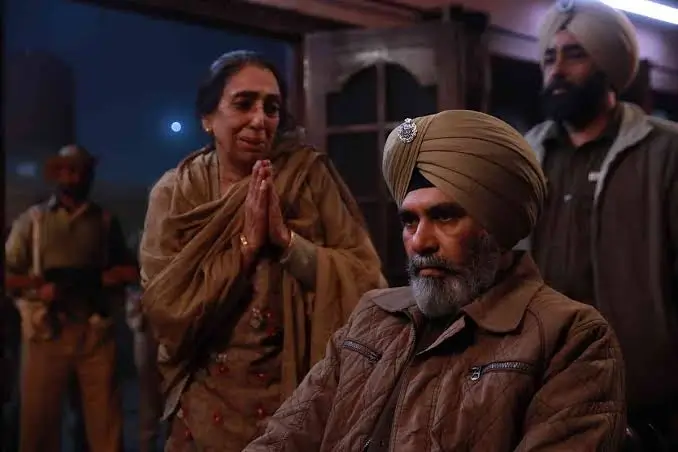
After a beyond three-year battle with India’s censor board over 127 demanded cuts, Diljit Dosanjh’s film Satluj, chronicling Sikh activist Jaswant Singh Khalra’s work exposing extrajudicial killings, finally premiered uncut on ZEE5 India. However, the film was abruptly removed within 48 hours, with ZEE5 citing only “current developments” for the decision, though it remains available globally.
127 cuts. I want to sit with that number for a moment. Not 5, not 20, not 50. 127 cuts were demanded by the CBFC before they would grant this film a theatrical certificate. The filmmakers refused. They were right to refuse. Dosanjh addressed the streaming premiere directly on Instagram Live: “Our film has finally been released on ZEE5.
Unfortunately, we couldn’t keep the original title, Punjab 95, for certain reasons, so it is now called Satluj. But there are absolutely no cuts in the film. The version I watched in theatres two years ago is exactly the same one I watched at home last week. If even a single cut had been made, I would not have promoted the film.”
When I sat down to watch Satluj, I felt something I did not expect to feel before a film had even started: frustration. Real frustration. Because I knew that the audience that most needs to see this film, the Indian public, in Indian theatres, watching their own suppressed history on a screen, has been denied that experience. First, by the CBFC’s demands. Then, by the platform that briefly gave it a home before removing it, with no explanation given, within 48 hours.
The removal of Satluj from ZEE5 in India has prompted comparisons with other politically contentious films that remain available on the platform, including The Kashmir Files (2022), The Kerala Story (2023), The Bengal Files (2025), and The Kerala Story 2 (2026).
That asymmetry tells you everything. The film is not gone. It is available on ZEE5 Global for international audiences. If you are reading this outside India, go watch it immediately. If you are inside India, find a way. This is not a film you can afford to miss for logistical reasons.
Satluj- Punjab 95 — Movie Info
| Detail | Info |
|---|---|
| Final Title | Satluj |
| Previous Titles | Ghallughara (original) → Punjab ’95 (CBFC-mandated) → Satluj |
| OTT Premiere | July 3, 2026, on ZEE5 |
| Status in India | Removed by ZEE5 India on July 5, 2026 (“unavailable until further notice”) |
| International Availability | ZEE5 Global — available worldwide outside India |
| Director | Honey Trehan |
| Producers | Ronnie Screwvala (RSVP), Honey Trehan, Abhishek Chaubey (MacGuffin Pictures) |
| Writers | Honey Trehan, Nirant Bhatt, Maitra Utsav |
| Language | Hindi and Punjabi |
| Runtime | 2 hours 43 minutes |
| Based On | The life of human rights activist Jaswant Singh Khalra |
| CBFC History | 127 cuts demanded, refused by filmmakers; no theatrical release in India |
| Our Rating | ★★★★★ (5/5) |
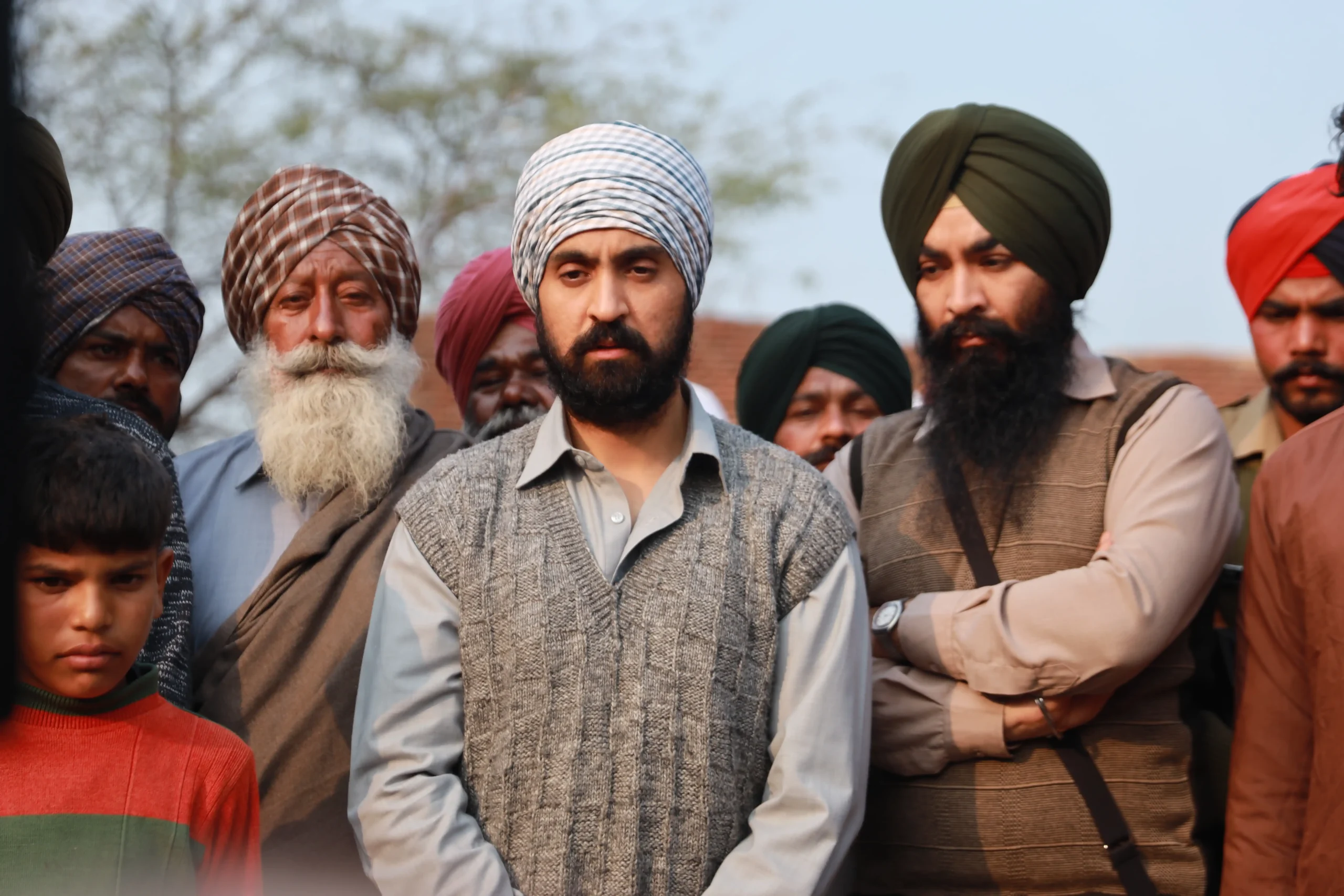
What Is Satluj / Punjab 95 About? The True Story of Jaswant Singh Khalra
Satluj draws on the life of Jaswant Singh Khalra, whose investigations into thousands of alleged illegal cremations, involving roughly 25,000 unidentified bodies and enforced disappearances during Punjab’s militancy years, brought national attention to human rights abuses. Khalra disappeared in 1995 after being taken into police custody, and later court proceedings resulted in the conviction of several police personnel. His body was never found.
The film is set in the Punjab of the late 1980s and early 1990s, a period when, in the aftermath of Operation Blue Star in 1984, the state government gave the Punjab Police extraordinary powers to detain and act against anyone suspected of links to militancy. What followed, the film documents with harrowing precision, was a systematic campaign of enforced disappearances in which thousands of Punjabi men, civilians with no militant connections, were picked up from their homes, their fields, their daily lives, and never returned. Their bodies were cremated as unidentified, their families given no information, no death certificates, no graves to visit.
Troubled by the disappearance of a friend and then his protesting mother, Jaswant (Diljit Dosanjh) begins investigating the mysterious increase in unclaimed bodies at morgues and crematoria. Although Jaswant’s campaign worries his wife Paramjit (Geetika Vidya Ohlyan), she remains supportive even after the family is subjected to scary phone calls and surveillance.
Khalra was not a lawyer, not a politician, not a professional activist. He was a bank employee in Amritsar who could not look away. And because he could not look away, he spent years documenting what the system was doing, visiting crematoria, collecting names, cross-referencing records, building a case that proved what had happened. In Amritsar district’s three crematoria alone, Khalra found more than 2,000 bodies listed as unclaimed.
Satluj explores how a common citizen like Khalra got involved in activism, and how anyone with a shred of moral fibre in their bones simply could not look away. True to the biopic genre, it highlights the gruelling fight that Khalra undertook. After witnessing the murder of his friend, followed by the murder of that same friend’s mother by the Punjab Police, Khalra embarked on a journey that would change his life and the history of the region.
He was abducted by the Punjab Police in 1995. He was never seen again.
Satluj Full Cast
| Actor | Character |
|---|---|
| Diljit Dosanjh | Jaswant Singh Khalra — human rights activist |
| Suvinder Vicky | SSP Sugga — rogue police officer, primary antagonist |
| Arjun Rampal | Samudra Singh — CBI officer |
| Geetika Vidya Ohlyan | Paramjit — Jaswant’s wife |
| Kanwaljit Singh | Bitta — venal politician |
| Saurabh Sachdeva | Satnam — police whistle-blower |
| Jagjeet Sandhu | Supporting |
| Varun Badola | Committed lawyer |
| Vansh Bhardwaj | Promotion-obsessed cop |
| Jyoti Dogra | Friend’s mother |
| Amardeep Jha | Supporting |
| Geeta Agrawal Sharma | Supporting |
| Nassar | Supporting |
| Ramji Bali | Supporting |
Director: Honey Trehan Producers: Ronnie Screwvala, Honey Trehan, Abhishek Chaubey Writers: Honey Trehan, Nirant Bhatt, Maitra Utsav Director of Photography: KU Mohanan Editor: Sreekar Prasad Production Design: Garima Mathur
Satluj Review: Why This Is the Most Important Hindi Film in Years
I have seen a lot of Indian films that want to make me feel something about injustice. Many of them try too hard. They push emotion at you, swelling background scores, close-ups held three beats too long, dialogue that explains what the character is feeling just in case you missed it. Satluj does none of that, and that restraint is the most powerful filmmaking choice Honey Trehan makes across an almost three-hour runtime.
The film is admirably measured in its outrage and powerfully performed across the board. When you finish watching Satluj, a kind of numbness seeps into you because what you just witnessed was based on reality. It is not a movie that immediately pulls you into that traumatic space.
The film does not tell you how to feel. It shows you what happened. And because what happened is so unbearably real, because the 25,000 unaccounted bodies were real people who walked out of real homes to buy real groceries and never came back, the emotions arrive not because the film manufactured them but because the truth of the story is simply that devastating. By the time the film was over, I was left feeling a wave of sadness so heavy that for several minutes I could not move. And then I remembered that this was not fiction. That is when it truly hit.
Punjab ’95, aka Satluj, breaks the general tendency to narrate a biopic only through its central character, and that creative decision makes it a thoroughly gripping film. The first half, approximately one hour and fifteen minutes, establishes who Jaswant Singh Khalra was, what he discovered, and what it cost him personally to keep looking once he knew what he was looking at. The second half becomes something sharper: a cat-and-mouse procedural in which the CBI officer Samudra Singh, played by Arjun Rampal, investigates the Punjab Police under international pressure. The gear shift between these two registers is one of the film’s most confident structural choices.
There is one shot in this film involving Diljit that I will not describe because it would be a spoiler. But I will tell you this: I could not get that image out of my mind for hours after the credits rolled. It is the kind of filmmaking that lives inside you.
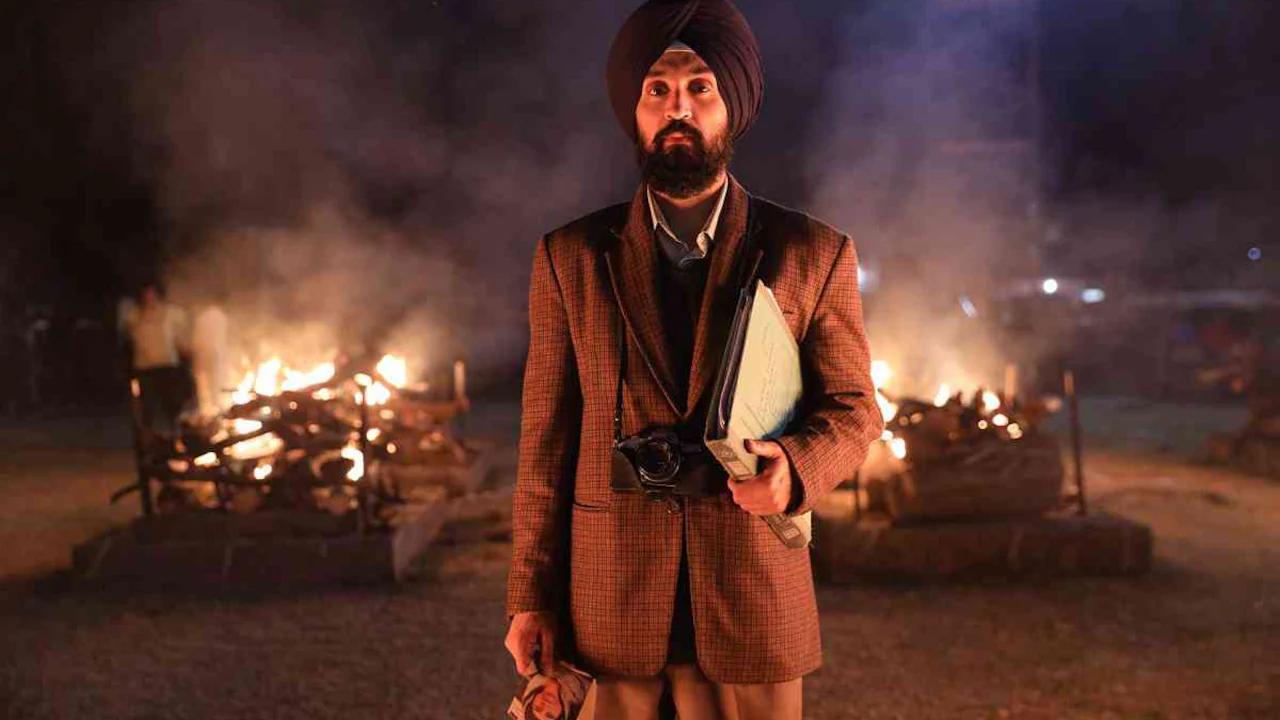
Diljit Dosanjh as Jaswant Singh Khalra: The Performance of His Career
There are few actors like Diljit Dosanjh to play an activist who can raise hell in quiet tones. Like the film itself, Dosanjh selflessly goes about his work without drawing attention to himself.
There is an almost Jimmy Stewart-like innocence in Diljit Dosanjh’s demeanour that beautifully channels the quiet passion Jaswant Singh Khalra’s legacy deserves. His contemplative portrayal forms the emotional core of the film.
What Diljit does in this film is not what most actors attempt when playing a historical figure. He does not perform heroism. He performs conviction — the small, stubborn, terrified conviction of an ordinary man who decided he could not pretend he had not seen what he had seen. His Jaswant does not strike poses. He does not have the certainty of a movie hero. He has the stumbling, incremental determination of someone who is genuinely afraid of what he is doing and does it anyway.
His character barely cries throughout the film. But in the moments where he does, you will cry with him without any warning, without any musical cue to tell you that now is when you should feel something. The scene, which is perhaps Diljit’s best performance to date, happens with no cues given to the audience. Trehan trusts the performance, and editor Sreekar Prasad respects it by including minimal cuts.
Dosanjh said in an interview with Variety India: “After this film, I had to take a week off to process everything that I went through portraying Jaswant Singh Khalra. The scenes, the emotions, and the aspects of the character lingered on, so it took time for me to pull away from that.”
That week off to process a role is not an actor’s affectation. It is a measure of how completely Diljit surrendered to this character. The body language he brings, the specific physical grammar of how Khalra moved, sat, stood, listened, felt studied and inhabited rather than performed. This is the finest work of his career, and it deserves every national award it is eligible for.
Suvinder Vicky as SSP Sugga: Cinema’s Most Frightening Villain in Years
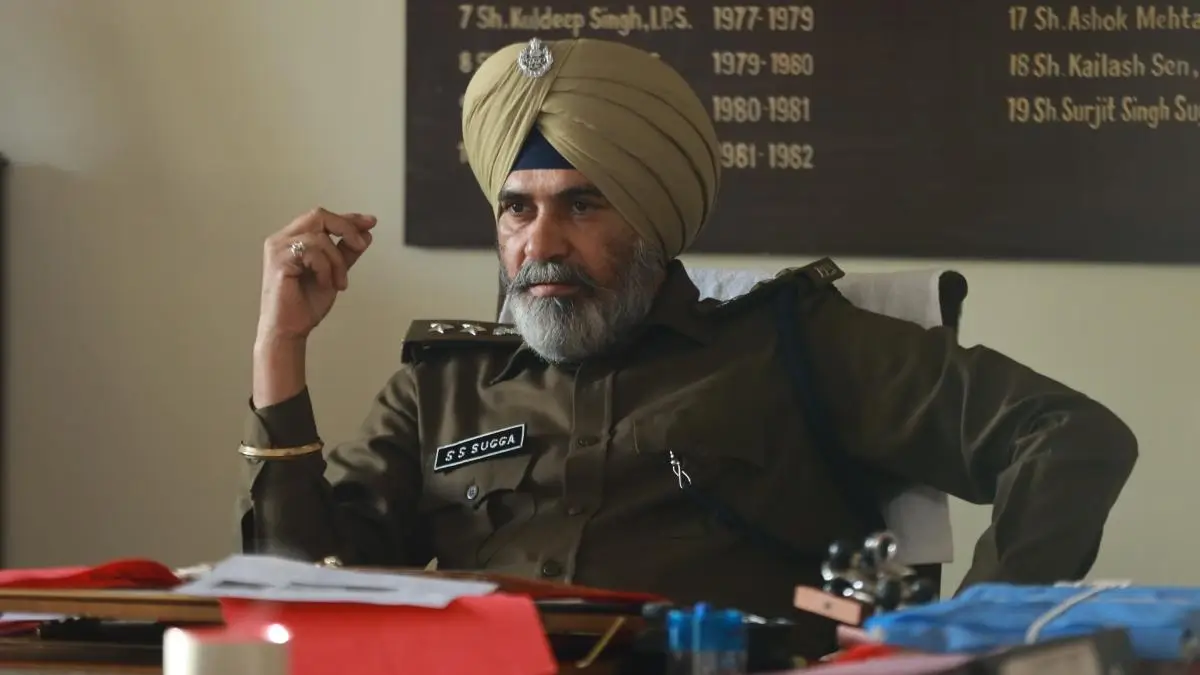
Suvinder Vicky’s demonic Sugga is a Nazi in a Punjab Police uniform who embodies the banality of evil.
If you have watched Kohrra on Netflix, you have seen Suvinder Vicky before. You know he is exceptional. What he does in Satluj makes everything else he has done feel like a warmup. His SSP Sugga is not a cartoon villain. He does not twirl a metaphorical moustache. He is worse than that; he is a man who genuinely believes in what he is doing. He believes the numbers justify the methods. He believes the end, clearing Punjab of militancy, excuses the means, which include burying innocent men alive and cremating their bodies as unidentified.
There is a scene where Sugga talks to CBI officer Samudra Singh for the first time, and the 84-95 debate basically shows how the system operates, how institutional violence justifies itself through institutional logic.
There is a scene in a dining room, a meal of saag, that is one of the most nerve-shredding sequences I have watched in Indian cinema in years. No weapons are drawn. No voices are raised. The threat in that room is entirely in Suvinder Vicky’s eyes, his stillness, the way he holds a spoon. I genuinely wanted to reach through the screen.
This man is one of the finest acting talents this country has produced. Satluj proves it conclusively.
Arjun Rampal: The Film’s Biggest Surprise
I’ll be honest. Arjun Rampal is not an actor I have historically expected much from. That was my mistake, and Satluj corrected it.
Arjun Rampal’s principled CBI officer Samudra Singh is a very grounded performance. What Rampal does here is not showy. It is meticulous. The way a senior government officer moves in the 1990s, the posture, the clothes, the particular cadence of authority, he has thought it all through and committed to every detail without a single false moment across the film’s entire runtime. He is the film’s audience surrogate in the second half, and he carries that function without ever making it feel mechanical.
I came out of Satluj wanting more of this version of Arjun Rampal. Whoever put him in this role and trusted him with this material made exactly the right call.
Geetika Vidya Ohlyan as Paramjit: What Feminism Actually Looks Like
Geetika Vidya Ohlyan’s strong-willed Paramjit stands firmly beside her husband’s decisions throughout the film.
Paramjit is not written as a supporting wife who exists to express worry and then be proved wrong. She is a woman who sees exactly what her husband is risking, who is threatened herself, who has children, and who chooses to stand beside him anyway, not from blind devotion but from moral conviction that matches his. The way Geetika Vidya Ohlyan plays that conviction, the quiet, undemonstrative solidity of it, redefines what it means to show female courage on screen. No speeches. No dramatic declarations. Just a woman standing where she has decided to stand.
Her work in this film is outstanding. The role is not the flashiest in the ensemble. It may be the most important.
Honey Trehan’s Direction: Restraint as the Most Powerful Filmmaking Choice
“The new title oddly suits the film: between Punjab ’95 and Satluj lies the story of a country as it was and continues to be,” wrote Scroll. That is a beautiful way to describe what Honey Trehan has achieved, a film whose title, forced on it by censorship, accidentally became more resonant than the original.
Trehan’s previous film was Raat Akeli Hai, a confident, stylish noir. Satluj is a different kind of challenge entirely, and he meets it with craft I did not anticipate. KU Mohanan uses blacks and shadows extensively in the emotionally unsettling parts of the movie, and there is a sense of steadiness to the frames to let us absorb the reality. This is not decorative cinematography. It is cinematography that understands what the subject demands: stillness, shadow, the refusal to glamourise suffering.
The production design by Garima Mathur deserves specific recognition. Every number plate is correct for the period. Every car, every glass, every pair of glasses from the 1990s is right. The attention to period detail is the kind of work that functions invisibly when done well; you do not notice it, but you feel completely inside the world from the first frame. That feeling of being inside the world is what makes the horror of the events land as history rather than drama.
The design of the second half, which comes across as a cat-and-mouse game between CBI and Punjab police, is smart and cinematic. From a documenting point of view, the film shifts to a cinematic perspective towards the end, and on a craft level, that’s where director Honey Trehan makes the movie deeply impactful.
Where Satluj Has Minor Limitations
I want to be honest, because this film deserves honesty more than hagiography.
There is a certain level of dialogue-heavy drama when it comes to the writing of the movie. The way Jaswant Singh explains why he is doing it at times becomes a little too verbal. There are moments in the first half where the screenplay articulates what it should trust the performances to show, a residual instinct toward explanation that the director’s best work, and the best performances, overcome.
The first half also requires patience. At one hour and fifteen minutes before the interval, it is doing necessary work, building character, establishing the world, earning the emotional devastation that follows, but it asks you to come toward the material rather than pulling you in immediately. The first half of this Honey Trehan movie, on a script level, is somewhat basic. By basic, I mean it largely documents the events that led the main man to activism. This is not a criticism that changes my view of the film. It is a note for viewers who need to know what they are walking into.
The Censorship Story: Why the CBFC’s 127-Cut Demand Is the Film’s Most Important Review
There’s no scope for whataboutery in Satluj, no quarter given to claims that the only way to fight terrorism was to let the police off the leash. Although laser-focused on Jaswant’s travails and exploring a specific period in Punjab’s history, the movie could be about any other part of India governed by unquestioned authority.
The CBFC demanding 127 cuts, which would have reduced the film by effectively half, and then the film being pulled from ZEE5 India within 48 hours of its OTT premiere is not a separate story from the film’s content. It is the film’s content, continuing in real time. A film about institutional suppression of truth is itself being institutionally suppressed. The system the film documents is the same system that has denied the film its audience.
In Bitta’s dismissal of activism as a gimmick, or Sugga’s acceptance of collateral damage in order to combat militants, Satluj goes beyond its immediate setting. This film is not only about Punjab in 1995. It is about every moment in which people with institutional power decide that some lives do not require accounting. That is why it was blocked. That is why it continues to be blocked. And that is why watching it, talking about it, and refusing to allow it to quietly disappear into unavailability is something that matters.
Is Satluj the Same as Punjab 95? The Three Titles Explained
| Title | When Used | Reason |
|---|---|---|
| Ghallughara | Original working title | Historic term for Sikh massacres of 1746, 1762, and 1984 |
| Punjab ’95 | After CBFC submission (2022) | CBFC mandated title change from the original |
| Satluj | Final release title (2026) | Used for OTT release to avoid further obstacles |
“We could not get the previous title of the film. The title is now Satluj. This is the complete film, without any cuts or compromises, in its original form as we always intended,” director Honey Trehan said in a statement to Variety.
Yes, Satluj and Punjab 95 are the same film. The story has not changed. The performances have not changed. Not a single frame was cut. The title is different. Everything else is the film its makers always intended.
Where to Watch Satluj / Punjab 95
Satluj, starring Diljit Dosanjh, Kanwaljit Singh, and Arjun Rampal, remains available on ZEE5 Global for international audiences. If you are outside India, open ZEE5 Global now and watch it.
If you are inside India, ZEE5 removed the film from its Indian catalogue on July 5, 2026, less than 48 hours after premiere, with no explanation beyond “current developments.” As of this writing, the film is not available on any Indian streaming platform. Follow Diljit Dosanjh’s social media accounts and the RSVP Movies accounts for updates on when and where it may return.
The film has previously screened internationally and may be available at future festivals or special screening events. Watch for announcements.
Satluj- Punjab 95 Pros & Cons
✓ Pros
- Diljit Dosanjh delivers the finest performance of his career, quiet, inhabited, devastating
- Suvinder Vicky as SSP Sugga is one of Indian cinema’s great villain performances
- Arjun Rampal’s career-best work as CBI officer Samudra Singh
- Geetika Vidya Ohlyan redefines female courage without a single speech
- Honey Trehan’s direction trusts the audience completely, no manipulation, no manufactured emotion
- KU Mohanan’s cinematography and Garima Mathur’s production design are immaculate
- 2 hours 43 minutes that never once make you want to look away
- A chapter of Indian history that the people who lived through it deserve to have told
✗ Cons
- First half (approx. 1 hr 15 min) requires patience, establishing rather than immediately gripping
- Occasional dialogue-heavy moments where the script explains what the performances already show
- Currently unavailable in India, the most important audience for this film cannot access it through legitimate channels
Satluj- Punjab 95 Review Final Verdict
| Category | Score |
|---|---|
| Direction | ★★★★★ |
| Diljit Dosanjh’s Performance | ★★★★★ |
| Suvinder Vicky’s Performance | ★★★★★ |
| Supporting Cast | ★★★★★ |
| Screenplay | ★★★★☆ |
| Cinematography (KU Mohanan) | ★★★★★ |
| Production Design | ★★★★★ |
| Emotional Impact | ★★★★★ |
| Historical Significance | ★★★★★ |
| Overall | ★★★★★ (5/5) |
Ultimately, the film reminds us that the dehumanisation of citizens continues unabated across decades. Ill-gotten power, fuelled by administrative ineptitude and moral bankruptcy, still plagues us today, and as long as it does, Satluj will remain devastatingly relevant.
Satluj is the kind of film that happens once in a decade. It is not the kind of film that is easy to watch. It is the kind of film that you are grateful you watched, and that stays with you long after you have closed the app and gone back to your life, because it keeps reminding you that for 25,000 families, the story it tells did not end.
The filmmakers spent four years fighting for this film to exist. The least we can do is watch it.
If you enjoyed our Satluj (Punjab 95) Review, don’t miss more in-depth movie and series coverage on NexaFeed. Read our reviews of Human Vapor, Young Washington, Alpha, Baby Do Die Do, Nagabandham, and many more from Bollywood, Hollywood, Netflix, Prime Video, Disney+, and international cinema. We also publish spoiler-free reviews, ending explained articles, OTT streaming guides, and the latest entertainment news to help you discover your next great watch.
Frequently Asked Questions
Q. Is the Satluj movie banned?
Ans. Not formally banned, but effectively suppressed at multiple stages. Certification became the film’s principal obstacle after it was submitted to the CBFC in 2022. The board initially requested numerous edits and insisted that the title Punjab ’95 be changed. The filmmakers refused, preventing theatrical release. After debuting on ZEE5, the platform removed the Diljit Dosanjh-starrer from its Indian catalogue less than two days after the film’s July 3 premiere. The film remains available on ZEE5 Global for audiences outside India.
Q. What is the Satluj movie based on?
Ans. Satluj draws on the life of Jaswant Singh Khalra, whose investigations into thousands of alleged illegal cremations, involving roughly 25,000 unidentified bodies and enforced disappearances during Punjab’s militancy years, brought national attention to human rights abuses. Khalra disappeared in 1995 after being taken into police custody, and later court proceedings resulted in the conviction of several police personnel. His body was never found.
Q. Why was Satluj removed from ZEE5 / OTT?
Ans. ZEE5 removed Satluj from its Indian catalogue less than two days after the film’s July 3 premiere. The platform cited only “current developments” for the decision without specifying further. ZEE5 said in a statement: “We stand firmly by Satluj and the creative vision behind it. We believe powerful storytelling has the ability to inspire, endure, and leave a lasting impact.”No official government order or legal reason has been publicly stated.
Q. Is Satluj the same as Punjab 95?
Ans. Yes. Satluj and Punjab 95 are the same film. The title was changed due to CBFC and legal pressures, first from Ghallughara to Punjab ’95, then to Satluj — but the film itself is completely uncut and in its original intended form. “This is the complete film, without any cuts or compromises, in its original form as we always intended,” said director Honey Trehan.
Q. Why was Punjab 95 not released in India?
Ans. Certification became the film’s principal obstacle. The CBFC board initially requested numerous edits, eventually totalling 127 demanded cuts, and insisted that the original title be changed. RSVP appealed that ruling in the Bombay High Court. The filmmakers refused to make the cuts, which prevented theatrical certification. After three years of legal and administrative battles, the film was released directly on ZEE5 OTT in July 2026, without the demanded cuts, before being removed from the India catalogue within 48 hours.
Q. Where can I watch Satluj / Punjab 95?
Ans. Satluj remains available on ZEE5 Global for international audiences. It is currently not available on any Indian streaming platform following its removal from ZEE5 India on July 5, 2026. International viewers can access it directly on ZEE5 Global. Indian viewers should watch for announcements from RSVP Movies and Diljit Dosanjh’s official channels for updates on availability.
Q. Who plays Jaswant Singh Khalra in Satluj?
Ans. Diljit Dosanjh plays Jaswant Singh Khalra and delivers, in the near-universal assessment of everyone who has seen the film, the finest performance of his career. Dosanjh said, “After this film, I had to take a week off to process everything that I went through portraying Jaswant Singh Khalra. The scenes, the emotions, and the aspects of the character lingered on.”
Q. Who is Jaswant Singh Khalra?
Ans. Jaswant Singh Khalra was a human rights activist whose investigations into thousands of alleged illegal cremations and enforced disappearances during Punjab’s militancy years brought national attention to human rights abuses by the Punjab Police. Khalra disappeared in 1995 after being taken into police custody. His body was never found. Later court proceedings resulted in the conviction of several police personnel for his murder.
Satluj is currently available on ZEE5 Global for international audiences. It is not currently available in India. Follow RSVP Movies and Diljit Dosanjh’s official social accounts for availability updates.