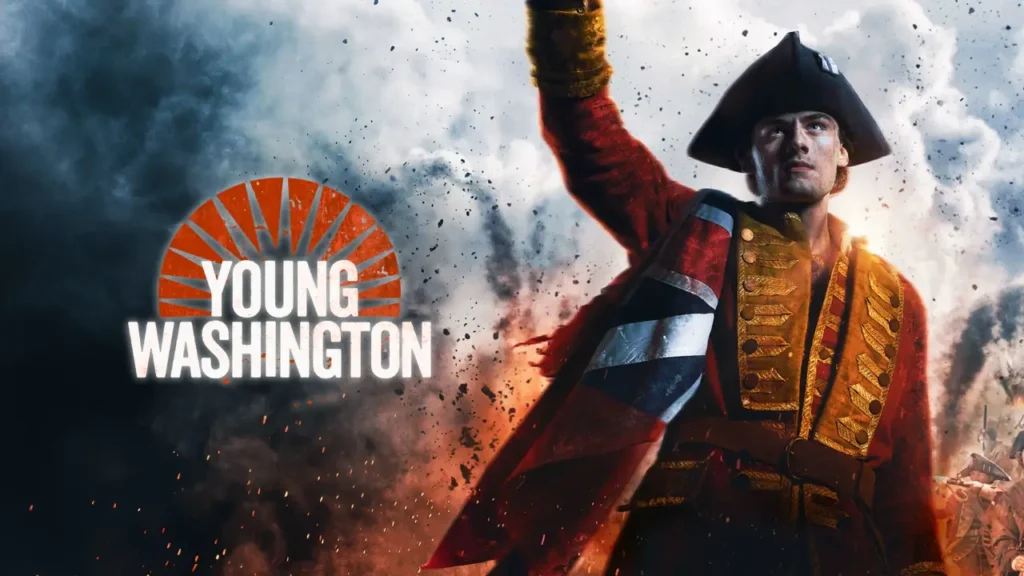
Young Washington Review Verdict: Young Washington is a handsome, well-intentioned, and ultimately hollow piece of patriotic filmmaking. It looks like a Hollywood epic. It moves like a school assembly. William Franklyn-Miller is compelling to watch even when the script gives him nothing to work with, and the supporting cast is genuinely star-studded, but Ben Kingsley, Andy Serkis, and Kelsey Grammer combined cannot compensate for a screenplay that refuses to let George Washington be a complicated human being. The final act goes so deliriously over the top that I was laughing in a packed theater, and I am still not sure whether the film intended that.
Young Washington premiered at the Tribeca Festival on June 13, 2026, and opened in US theaters on July 3, 2026 — timed to America’s 250th birthday. Rated PG-13 for Some Bloody Images and Strong War Violence. Runtime: approximately 2 hours. This review is based on a theatrical screening. Mild spoilers discussed.
Quick Verdict: Is Young Washington Worth Watching?
It depends entirely on who you are and what you want from a Fourth of July movie. If you are the kind of person who finds genuine pleasure in rousing, old-fashioned patriotic cinema, the kind of film that makes you feel good about the country rather than complicated about it, Young Washington will probably satisfy you. I sat next to an elderly couple in the theater and they were visibly loving every minute. Good for them. That reaction is real, and I think it tells you exactly who this film was made for.
If you are looking for a genuinely great historical epic, something with the moral complexity of Lawrence of Arabia, the kinetic energy of Braveheart, or even the pulpy entertainment of The Patriot, you are going to leave disappointed. Young Washington plays George Washington as model-handsome and moody, with a cast of supporting scowlers and a screenplay so determined to sanctify its subject that it drains the drama out of what should be an inherently dramatic story.
Young Washington (2026) — Movie Info
| Detail | Info |
|---|---|
| Title | Young Washington |
| Release Date | July 3, 2026 (US Theatrical) |
| Premiere | Tribeca Festival, June 13, 2026 |
| Director / Co-Writer | Jon Erwin |
| Distributor | Angel Studios |
| Budget | $30–35 million (reported) |
| Rating | PG-13 (Some Bloody Images, Strong War Violence) |
| Genre | Historical War Drama, Biography |
| Our Rating | ★★½☆☆ (2.5/5) |
What Is Young Washington About?
Young Washington is a 2026 American epic historical war drama film directed, produced, and co-written by Jon Erwin. It is based on the early life of the Founding Father and first president of the United States, George Washington, and focuses on his experiences and command in the French and Indian War between 1753 and 1755.
In 1743, after the death of his father Augustine, George Washington meets his older half-brother Lawrence. Because of his father’s death, George is not given a formal education. Lawrence tutors his half-brother in land surveying. In 1753 in Williamsburg, Virginia, George is denied commission into the British Army due to his colonial background. Thanks to Lawrence’s recommendation, Lieutenant Governor Robert Dinwiddie signs George into the Virginia Militia, where he is assigned to travel to the Ohio Country to deliver a message to the French demanding they leave.
What follows is a coming-of-age war story in which a young, inexperienced Washington is repeatedly told he cannot do something and then does it anyway, faster and more completely than anyone could reasonably expect. The French and Indian War provides the backdrop. The Ohio Territory land dispute between the British, the French, and Native American tribes provides the conflict. And Washington’s rapid, almost comically accelerated rise from foot soldier to commanding officer provides the structure.
The film covers only the years 1753 to 1755, a deliberately narrow window that sets up sequels rather than delivering a complete portrait of Washington’s life. Do not go in expecting the Cherry Tree, the Revolutionary War, or Valley Forge. This is an origin story, with all the promise and incompleteness that genre implies.
Young Washington Cast — Full Lineup
Young Washington stars William Franklyn-Miller in the title role, alongside Mary-Louise Parker as George Washington’s mother Mary Washington, Kelsey Grammer as Lord Fairfax, Ben Kingsley as Robert Dinwiddie, and Andy Serkis as General Braddock.
| Actor | Character |
|---|---|
| William Franklyn-Miller | George Washington |
| Mary-Louise Parker | Mary Washington — George’s mother |
| Kelsey Grammer | Lord Fairfax |
| Ben Kingsley | Lieutenant Governor Robert Dinwiddie |
| Andy Serkis | General Braddock |
| Joel David Smallbone | Lawrence Washington — George’s half-brother and mentor |
| Mia Rodgers | Sally Cary — love interest |
| Jonno Davies | Thomas Gage |
| Leo Hanna | Supporting |
| Ryan Begay | Supporting |
Director: Jon Erwin Screenwriters: Jon Erwin, Tom Provost, Diederik Hoogstraten Producers: Adam Abel, Jon Erwin, Chip Diggins, Benton Crane, Edmund Sampson, Tyler Zacharia, Kristopher Kimlin
Young Washington Review: The First 90 Minutes
I want to be fair to this film, because for the first 90 minutes it is genuinely trying to do something ambitious. Jon Erwin, whose previous work includes I Can Only Imagine and the Apple TV+ series House of David, is clearly reaching for the kind of naturalistic, epic-scale period filmmaking associated with films like The Revenant. The cinematography shows real effort: big sweeping shots of the Irish countryside standing in for the American frontier, natural lighting, overhead vistas of uncharted territory. There are individual shots in this film that are beautiful. I will freely acknowledge that.
The world-building is also more sophisticated than I expected going in. What almost everyone agrees on is that the film treats a genuinely under-told chapter of American history with more seriousness than spectacle alone would require. The French and Indian War is not a period of American history that gets much cinematic attention, and there is real value in dramatising it, the land dispute between British colonial interests, French territorial ambition, and Native American communities is a legitimately complex historical situation that deserves more than footnote treatment.
The problem is that Young Washington keeps bumping up against its own limitations in ways that shatter the illusion it is working so hard to create. I would see a genuinely impressive naturalistic shot, and then the next one would feature obviously generated AI backgrounds that look like a high-end video game from four years ago.The unmistakable, hideous generative AI throughout doesn’t help anything. It is the Renaissance fair problem: you are enjoying the atmosphere and then you catch one of the actors texting in the corner, and the spell is broken.
The script compounds this by never trusting the audience to fill in any gaps. Every scene in the first 90 minutes is expository in the most mechanical sense, characters exist to deliver information, and that information is delivered whether or not it serves the drama. Washington is told he cannot do something. He does it. Someone is surprised. Repeat. One review argued the film suffers from the stiff, stodgy quality common to historical dramas about this era, comparing it unfavorably to films like The Patriot. That comparison is apt. The Patriot had problems of its own, but it understood how to make a battle sequence feel like something. Young Washington’s first 90 minutes of action is competent, never exciting.
The dialogue is the first act’s most consistent problem. Early in the film, Washington is told he is just a pawn. His response: “Yes, but a pawn can still beat a king.” I wrote that down in my notes. Not because it was good, but because the film then brings it up again toward the end as though it was so wise the first time that it bears repeating. It is the kind of line that thinks it has just the right amount of clever zing, and it does not.
William Franklyn-Miller as George Washington — Is He Good?
This is the film’s most complicated question. Franklyn-Miller is not a bad actor. He has a genuine minimalistic quality, he does not puff out his chest or resort to dramatic facial expressions when something quieter would serve the scene better. There is real intelligence in how he approaches the role physically.
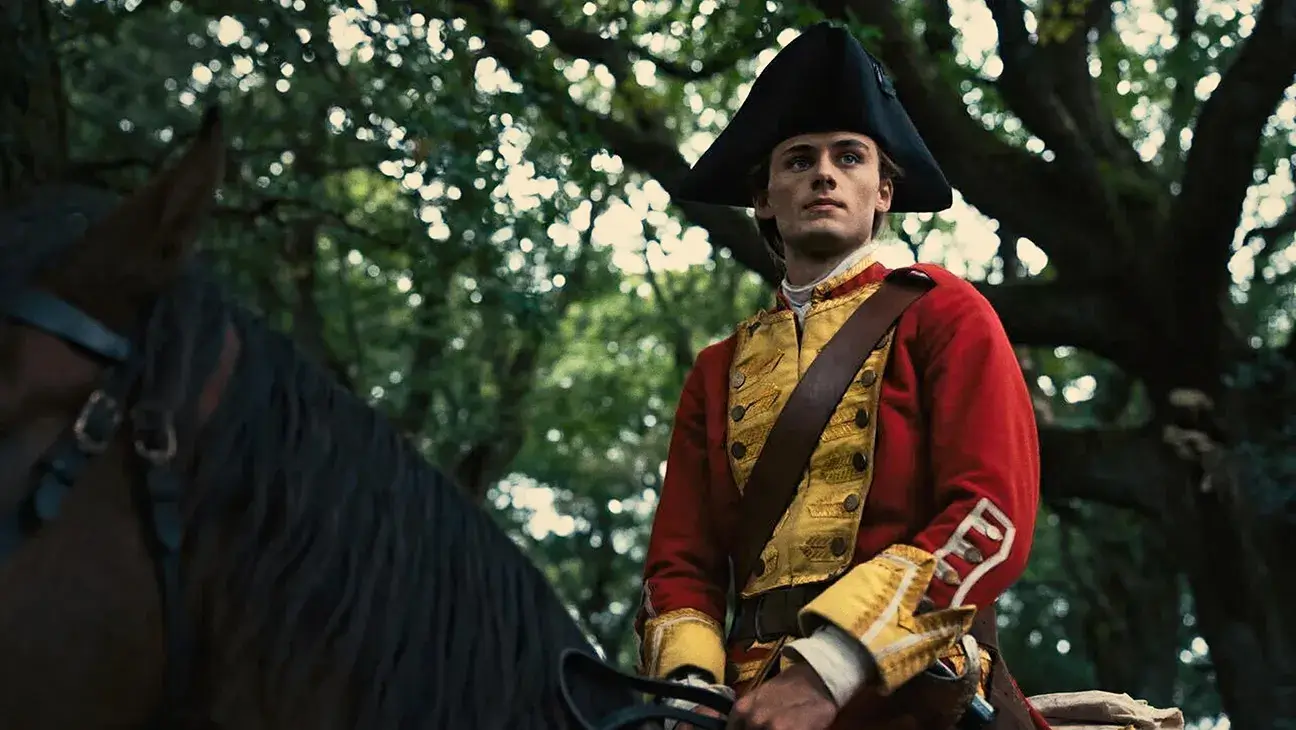
But he is miscast, and the miscasting is partly the role’s fault. William Franklyn-Miller plays George Washington as model-handsome and moody.The film has styled him in a way that reads as aggressively contemporary, almost twilight-adjacent in its presentation of a brooding, beautiful young man with flowing hair and period costume. Someone needed to dial back the makeup and the styling, because the effect is that you are watching an attractive young actor play dress-up rather than watching George Washington become a man.
The script does not help him. Washington is given the cheat codes throughout, he rises through the ranks with a speed that would be implausible even in a pure fiction, let alone in a film making claims about a historical figure. He does not have to work for anything in a meaningful way. He shows up, does one impressive thing, and authority figures capitulate. The 2009 JJ Abrams Star Trek version of character development: instant promotion without demonstrated earning. A historical film needs the central character to be genuinely tested and genuinely shaped by that testing. This one moves too fast through those formative moments for any of them to land.
There isn’t a single aspect of this performance resembling the Founding Father we are all familiar with, or a younger version of what that would be. I think that is slightly too harsh, Franklyn-Miller has moments, but the core observation is fair. You never feel like you are watching the origins of someone who will become that specific person.
The Supporting Cast: Ben Kingsley, Andy Serkis, Kelsey Grammer
The film assembled a genuinely remarkable supporting cast for a $30-35 million independent production, and I respect Angel Studios for that. Ben Kingsley, Andy Serkis, and Kelsey Grammer appearing together in a historical biopic is a legitimately impressive credential, and I do not want to diminish the achievement of getting them here.
The problem is what the film does with them once they arrive. Kingsley is over the top in ways that feel like a different register from everything around him, committed to a performance energy the film’s tone cannot accommodate. Grammer is deploying an accent I could not fully identify but found entertaining in its confidence. Serkis as General Braddock is given more to work with than the others and makes the most of it, but his screen time is still limited to the kind of cameo that reads as expensive window dressing rather than meaningful character work. These are great actors and yet I didn’t see a great performance from any of them emphasised here.
Mary-Louise Parker as Mary Washington fares better. Her scenes with Franklyn-Miller have a warmth and a grounded quality the rest of the film struggles to achieve, and when she delivers her sage maternal advice, the Peter’s Aunt, Spider-Man moment, as I noted in my head, it works better than it should because Parker commits to it without irony.
The Love Interest: Who Is Sally Cary and Why Is She in This Movie?
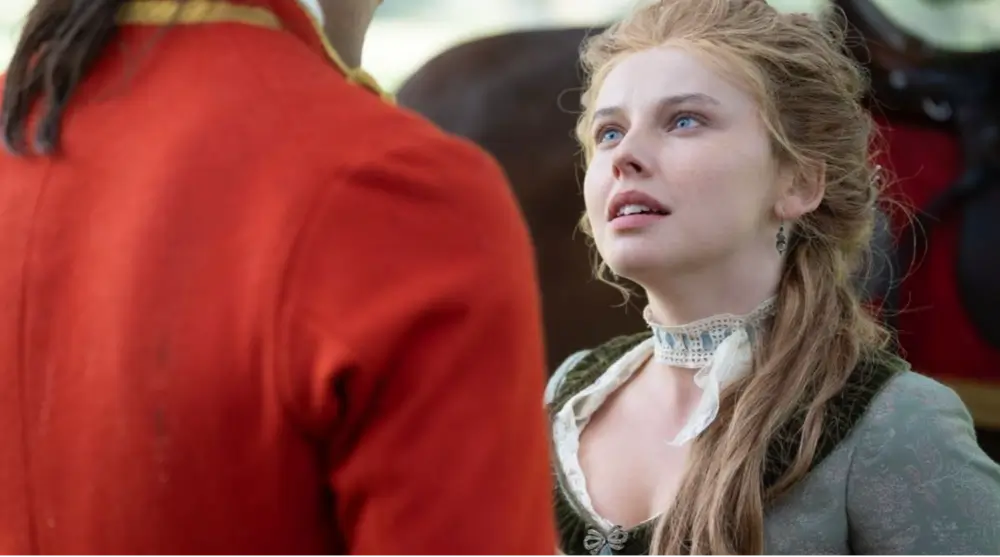
Before he departs, George arrives uninvited at Thomas Fairfax’s plantation Belvoir. There, Washington meets Sally Cary. She appears several times in the film’s first act as a romantic interest, and then effectively disappears. There is no closure to this storyline. She is simply gone.
For history enthusiasts, Sally Cary is a meaningful figure in Washington’s early life, a genuine historical relationship that has real interpretive weight. For a general audience, she is a confused subplot that takes up several scenes, generates no payoff, and leaves you wondering why the film introduced her in the first place. If you are going to include a love interest in a 1753-1755 window, give it somewhere to go, or do not include it at all. This one exists in limbo.
The Final Act: Where Young Washington Goes Completely Off the Rails (In the Best and Worst Way)
I want to be honest: the final act of Young Washington is the reason I do not regret seeing this in a theater with a crowd.
It goes spectacularly, hilariously, unhinged. Washington runs into combat with explosions on either side of him. He dodges a cannonball, yes, genuinely dodges a cannonball, while on horseback. He single-handedly dispatches what appears to be an implausible number of opponents in a sequence that has more in common with an action blockbuster than a period drama.
And then the film delivers its most extraordinary scene. Washington is surrounded by Native American fighters. Guns are drawn. His musket misfires. They all open fire. Washington is virtually unscathed. An elder comes down from the hills, looks at Washington, and essentially tells him, and I am paraphrasing only slightly, that legend says a great leader will come who cannot be harmed by our weapons, and that he is the chosen one. Director Jon Erwin’s consistent track record as a hokey evangelical filmmaker is also on full display, at one point insinuating that divine intervention protected George Washington in battle.
I was laughing in my seat. The person next to me was laughing. This is not the reaction a film about a Founding Father is supposed to generate, and I genuinely could not tell whether Erwin intended it as earnest divine-destiny filmmaking or whether he understood exactly how it would land. Either way, the final act gives this movie a personality its first 90 minutes completely lacks, and in its own deranged way it is memorable cinema.
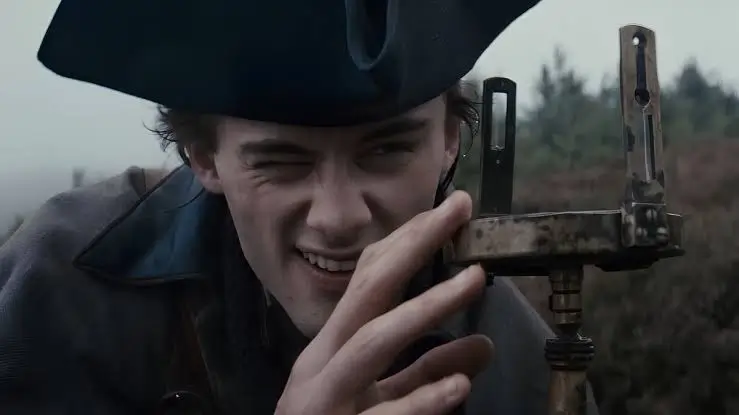
Is Young Washington Historically Accurate?
Did Angel Studios actually get the history right, or did they smooth over the messier parts of George Washington’s early life to make him more palatable for a Fourth of July weekend crowd?
The honest answer is: selectively. The broad strokes of Washington’s early military career, his assignment to the Ohio Territory, his encounters with French forces, his rapid rise in the Virginia Militia, are grounded in historical reality. The film correctly identifies the French and Indian War as the crucible that shaped Washington’s leadership instincts.
What it leaves out is more telling than what it includes. The film’s Washington comes from “little means” in the framing, a man who did it his own way. It acknowledges in passing that the Washington family had thousands of acres of land and owned over fifty enslaved people, but this context is not examined or developed. It is mentioned and moved past, which is a choice that tells you exactly what kind of biopic this is: the kind that wants you to feel good about its subject, not complicated about him.
The divine-protection scene involving Native American characters is not historical. The rapid promotion timeline is significantly compressed for dramatic effect. And the single-handed combat heroics in the final act belong to the genre of mythology rather than history.
Some critics were tougher on the execution than the history itself. One critic called it a well-crafted and accessible biopic about the maturation of a person who helped shape the nation’s image of itself, even while admitting it isn’t a knockout. That is a fair characterisation of the film’s relationship with its subject: accessible, sanitised, and built for inspiration rather than examination.
Young Washington Rating: Critics vs. Audiences
The gap between the critics score and the audience score for Young Washington tells a specific story about who this film was made for.
Young Washington has earned a 61% “fresh” critics score on Rotten Tomatoes’ Tomatometer based on 31 reviews. Metacritic sits at 50-52 out of 100.Rotten Tomatoes has now aggregated more than 250 verified user ratings for Young Washington, which is enough for the movie to earn an official score on the Popcornmeter. At the time of writing, the movie has a near-perfect score of 92%.
One possible reason why the movie’s Popcornmeter score is so high is that it was distributed by Angel Studios, a faith-based media company that tends to advertise directly to its core demographic, giving their movies more of a self-selecting audience than typical major studios. Their audiences tend to be small but motivated to see their movies, leading to consistently strong user ratings.
This is not a criticism of those audience members, their experience of the film is genuine and valid. But if you are using the audience score to calibrate your own expectations, it is worth knowing that this film had an unusually self-selected opening weekend viewership. The critics score at 58-61% is the more broadly representative indicator of what a mixed general audience will encounter.
Young Washington vs. The Patriot: Which Is the Better Historical Epic?
This is the comparison I kept making to myself in the theater, and the answer is clear: The Patriot is the better film, even accounting for its own historical liberties and tonal excess. The Patriot understood how to stage a battle sequence with genuine kinetic energy, how to give its protagonist a personal loss that made the war feel consequential, and how to use Mel Gibson’s considerable star power to carry the film through its weaker moments.
Young Washington has better cinematography, a more restrained tone in its first 90 minutes, and a more impressive supporting cast on paper. What it lacks is The Patriot’s willingness to go hard, to commit to spectacle or emotion with the kind of full-throated energy that makes even a flawed historical epic stick in the memory. Young Washington hedges. The Patriot did not.
What Young Washington Gets Right
The cinematography (in its best moments). There are genuinely beautiful shots in this film, overhead views of the frontier, naturalistic lighting in the early interior scenes. When the visual ambition is achieved, it lands.
The historical period. The French and Indian War is genuinely under-explored in American cinema, and the film’s depiction of the three-way territorial conflict between the British, French, and Native American communities has more nuance than the genre typically allows.
Mary-Louise Parker. She grounds every scene she inhabits with a warmth that the rest of the film cannot quite replicate.
The final act’s insane energy. It is not good filmmaking. It is absolutely unforgettable cinema-going. The cannonball dodge. The divine protection scene. I was in a packed theater and everyone was reacting. That is something.
The 250th anniversary timing. Whatever its craft limitations, Young Washington was the right film for the right moment. Releasing a George Washington biopic on America’s 250th birthday was a genuinely smart cultural play by Angel Studios.
What Young Washington Gets Wrong
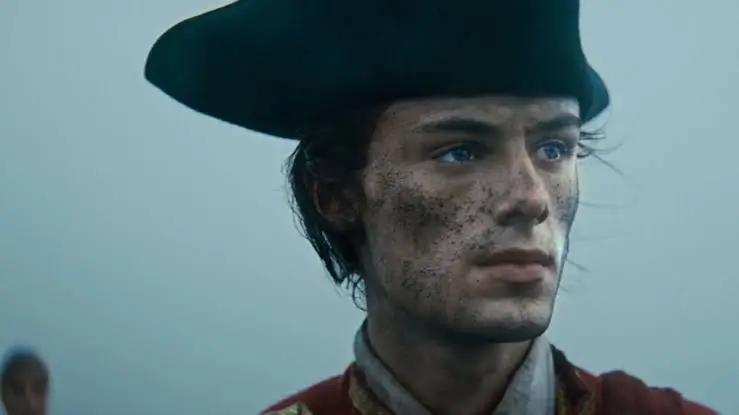
The screenplay. Formulaic to a fault, telegraphed from scene one, and lacking any interest in the connective tissue between big moments that would make Washington’s transformation feel earned rather than decreed.
William Franklyn-Miller’s styling. The actor has potential. The movie has styled him as a contemporary model in period costume rather than a historical figure, which creates persistent cognitive dissonance.
The AI backgrounds. The unmistakable, hideous generative AI throughout doesn’t help anything, pulling you out of the period setting at the moments you most need to be inside it.
The supporting cast usage. Kingsley, Serkis, and Grammer are expensive, acclaimed actors who are here for approximately a day each and given nothing meaningful to do. The film buys their credibility without earning their presence.
The Sally Cary subplot. Appears, generates nothing, disappears. A complete structural dead end.
The cheat-code protagonist. Washington rises too fast, is tested too lightly, and arrives at his final-act heroism without the dramatic preparation that would make it feel triumphant rather than unearned.
Young Washington Pros & Cons
✓ Pros
- Genuinely beautiful cinematography in its strongest sequences
- A historically under-explored period brought to the screen with reasonable seriousness
- Mary-Louise Parker is the film’s most grounded and human performance
- The final act is memorably deranged, whatever its intentions, it generates a reaction
- Strong audience score (92% Popcornmeter) suggests a real and enthusiastic target audience
- $7.6 million opening day is a strong commercial result for Angel Studios
- Smart cultural timing with America’s 250th anniversary
✗ Cons
- Critics consensus sits at 58-61% on Rotten Tomatoes, accurately reflecting a mixed experience
- Metacritic score of 50-52 indicates reviews skewing negative among major publications
- Formulaic, over-expository screenplay with no interest in dramatic nuance
- AI backgrounds are conspicuous and immersion-breaking
- Supporting cast (Kingsley, Serkis, Grammer) is expensive window dressing rather than meaningful performance
- Washington’s rise is unearned, the cheat-code protagonist problem
- The divine protection / Native American scene in the final act plays as propaganda regardless of intent
- Sally Cary subplot goes absolutely nowhere
Final Verdict
| Category | Score |
|---|---|
| Screenplay / Story | ★★☆☆☆ |
| Direction | ★★½☆☆ |
| Lead Performance (Franklyn-Miller) | ★★½☆☆ |
| Supporting Cast | ★★★☆☆ |
| Cinematography | ★★★☆☆ |
| Historical Authenticity | ★★☆☆☆ |
| Entertainment Value (Final Act) | ★★★★☆ |
| Overall | ★★½☆☆ (2.5/5) |
One sees the potential in showing the rise of George Washington from inexperienced and incompetent to a unifying leader who would go on to overthrow the British, and there is still some respect to be had for the human-crafted aspects of those battle sequences, but narratively, Young Washington has no ambition beyond an Angel-approved history lesson.
That is the sharpest summary I can offer. Young Washington is a film that knows what it wants to be, a rousing, patriotic, feel-good Fourth of July movie about the greatest American president, and it achieves that goal well enough that its core audience will leave genuinely satisfied. For everyone else, it is a handsome disappointment: a $30-35 million period epic that looks like imitation Hollywood and moves like a school textbook.
If it is playing near you and you want something seasonally appropriate, go see the elderly couple’s experience. Go in with low expectations. Enjoy the cannonball dodge. Laugh at the divine protection scene. Get your money’s worth from the final act’s lunatic energy.
And then come home and watch The Patriot.
If you enjoyed this Young Washington review, you might also like my reviews of Citizen Vigilante, Minions and Monsters, Enola Holmes 3, Couture, and other historical dramas, war movies, and biographical films. I watch every film with a critical eye and share honest, first-person reviews covering storytelling, performances, historical accuracy, direction, and whether each movie is actually worth your time. Browse more reviews on Nexafeed to discover your next great watch.
Frequently Asked Questions
Q. Is Young Washington a true story?
Ans. Young Washington is based on the early life of the Founding Father and first president of the United States, George Washington, focusing on his experiences and command in the French and Indian War between 1753 and 1755. The broad historical framework is real. The dramatic liberties, including Washington’s rapid promotion, several battle sequences, and a scene involving divine protection, are significant departures from the historical record.
Q. Is the movie Young Washington any good?
Ans. It depends on your expectations. On Rotten Tomatoes, the film sits at 60 percent among 30 critics with an average rating of 6 out of 10, while Metacritic gave it a 52 out of 100 based on eight critics, landing in mixed or average territory. The audience Popcornmeter score is 92%, reflecting Angel Studios’ devoted core demographic. Critics found it formulaic and over-simplified. Audiences, particularly those sympathetic to Angel Studios’ faith-based filmmaking approach, found it rousing and satisfying. Our rating: 2.5 out of 5.
Q. Who stars in Young Washington?
Ans. Young Washington stars William Franklyn-Miller in the title role, alongside Mary-Louise Parker, Kelsey Grammer, Ben Kingsley, and Andy Serkis. Joel David Smallbone plays Lawrence Washington, George’s half-brother and mentor. Mia Rodgers plays Sally Cary, a brief love interest.
Q. Is Young Washington rated R?
Ans. No. Young Washington is rated PG-13 for Some Bloody Images and Strong War Violence. It is appropriate for older children and teenagers, though the battle sequences are realistically depicted within the PG-13 framework.
Q. Where can I watch Young Washington?
Ans. Young Washington is distributed by Angel Studios and available to buy tickets on Fandango for theatrical viewing. It is also available to buy on Fandango at Home. As with most theatrical releases, a digital rental/purchase window will follow the theatrical run, typically 45-90 days after release. Angel Studios previously made Sound of Freedom available on its own platform, check Angel Studios’ website and major streaming platforms including Amazon Prime Video and Apple TV for digital availability updates.
Q. Who made Young Washington?
Ans. Young Washington was directed, produced, and co-written by Jon Erwin, and distributed by Angel Studios, the independent faith-based media company that also produced Sound of Freedom (2023). The production company is Wonder Project.
Q. Is Young Washington part of a series?
Ans. The film covers only 1753-1755 and explicitly sets up further entries. The film feels designed as the first chapter of what one reviewer called the “American Cinematic Universe”, a George Washington trilogy covering his youth, the Revolutionary War, and beyond. No sequels have been officially announced as of this writing, but the film’s structure assumes they are coming.
Q. How much did Young Washington make at the box office?
Ans. Young Washington is projected to gross around $15 million from 2,700 theaters in its opening weekend. The film made $7.6 million on its first day. For context, Angel Studios’ Sound of Freedom grossed $14.2 million in its opening weekend in 2023, eventually reaching $184 million domestic, so a similar or stronger opening for Young Washington is commercially meaningful for the studio.
Young Washington is now in wide theatrical release from Angel Studios across 2,700 US theaters.