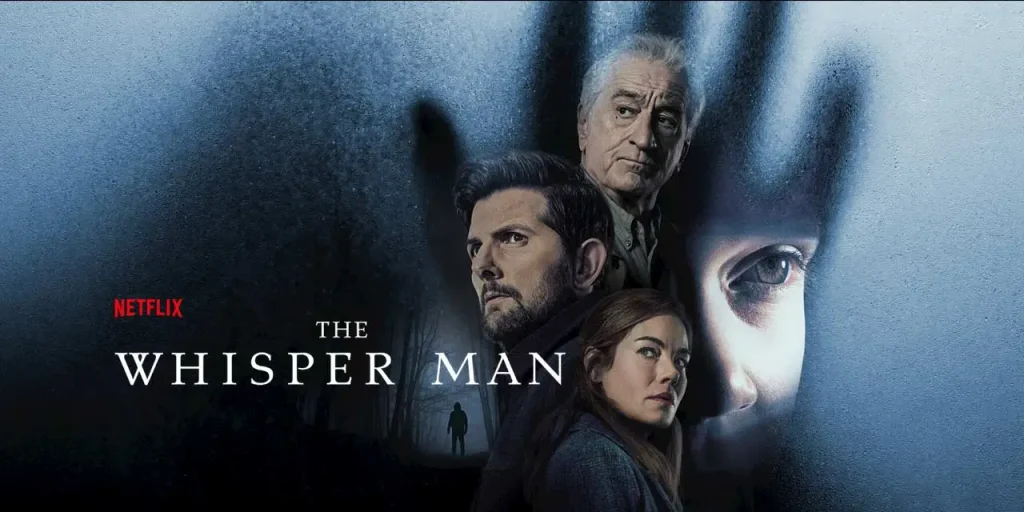
The Whisper Man Review Verdict: The Whisper Man arrived on Netflix with a genuinely impressive cast, Michael Keaton, Robert De Niro, Adam Scott, Michelle Monaghan, and the dark, atmospheric bones of what could have been a compelling crime thriller. What it produced was a sluggish, emotionally hollow David Fincher impression that never earns the weight it keeps reaching for. Keaton is extraordinary. Everything else is a disappointment.
The Whisper Man is now streaming on Netflix worldwide. This review contains full spoilers, including the ending. A spoiler-free quick verdict appears first, the ending explained section begins midway through.
Quick Verdict: Is The Whisper Man Worth Watching?
Conditionally. If you are a Michael Keaton completist, yes, his performance as Frank Carter is the best thing in the film by a meaningful distance and worth the watch on its own terms. If you are going in expecting a tight, emotionally engaged crime thriller in the Fincher tradition it is clearly trying to inhabit, manage your expectations significantly. The film is slow, its characters are frustratingly thin, the ending action is implausible, and the emotional weight it needs to land never quite arrives.
Based on a highly rated book, the adaptation does not manage the translation from page to screen with any particular success. I suspect the novel does considerably more with its material.
The Whisper Man (2026) — Movie Info
| Detail | Info |
|---|---|
| Title | The Whisper Man |
| Platform | Netflix (exclusive) |
| Based On | Novel by Alex North |
| Genre | Crime Thriller / Mystery |
| Lead Cast | Adam Scott, Robert De Niro, Michael Keaton, Michelle Monaghan |
| Tone | Attempting David Fincher — Prisoners, Zodiac |
| Our Rating | ★★☆☆☆ (2/5) |
The Whisper Man Netflix Cast
| Actor | Character |
|---|---|
| Adam Scott | Tom Kennedy — widower, writer, Jake’s father |
| Robert De Niro | Peter Willis — retired detective, original case investigator |
| Michael Keaton | Frank Carter — the original Whisper Man, incarcerated serial killer |
| Michelle Monaghan | Detective Amanda Beck — lead investigator on the copycat case |
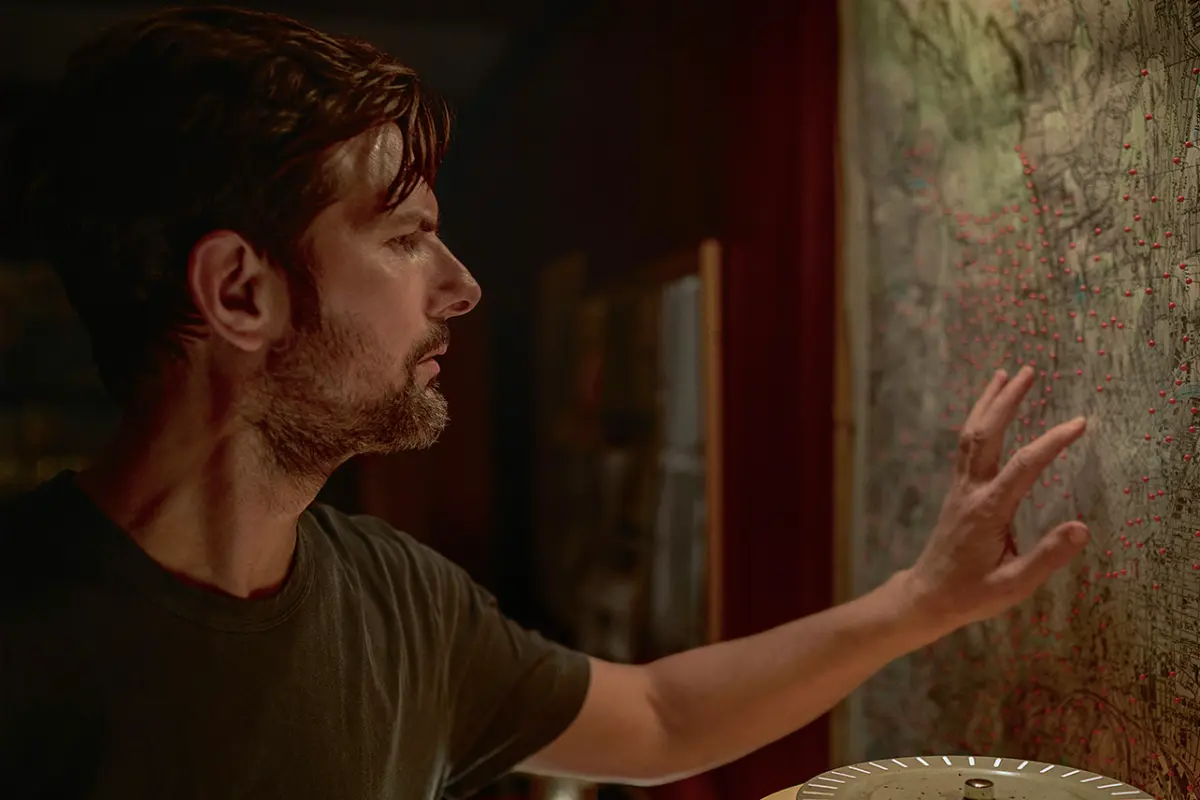
What Is The Whisper Man About?
The film drops you into the world of Frank Carter, known as the Whisper Man, a serial killer who was convicted of a series of murders decades ago and has been incarcerated ever since. Now, a copycat has emerged. The new killer shares enough specific traits with Carter’s original crimes that the cases are clearly connected, and the latest victim to be targeted is Jake, the young son of Tom Kennedy, a grieving widower and struggling writer.
The investigation runs on two tracks simultaneously. Detective Amanda Beck pursues the current case with active leads. Retired detective Peter Willis, who worked the original Carter case and was never fully able to close it emotionally, begins his own parallel pursuit, eventually going directly to Frank Carter himself in prison to extract information about who the copycat might be.
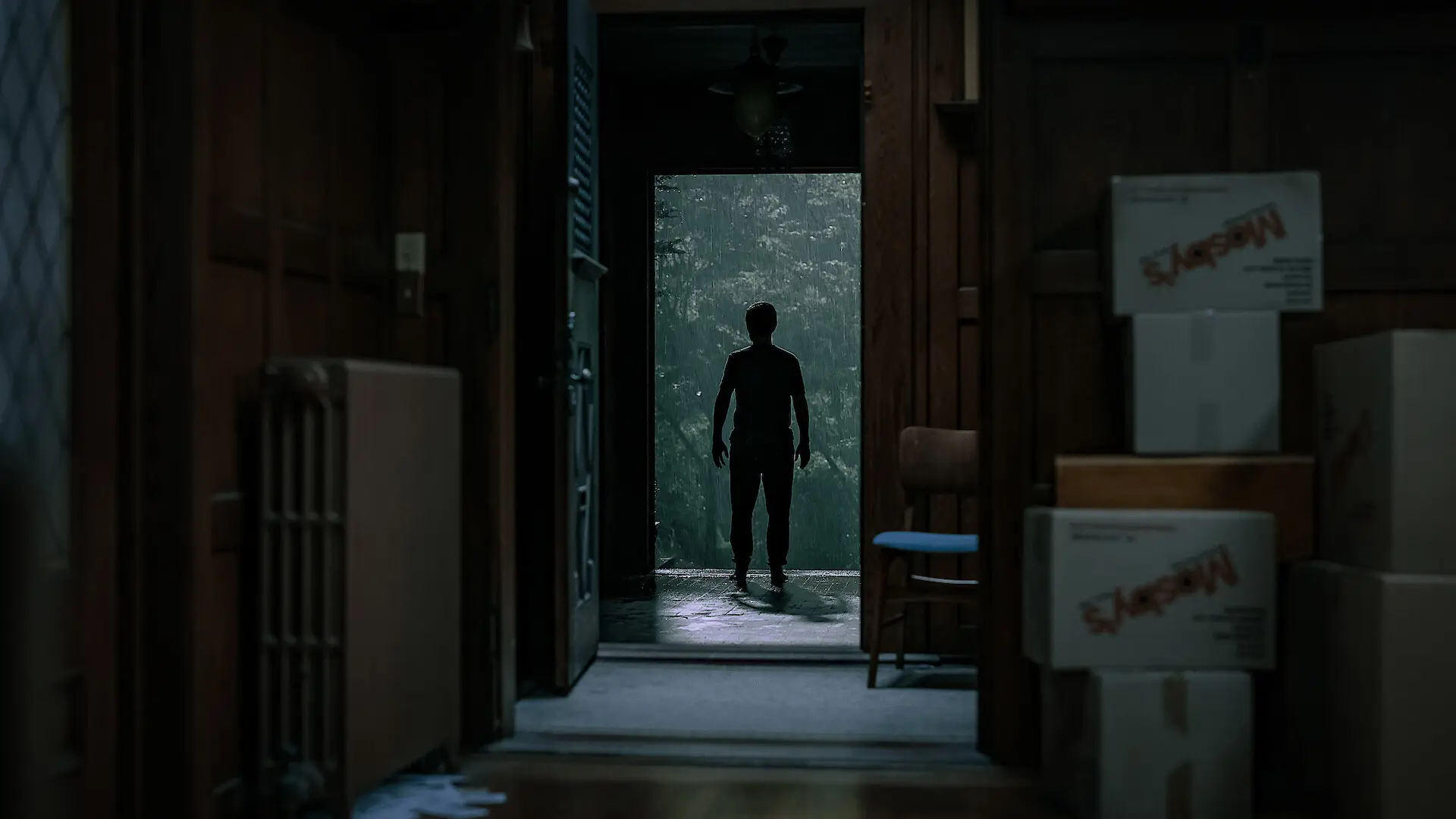
The film is paced slowly and deliberately, reaching for the atmospheric dread of its obvious inspirations, Fincher’s Zodiac, Villeneuve’s Prisoners — without the craft or character investment to sustain that pacing. By the time the reveals arrive, the film has spent too long in a register of mounting tension without commensurate payoff.
The Whisper Man Review: What It Gets Right
Michael Keaton as Frank Carter
I want to be clear about how good Keaton is in this film because it is the one unambiguous creative success the production can claim, and it deserves naming without qualification.
Frank Carter is a character who needs to feel genuinely dangerous while sitting in a room, behind glass, unable to physically touch anyone. He needs to suggest that his mind operates in a register most people cannot access, not through theatrical villainy but through a subtler, more chilling intelligence. Keaton delivers all of this and then some. The stillness he brings, the specific quality of his eye contact, the way he holds silences longer than they should be comfortable, it is a genuinely unsettling performance that makes every scene he inhabits feel like it carries real threat regardless of the physical constraints the character operates under.
There is a strange quality to the way Keaton plays Carter’s relationships, particularly with Peter Willis, that feels genuinely psychologically complex. He is not a cartoon villain. He is something more interesting and more frightening: a man of genuine intelligence who has made catastrophic moral choices and is entirely comfortable with who he is. The scenes between Keaton and De Niro are the film’s best. They are the moments where it approaches the Fincher territory it aspires to.
My honest reaction, sitting with the film after seeing it: I would have preferred a film about Frank Carter’s original spree. Set thirty years earlier, with Keaton in that role, in that period, building to the crimes rather than operating in their aftermath. That film would have been considerably more disturbing and considerably more interesting than the one we got.
The Symbolic Thread — The Crack in the Ceiling
One of the film’s smarter pieces of writing is the metaphor attached to Peter Willis’s inability to move on from the original case. He describes a crack in his ceiling that keeps reappearing no matter how many times he plasters over it. It is a simple device, but it is used with enough consistency that it lands as a genuine expression of the psychological damage the Whisper Man case has done to him over decades. Some people cannot close certain things. Some wounds keep reopening. It is a real idea handled with genuine economy.
The Whisper Man Review: Where It Falls Apart
The Pace Is a Problem
The Whisper Man is slow. Deliberately so, clearly aspiring to the unhurried dread of the films it is modelling itself on. The problem with slow crime thrillers is that the pacing has to be earned by the depth of what is being revealed at each unhurried step. Zodiac works at its pace because the accumulation of detail and the erosion of certainty is the actual subject of the film. Prisoners works because the character psychology is doing genuine work throughout every extended quiet scene.
The Whisper Man does not have the character depth to justify its pacing. The reveals, when they come, do not land with the weight the slow build was supposed to generate, because the emotional investment in the people involved was never fully established. You end up sitting through slowness that did not serve a purpose you can identify in retrospect.
Michelle Monaghan Is Underserved
This is less a criticism of the performer and more a criticism of the material, but the end result is the same: Amanda Beck is one of the film’s most important characters, the active investigator at the centre of the present-day case, and she is written as a functional plot device rather than a person. Monaghan gives a flat, emotionally uninvested performance throughout, and while I am reluctant to blame an actor for that without knowing what the production environment offered her, the result on screen is that Beck registers as a presence rather than a character. She makes procedural decisions. She appears in scenes. She does not compel.
Adam Scott’s Character Is the Wrong Kind of Weak
Adam Scott is a good actor. His performance in The Whisper Man is fine, competent, present, doing what the script asks. The problem is what the script asks of him. Tom Kennedy is written as a passive participant in the crisis surrounding his own son. He absorbs beatings. He fails repeatedly. He survives the film’s climax not because of anything he actively does but because the floorboards in the attic happen to be damaged and Francis Jr. falls through them.
There is a version of a passive, grieving father as a thriller protagonist that works, where the passivity is the psychological truth of the character, deliberately contrasted with the active evil around him. Tom Kennedy never rises to that reading. He just feels ineffectual in a way that generates frustration rather than empathy. When your child’s life is at risk, the script seems to suggest, your survival instincts might not actually kick in, and you will be relying on structural decay to save the day.
The Prison Kill Scene Breaks the Film’s Reality
Without entering the ending explained section just yet, I want to name this as the moment the film lost me. There is a moment in the climax where a retired detective receives a specific, explicit promise from Frank Carter about what he wants in return for information, and that promise is delivered on by law enforcement in a way that is so far outside the plausible reality of how institutions operate that it collapses whatever grounded credibility the film had been building. Some thrillers operate in a stylised register where this kind of thing works. The Whisper Man has been playing for gritty, atmospheric realism. The two modes are incompatible, and the seam between them is visible and jarring.
The Whisper Man Ending Explained (Full Spoilers)
The copycat killer, who is Francis Jr.?
The film’s central mystery resolves around Frank Carter’s son, Francis Jr. He was never in his father’s life; Frank Carter was incarcerated for most of or all of his son’s childhood, and in that absence, Francis Jr. mythologized his father. He adopted his father’s mindset, his methods, and his specific behaviours. He was not carrying out the killings out of compulsion or pathology in the traditional sense; he was attempting to impress a father he had never known, to embody a legacy he had constructed entirely from outside.
This is underscored by the dialogue the film gives Frank Carter himself: “When we are denied our father’s love, we mythologize them.” The film makes this theme explicit. Tom Kennedy is also quietly doing this; the book he is writing about his own father is a version of mythologizing, processing a paternal relationship through fiction. The parallel is intentional, connecting Tom’s grief to Francis Jr.’s compulsion in ways that give the film’s emotional architecture more dimension than most of its execution manages to realise.
How is Francis Jr. identified?
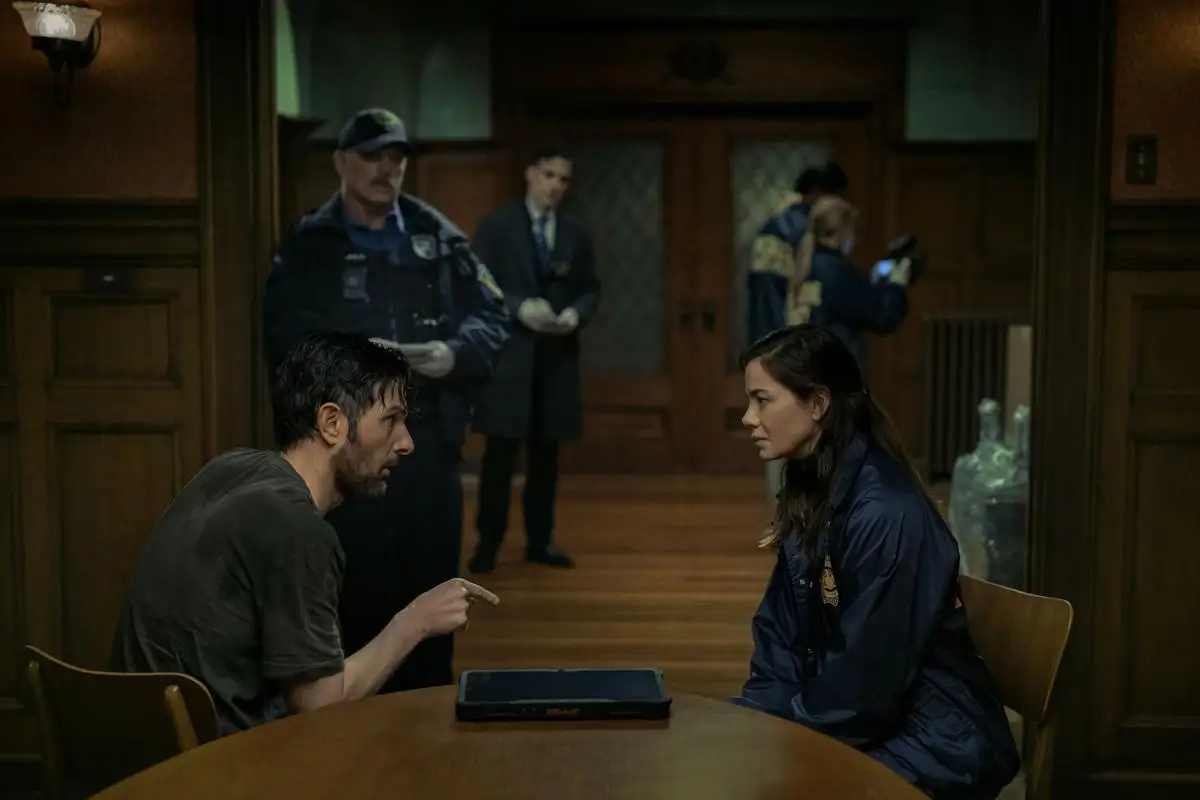
Peter Willis visits Frank Carter in prison and gets inside his head with a specific threat: if Francis Jr. is not stopped and caught, his kills will eventually outnumber Carter’s, and the Whisper Man’s legacy will be defined by his copycat rather than by the original. Carter’s ego responds to this. He gives up his son, but only in exchange for a specific promise: that once Francis Jr. is imprisoned, Carter will be placed in the same facility and allowed to carry out the one kill he never managed to make, his own son.
Willis extracts the information. Detective Beck, acting on a tip, arrives at a door and receives a photo of Carter’s son, and realises she is already standing in front of him, in the very house where Jake is likely being held.
Why does Carter cover his victims’ faces?
The film’s most psychologically interesting reveal concerns this specific detail. Carter covered the faces of his victims because in his mind, he was always imagining killing his own son. The item of clothing over the face was the psychological mechanism that allowed him to carry out the killings at all; he never wanted to kill strangers. His real compulsion was toward his son, but he could not bring himself to do it. He killed others instead, imagining them as his son each time.
Peter Willis’s death
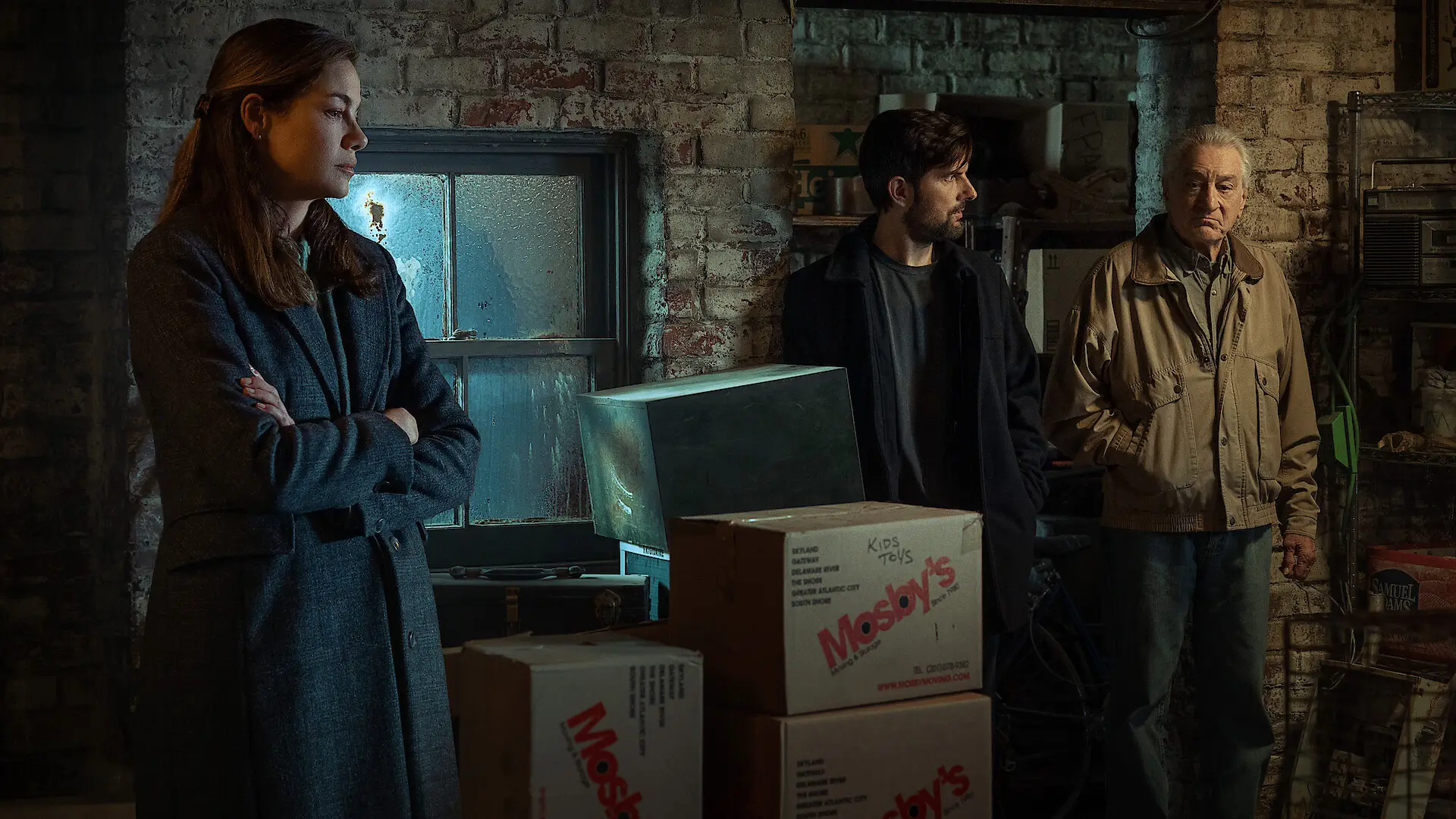
When Peter and Tom arrive at the house, they attempt to overpower Francis Jr. and fail. Francis Jr. kills Peter. His death is the film’s most genuinely weighted moment; the man who could never leave this case behind finally has it close in on him permanently. The metaphor of the crack in the ceiling resolves here: he was always going to end up consumed by this case. He almost couldn’t live without it, and in the end, he didn’t.
Jake escapes, and who is the girl in the blue sweater?
Jake survives because throughout the film he has been guided by an imaginary friend, someone who told him to run, told him to scream, showed him where to hide in the attic. The film’s final scene reveals what this imaginary friend actually was. Tom, looking through old photos of his wife, finds one of her as a young woman wearing a blue sweater, exactly the sweater Jake described his imaginary friend wearing. Jake had been imagining his dead mother. In his most desperate moments, his mind created a guide out of his grief and his memory of her. Jake’s words to his father, “She saved me”, are both heartbreaking and the film’s most emotionally honest moment.
The prison scene and Carter’s letter
Frank Carter is placed in the same prison as his son and, with a correctness the film asks you to accept despite its implausibility, is allowed to kill him. Amanda Beck later receives a letter from Carter, the tone of which suggests he considers them connected now, the way he was connected to Peter Willis. She has become his new pen pal in Willis’s absence. The implication is uncomfortable and intentionally so: this case does not really end.
Is The Whisper Man Based on a True Story?
No. The Whisper Man is an adaptation of Alex North’s novel of the same name, published in 2019. The novel is entirely fictional. The film does not draw from any real criminal case or real individuals.
Final Verdict
| Category | Score |
|---|---|
| Michael Keaton’s Performance | ★★★★★ |
| Direction / Atmosphere | ★★★☆☆ |
| Screenplay | ★★☆☆☆ |
| Adam Scott (Performance / Character) | ★★☆☆☆ |
| Michelle Monaghan | ★★☆☆☆ |
| Robert De Niro | ★★★☆☆ |
| Pacing | ★★☆☆☆ |
| Ending Logic | ★★☆☆☆ |
| Overall | ★★☆☆☆ (2/5) |
The Whisper Man wants to be a David Fincher film. It has the muted palette, the atmospheric score, the deliberate pacing, the serial killer psychology. What it does not have is the character depth, the narrative precision, or the sustained dread that makes Fincher’s best work so effective. The result is something that feels like a copycat, which is, perhaps inadvertently, the film’s own central metaphor turned inward.
Keaton is extraordinary. The blue sweater reveal is genuinely moving. Beyond these two things, The Whisper Man is a film that had the right ingredients for something memorable and assembled them without the craft to make them cohere.
If you’re deciding which movie to watch next, explore our latest reviews of Coyote vs. Acme Review, Insidious: Out of the Further Review, Toxic Review, Spider-Man: Brand New Day Review, Spider-Man: Brand New Day Post-Credits Scene Explained, Hanuman Ansh Review, and Mutiny Review. At NexaFeed, we publish spoiler-free movie reviews, OTT series reviews, ending explained articles, hidden details, and streaming guides covering Disney, Pixar, Marvel, Netflix, Prime Video, Apple TV+, HBO Max, and the biggest theatrical releases from around the world.
Frequently Asked Questions
Is The Whisper Man any good?
Conditionally. Michael Keaton’s performance as Frank Carter is exceptional and worth watching in isolation. As a complete film, The Whisper Man is slow, emotionally thin, and suffers from a weak central character, a flat lead performance from Michelle Monaghan, and an ending action sequence that strains credibility. Our rating: 2 out of 5.
How scary is The Whisper Man?
It is not conventionally scary in a horror sense. The film builds atmospheric dread through mood and implication rather than jump scares or explicit horror. It is dark and unsettling in stretches, particularly the Frank Carter prison scenes, but it is more of a slow psychological thriller than a fright film.
Is The Whisper Man a true story?
No. It is an adaptation of Alex North’s 2019 novel of the same name. The story is entirely fictional and not based on any real criminal case or real individual.
What is The Whisper Man ending explained?
Francis Jr., Frank Carter’s son, is the copycat killer. He mythologized his incarcerated father and was attempting to impress him through the killings. Peter Willis dies confronting Francis Jr. Francis Jr. is arrested when he falls through attic floorboards. Frank Carter is placed in the same prison as his son and kills him. Jake’s imaginary friend throughout the film was his dead mother. Tom finds a photo of her wearing a blue sweater identical to what Jake described. Detective Beck receives a letter from Carter suggesting she has become his new pen pal.
Who played Frank Carter in The Whisper Man?
Michael Keaton plays Frank Carter and delivers the film’s standout performance, menacing, psychologically complex, and genuinely unsettling throughout.
The Whisper Man is now streaming exclusively on Netflix.