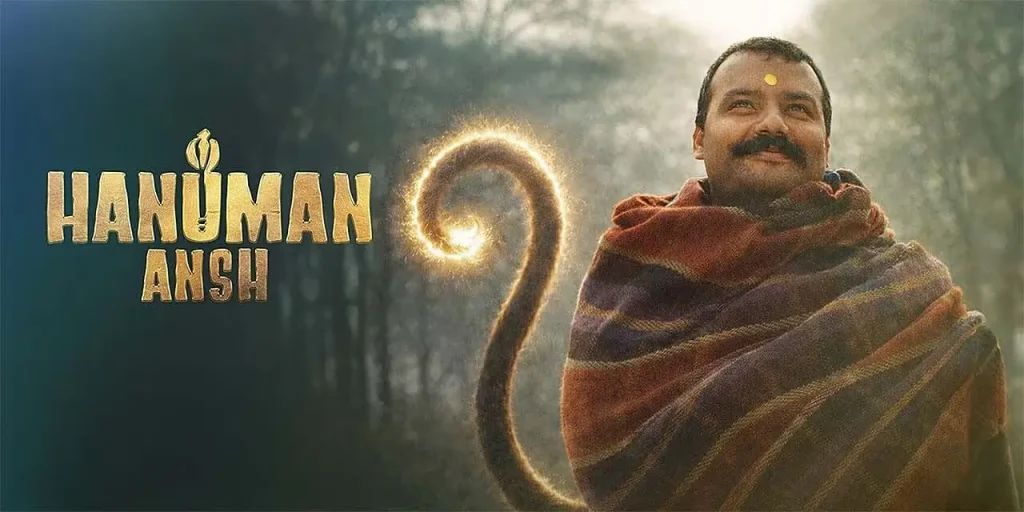
Hanuman Ansh Review Verdict: Hanuman Ansh is the kind of film that does not announce itself. It does not arrive with a trailer full of spectacle. It does not need one. It tells the story of Neem Karoli Baba with the same quality that defined the man himself: simplicity, honesty, and a complete absence of ego. In a year where 500-crore productions are collapsing at the box office, this 2-crore film is quietly earning six times its budget on word of mouth alone. There is a lesson in that.
Hanuman Ansh is currently in theatrical release across India. Runtime: approximately 2 hours. Language: Hindi. This review is based on a theatrical viewing. The film is family appropriate and suitable for all ages.
Quick Verdict: Is Hanuman Ansh Worth Watching?
Yes. Not just worth watching, worth making time for. Worth going to the theater for specifically, in a cinema with good sound so the bhajans land the way they were recorded. Worth taking your family to, including your children, because this is exactly the kind of film that gives young people an honest, non-preachy window into what devotion can actually look like, as opposed to the loud, performative version of it that fills the news cycle.
This is a rare film in Hindi cinema. It is not trying to make you cry on cue. It is not trying to manufacture awe. It is not lecturing you about faith or asking you to justify your relationship with God to anyone. It is just telling you a story, clearly and with love, and trusting you to receive it in whatever way resonates with where you are.
Go see it before it leaves theaters. Films like this deserve the theatrical experience. Films like this do not get enough of it.
Hanuman Ansh (2026) — Movie Info
| Detail | Info |
|---|---|
| Title | Hanuman Ansh |
| Director / Writer | Vishal Chaturvedi |
| Music Director | Sadhu Susheel Tiwari |
| Child Lead | Daivik Bhanushali (young Neem Karoli Baba) |
| Adult Lead | Shobhit Satsangi (adult Neem Karoli Baba) |
| Based On | Divine Detour by American author Lori Wood |
| Budget | ₹1.8–2 crore (estimated) |
| Box Office | ₹12+ crore and climbing |
| Genre | Biographical / Spiritual Drama |
| Language | Hindi |
| Our Rating | ★★★★½ (4.5/5) |
Who Was Neem Karoli Baba? Understanding the Film’s Subject
Before I talk about the film itself, I want to make sure you understand who Neem Karoli Baba was, because the film assumes a degree of familiarity that not everyone will have, and going in with that context makes the experience significantly richer.
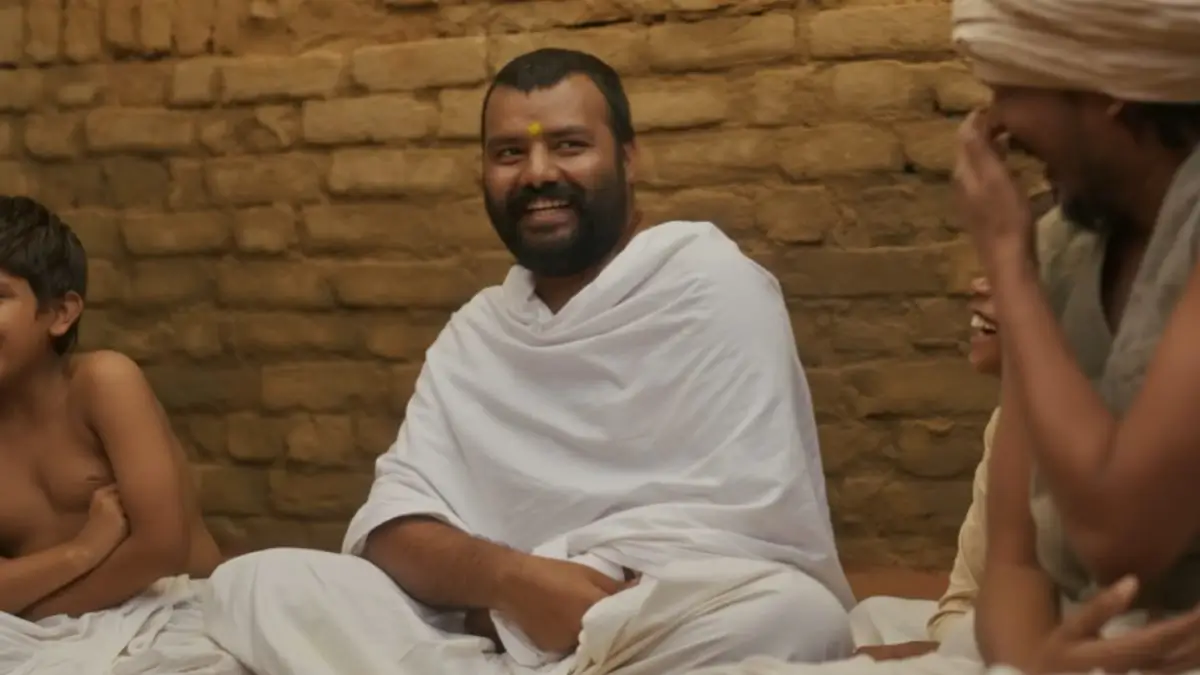
Neem Karoli Baba, also known as Maharaj-ji, was a Hindu saint from Uttar Pradesh. He was not a self-promoter. He never claimed to be God. He never asked for temples in his name or statues of himself. His only stated goal was to draw closer to God through devotion, specifically through his unwavering connection to Hanuman and the continuous recitation of the names of Ram, and to help the people around him in whatever way he could, without condition and without expectation.
To understand why the film is structured the way it is, the film’s opening makes a distinction that I found clarifying and that I will pass along here. There is a difference between a Sadhu and a Sant. A Sadhu is a seeker, someone who has entered a path of spiritual discipline and practice, renouncing the material world in pursuit of internal purification.
A Sant is an enlightened, self-realised teacher whose primary purpose is to share their wisdom with others. Most people who become Sadhus never reach the level of Sant. The journey from Sadhu to Sant is not one that can be planned, claimed, or marketed. Hanuman Ansh traces exactly that journey: how a small boy drawn to devotion from the age of five became, without seeking to become, the Sant that changed the lives of people across the world.
Hanuman Ansh Review: What the Film Does Exceptionally Well
The Screenplay’s Restraint Is Its Greatest Achievement
In a genre where the tendency is to dramatise, to amplify, to make devotion cinematic by making it loud, Vishal Chaturvedi does the opposite. He makes it quiet. He makes it small. He makes it something that happens in a person’s face and body rather than in the production design around them.
The best thing I can say about the screenplay is that it moves forward without boasting about itself. Every scene earns its place. Every conversation exists because it needs to. There is no padding, no filler sequence inserted because the runtime needed to reach a certain length, no scene where a character explains to another character what we as an audience already understand. The film respects you enough to show rather than explain.
For a story about a figure who performed acts that the film calls miraculous, and which you are free to call whatever you want, label-wise, the screenplay is remarkably non-evangelical. It does not insist you believe anything. It shows you what happened, it shows you who was there, and it leaves the interpretation exactly where it belongs: with you.
Daivik Bhanushali as Young Neem Karoli Baba
The child performance in this film is extraordinary. Daivik Bhanushali plays the young Neem Karoli Baba across the film’s first act, and what he brings to the role goes well beyond what most adult actors can manage in a lifetime of screen work. There is a gravity to this child’s face and eyes that does not read as performance. When you watch him, you believe completely that you are watching someone for whom the pull toward God is not metaphorical; it is as real and specific as hunger.
The scene where the young boy explains that he wants to reach Ram because he wants to reach his mother, delivered quietly, simply, with no theatrical emphasis whatsoever, is one of the finest moments of child acting I have seen in Indian cinema. Full stop.
Shobhit Satsangi as Adult Neem Karoli Baba
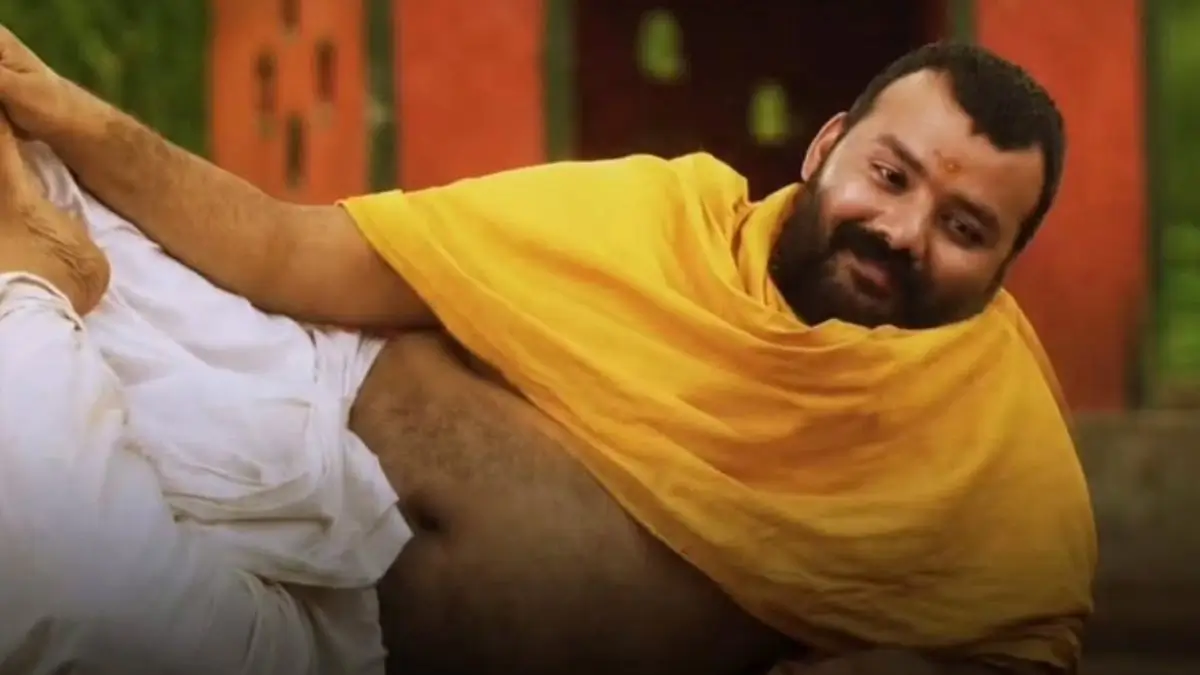
I had not heard of Shobhit Satsangi before this film. I suspect a great many people are about to learn his name. What this role requires above everything else is a face that communicates stillness, not blankness, not vacancy, but the specific quality of someone who has genuinely resolved something internal that most people spend their entire lives fighting.
A face that communicates selflessness without performing it. Satsangi has this. The moment he appears on screen as the adult Neem Karoli Baba, you feel the character rather than observe him. That is an extremely rare thing.
The Score: Sadhu Susheel Tiwari’s Bhajans
The music in Hanuman Ansh does something that the music in most Indian films cannot: it settles you. In a cinema environment full of advertising noise and the restlessness that precedes a new release, the bhajans in this film create a specific quality of internal quiet that I noticed happening in myself mid-screening. The devotional compositions are soothing without being soporific. They enhance rather than announce. They serve the film rather than trying to stand apart from it.
Sadhu Susheel Tiwari deserves specific recognition because this score would have been easy to get wrong. Devotional music in mainstream cinema frequently crosses into something that feels like advertisement, music that is informing you of the sacred rather than creating a space for it. That line is not crossed here, not once.
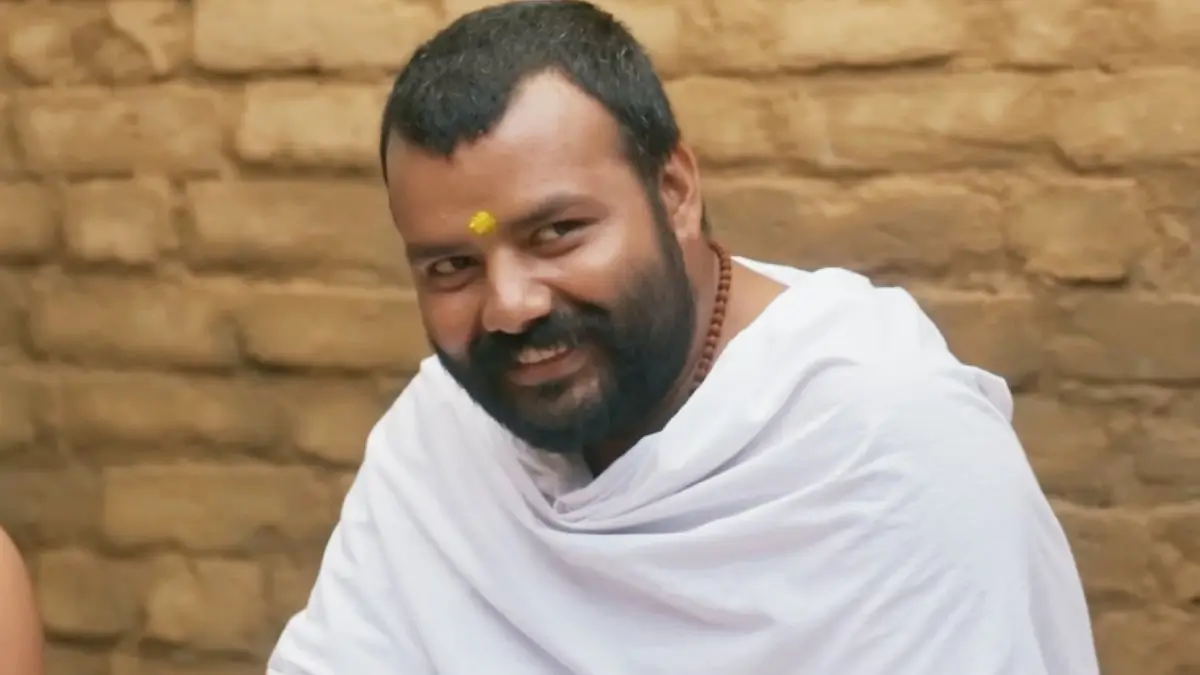
Hanuman Ansh and the Neem Karoli Baba Connection to Steve Jobs, Mark Zuckerberg, and Dr. Larry Brilliant
This is the aspect of Neem Karoli Baba’s story that the internet tends to know, and the film contextualises it more thoughtfully than most social media coverage manages.
Steve Jobs came to India in 1974. He had read a book called Be Here Now by Ram Dass, an American psychologist and author who had become one of Neem Karoli Baba’s most devoted disciples. Jobs specifically wanted to meet Neem Karoli Baba. When he arrived, he learned that Maharaj-ji had left his body some months earlier. Jobs did not leave.
He stayed in India for seven months, living with Neem Karoli Baba’s disciples, spending much of that time barefoot. He later spoke publicly at multiple conferences about what he learned in India: that intuition is more powerful than pure intellect, and credited that understanding to his time among Maharaj-ji’s community.
Upon returning to the United States, Steve Jobs started Apple within a few years.
Mark Zuckerberg visited Kainchi Dham, Neem Karoli Baba’s ashram in Uttarakhand, at a point when Facebook as a startup was going through a genuinely difficult period. He did so on the specific recommendation of Jobs. He has publicly credited that visit as meaningful to his own subsequent path.
The film does not make grandiose claims about causality between these visits and what Jobs and Zuckerberg built. It is honest that this is a matter of faith and belief rather than direct scientific correlation. What it does show is the nature of Neem Karoli Baba’s influence on people who encountered him, not through instruction or guidance given, but through a quality of presence and clarity that people experienced simply by being in his proximity.
The most compelling story for me personally is that of Dr. Larry Brilliant, an American physician and epidemiologist who was one of the key figures in the global eradication of smallpox. Dr. Brilliant had never worked in public health or epidemiology before coming to India. His wife was already living at Neem Karoli Baba’s ashram.
When Larry eventually arrived, deeply skeptical, certain his wife had joined a cult, something shifted. Neem Karoli Baba persistently encouraged him, across multiple visits and multiple rejections, to go to the nearest United Nations office in India and offer his services in the fight against smallpox. He was rejected multiple times. Each time he returned to the ashram, Maharaj-ji told him to go back and try again.
He got in. He joined the team. He became a crucial figure in one of the greatest public health achievements in human history, the elimination of a disease that had killed and disfigured human beings for millennia. And he publicly credits Neem Karoli Baba as the force that set him on that path. He has written about it. He has spoken about it. The film references all of this.
I present this not as evidence of the supernatural; what you make of it is your business and your right. I present it because the film handles all of this with appropriate seriousness and appropriate humility, which is harder to achieve than it sounds.
What ₹2 Crore Looks Like When Used Correctly
The reported budget of Hanuman Ansh is approximately ₹1.8 to 2 crore. In an era where even modest Hindi releases claim budgets of 50 to 100 crore, this number initially seems impossible. And then you watch the film, and you understand something important about where money actually goes in cinema and why it is so frequently wasted.
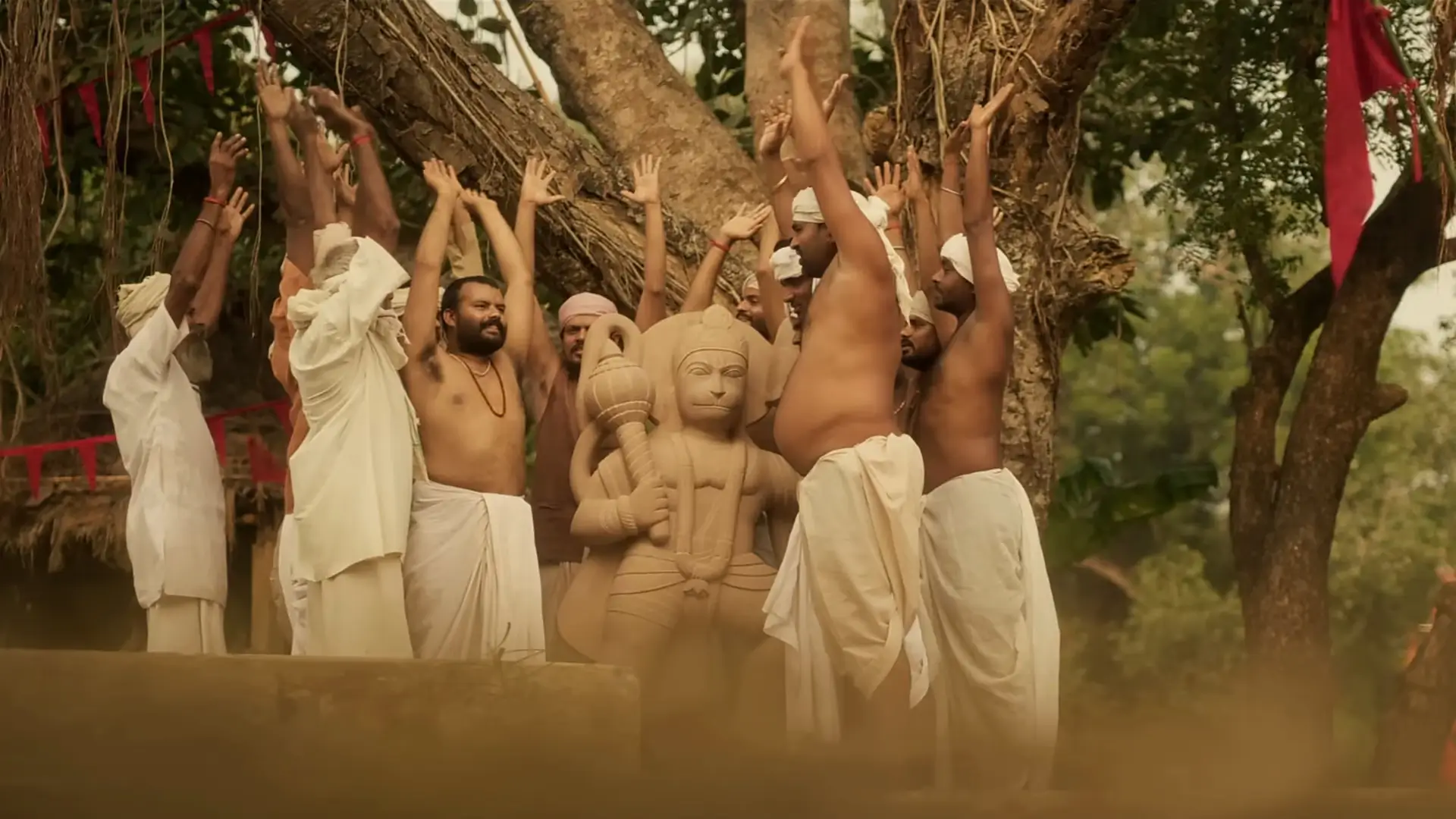
This film used practical locations. Real trees. Real ashrams. Real environments that carry the texture and weight of the actual geography they represent. When Neem Karoli Baba sits beneath a tree in meditation, you believe in the tree. You believe in the ground. You believe in the light. No amount of CGI recreates that belief, regardless of budget.
There are a few CGI shots in the film. They are brief, and the film does not draw attention to them. They do not undermine the film’s overall visual authenticity because they are deployed selectively rather than used as the primary production strategy. The contrast with films that spend 500 crore and still produce CGI that pulls you out of the story is instructive.
The film has crossed ₹12 crore at the box office on genuine word of mouth, no star power, no marketing blitz, no controversy to drive clicks. That is a 6x return on its reported budget through people simply telling other people to go see it. That is what happened with films like this before the industry forgot that audiences are capable of making their own decisions.
Where Hanuman Ansh Has Limitations
Honest reviewing requires naming what does not fully work, even in a film I am recommending strongly.
The CGI, while minimal, is occasionally noticeable and slightly breaks the practical authenticity the film builds so carefully elsewhere. On its budget, this is forgivable, and the film recovers quickly each time. But it is there.
The film’s pacing in its early sections is genuinely slow for viewers accustomed to the rhythms of contemporary commercial cinema. This is not a criticism of the creative choice; the slowness is appropriate for the subject matter and serves the film’s meditative quality, but it is worth naming for audiences who may need time to adjust their expectations before settling in.
And the film is, by design, not for everyone. If you have no interest in Indian spiritual and devotional traditions, if you approach the subject with active hostility, the film will not win you over and does not try to. It is made honestly for a specific audience. That is an admirable creative decision that also means the experience varies significantly depending on who is sitting in the seat.
Pros and Cons
✓ Pros
- Screenplay of exceptional restraint and honesty, no manipulation, no preaching
- Daivik Bhanushali’s child performance is one of the finest in recent Indian cinema
- Shobhit Satsangi finds exactly the right quality for an extraordinarily difficult role
- Sadhu Susheel Tiwari’s score is genuinely beautiful and serves the film perfectly
- Practical shooting gives the film a tactile authenticity that CGI-heavy productions cannot replicate
- A ₹2 crore film earning ₹12+ crore through genuine word of mouth, proof that quality finds its audience
- Completely family-appropriate, genuinely recommended for children
- Never preachy, never evangelising, never insisting on your interpretation
- Based on documented historical accounts, not mythology or hagiography
✗ Cons
- Pacing in the first act requires patience from contemporary audiences
- Occasional CGI shots are noticeable against the film’s otherwise practical visual language
- Deliberately not made for every audience; those without interest in the subject will not be converted
Final Verdict
| Category | Score |
|---|---|
| Direction | ★★★★★ |
| Screenplay | ★★★★★ |
| Child Performance (Bhanushali) | ★★★★★ |
| Adult Lead (Satsangi) | ★★★★★ |
| Score / Bhajans | ★★★★★ |
| Cinematography / Practical Environments | ★★★★☆ |
| CGI | ★★★☆☆ |
| Pacing | ★★★★☆ |
| Overall | ★★★★½ (4.5/5) |
Hanuman Ansh is an act of cinematic devotion in its own right, a film made without excess, without ego, and without the assumption that spectacle and sincerity are the same thing. Vishal Chaturvedi has done what so many filmmakers with ten times the budget fail to do: he has made a film that trusts its subject, trusts its audience, and trusts the story to carry itself without embellishment.
Go see it in theaters while you can. Take your family. Take your children especially. This is the kind of cinema that reminds you what the medium is capable of when it is freed from the obligation to perform.
If you’re deciding which movie to watch next, explore our latest reviews of The Odyssey Review, Insidious: Out of the Further Review, Toxic Review, Spider-Man: Brand New Day Review, Spider-Man: Brand New Day Post-Credits Scene Explained, The Odyssey Ending Explained, and Mutiny Review. At NexaFeed, we publish spoiler-free movie reviews, OTT series reviews, ending explained articles, hidden details, and streaming guides covering Disney, Pixar, Marvel, Netflix, Prime Video, Apple TV+, HBO Max, and the biggest theatrical releases from around the world.
Frequently Asked Questions
Is Hanuman Ansh worth watching?
Strongly yes. It is one of the finest low-budget biographical films Hindi cinema has produced in years, carried by exceptional performances, a genuinely moving score, and a screenplay of rare restraint and honesty. Our rating: 4.5 out of 5.
Who are the actors in Hanuman Ansh?
Daivik Bhanushali plays the young Neem Karoli Baba and delivers one of the most impressive child performances in recent Indian cinema. Shobhit Satsangi plays the adult Neem Karoli Baba with a stillness and presence that the role demands. The film also features a strong supporting cast throughout.
What is Hanuman Ansh about?
Hanuman Ansh is a biographical film about the life and times of Neem Karoli Baba, a Hindu saint whose disciples included Steve Jobs, Mark Zuckerberg, Ram Dass, and Dr. Larry Brilliant (one of the key figures in the global eradication of smallpox). The film traces his journey from a childhood drawn to devotion, through his years as a Sadhu, to his recognition as a Sant whose influence reached far beyond India.
What is the rating of Hanuman Ansh?
We rate Hanuman Ansh 4.5 out of 5, one of the most quietly excellent films of 2026, remarkable in particular for what it achieves within its reported budget of under ₹2 crore.
Is Hanuman Ansh suitable for children?
Yes. The film is completely family-appropriate and is specifically recommended for children. Watching this film with young people is an opportunity to introduce them to genuine devotional tradition, as distinct from the loudness and spectacle with which it is sometimes associated, in a form they can receive at their own level.
Hanuman Ansh is in theatrical release across India. Go before the run ends.