Welcome to the Jungle Review Verdict: Welcome to the Jungle is not a film. It is an extremely expensive paid vacation disguised as one, a collection of improvised comedy reels stitched together without a script, a structure, a narrative logic, or any measurable effort from anyone behind the camera. The cast occasionally saves individual moments. Nothing saves the movie.
I watched Welcome to the Jungle in theatres on opening weekend. What follows is an honest assessment, cross-referenced with multiple early audience reactions, of a film that made me question whether Hindi commercial cinema has a floor.
Quick Verdict
Welcome to the Jungle arrives as the third instalment of the Welcome franchise, a franchise that began with Anees Bazmee’s genuinely funny original in 2007. This instalment has nothing to do with that film in terms of energy, craft, or intention. Director Ahmed Khan and writer Farhad Samji have delivered a film with no script, no structure, no coherent editing, and production values that would embarrass a mid-budget Bhojpuri production.
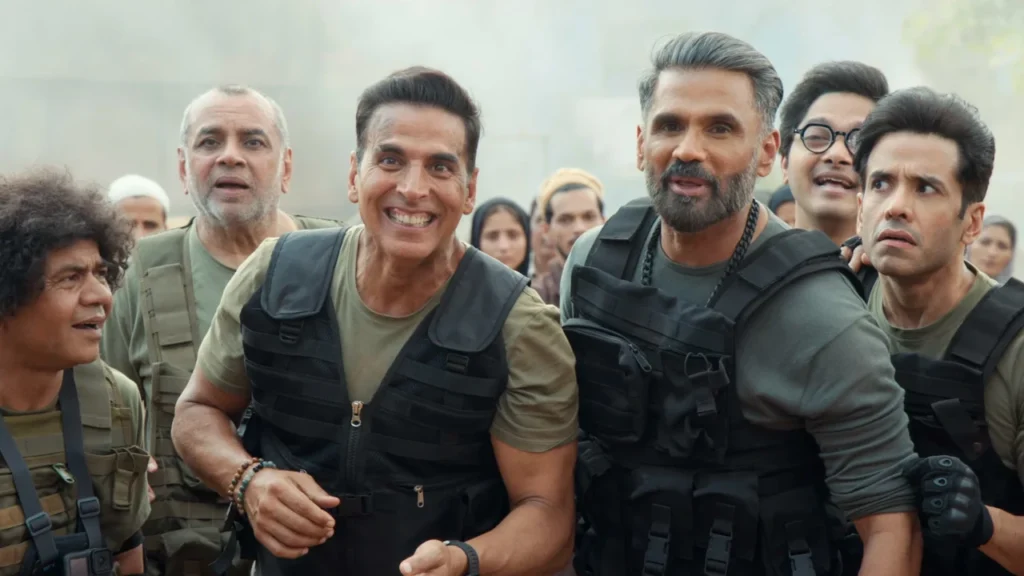
The legacy cast, Akshay Kumar, Arshad Warsi, Suniel Shetty, Paresh Rawal, Johny Lever, Rajpal Yadav, occasionally produce individually funny moments through sheer force of experience. None of it adds up to a film. Skip. Hard skip. Watch the original Welcome instead.
Movie Info
| Detail | Info |
|---|---|
| Title | Welcome to the Jungle (Welcome 3) |
| Release Date | 25 Jun, 2026 |
| Director | Ahmed Khan |
| Writer | Farhad Samji |
| Lead Cast | Akshay Kumar, Suniel Shetty, Arshad Warsi, Paresh Rawal, Johny Lever, Disha Patani, Jacqueline Fernandez, Raveena Tandon, Lara Dutta, Jackie Shroff |
| Genre | Comedy, Action |
| Studio | Tips Films |
| Our Rating | ★☆☆☆☆ (1.0/ 5 ) |
Welcome to the Jungle Story & Plot
The concept, and calling it a story would be generous, is this: a businessman needs to hide ₹2,000 crore of illegal money and decides the best way to do it is to produce a film guaranteed to flop, which will let him show losses on the books. To make this happen, he assembles a multi-starrer cast, a shoestring production, and a single jungle location.
Then a police raid wipes out his funds, which means the deliberate flop now needs to actually make money. And somewhere in the middle of all of this, a PoK terrorist shows up, one who, in a touch so bizarre it almost qualifies as satirical, seeks consent from women before doing anything to them.
That is the concept. There is no story. There is no second act. There is no resolution that grew organically from anything established earlier. The film acknowledges this openly, in the most self-aware moment of the entire runtime, characters within the film explain that cameras have been placed all over the village, and whatever the actors do will be filmed and cut into a movie.
That is not a joke about the characters’ film-within-the-film. That is the actual production strategy Ahmed Khan applied to Welcome to the Jungle itself.
The self-referential framing, a bad film about people trying to make a bad film, could have been clever. It is not. Claiming self-awareness does not excuse the absence of effort. Farah Khan built self-referential, over-the-top ensemble comedies with genuine structural intelligence. Main Hoon Na and Om Shanti Om knew exactly what they were doing and did it with architectural precision. Welcome to the Jungle knows it is making a mess and treats that knowledge as permission to not clean it up.
Welcome to the Jungle Cast
| Actor | Role |
|---|---|
| Akshay Kumar | Lead — failed actor cast in a doomed film |
| Arshad Warsi | Supporting lead |
| Suniel Shetty | Supporting lead |
| Paresh Rawal | In-film director character |
| Rajpal Yadav | In-film director character |
| Johny Lever | Supporting comedy |
| Jackie Shroff | Antagonist — dangerous local warlord |
| Disha Patani | Supporting — decorative presence |
| Jacqueline Fernandez | Supporting — over-acting character (intentional) |
| Raveena Tandon | Supporting |
| Lara Dutta | Supporting |
| Tusshar Kapoor | Supporting — disappears after the first half |
| Mukesh Tiwari | Cameo-level appearance |
| Yashpal Sharma | Cameo-level appearance |
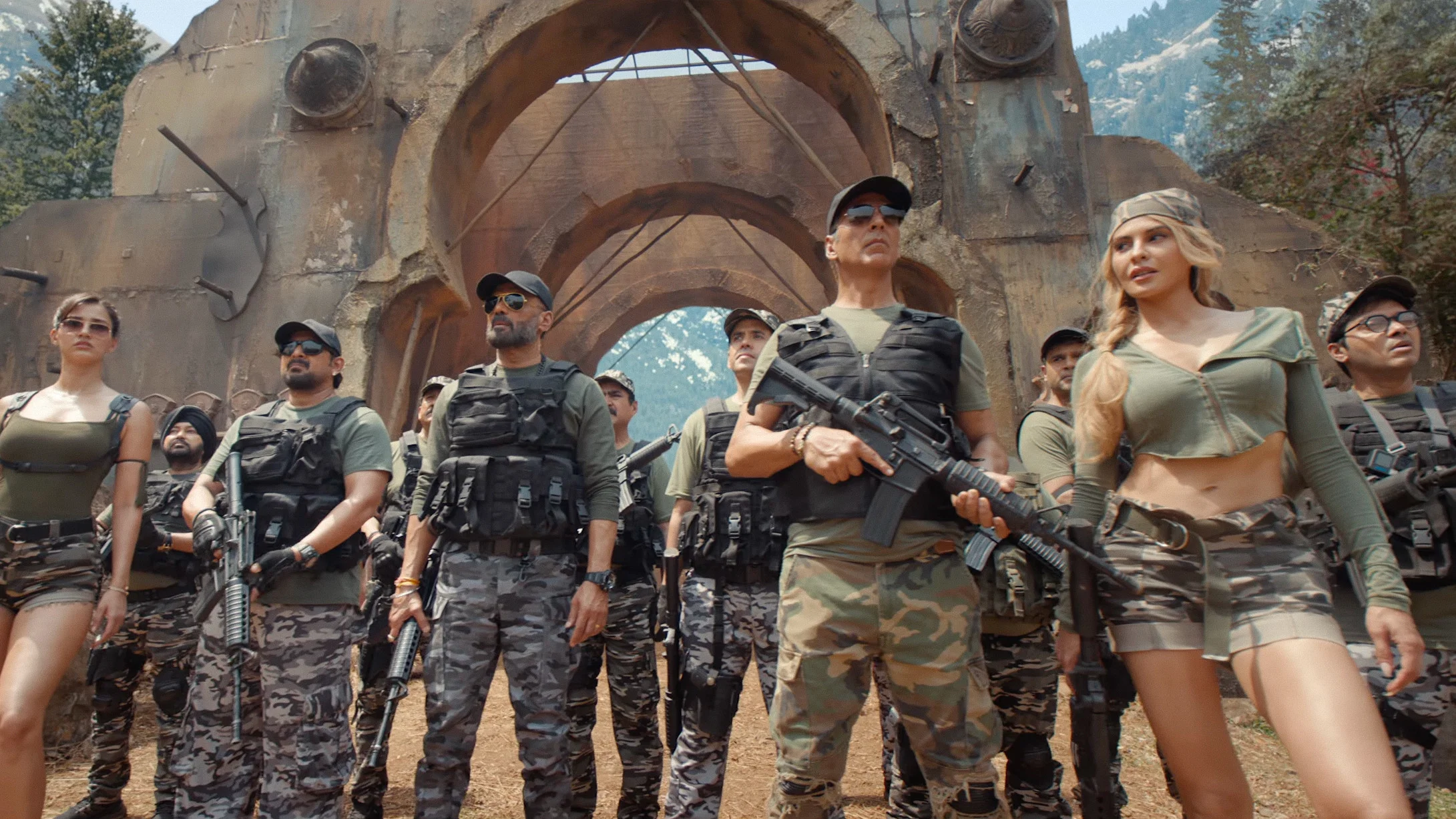
Welcome to the Jungle Performances
Akshay Kumar
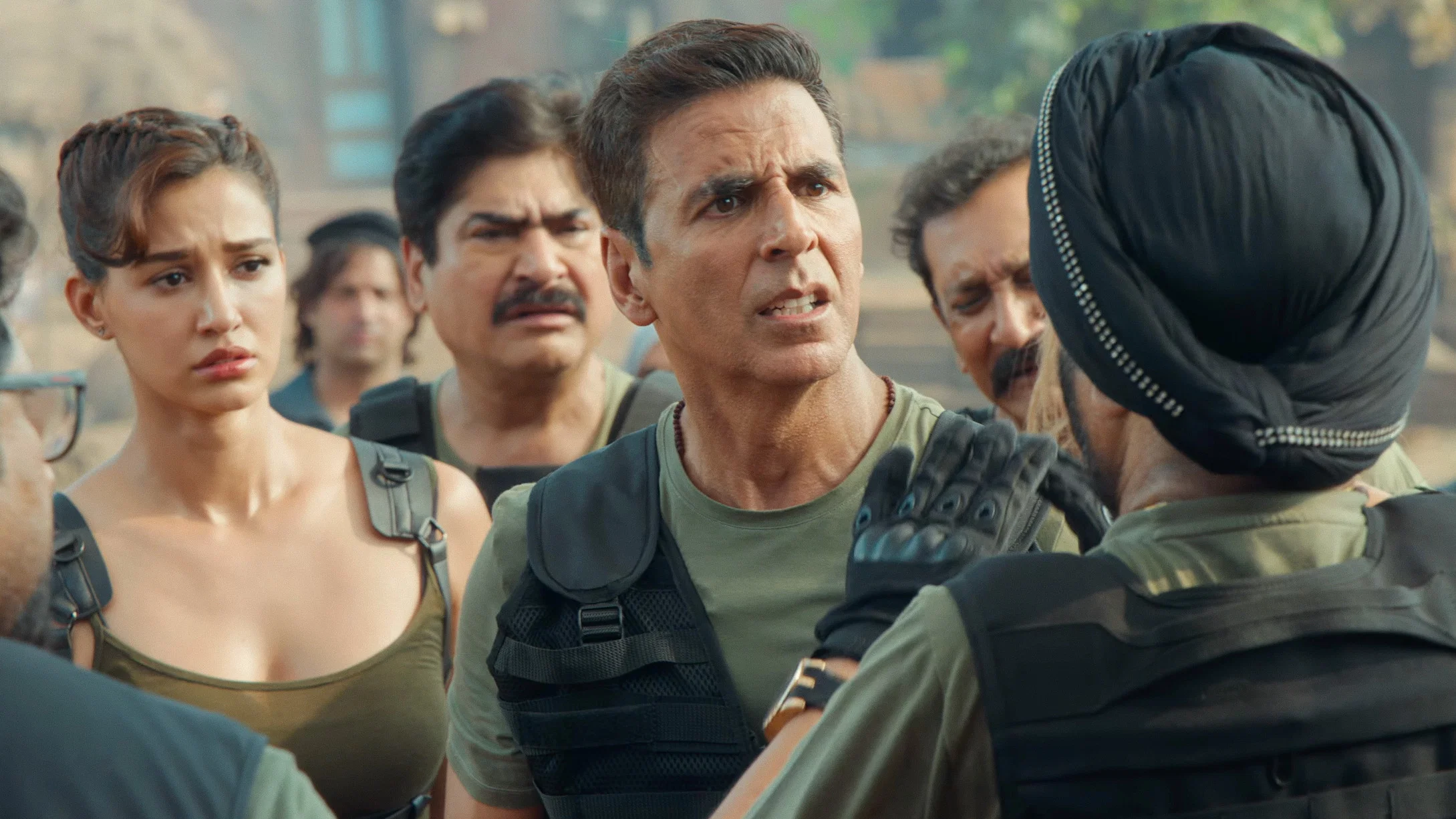
Akshay Kumar is one of the few people in this film who appears to be genuinely trying. His comic timing, the thing that made him the king of Bollywood comedy in the Priyadarshan era, is still intact. His dialogue delivery is sharp, and the material gives him anything to work with. His improvised energy in ensemble scenes is the closest the film gets to actual entertainment. None of this is enough to save Welcome to the Jungle, but it is enough to confirm that the failure is not his. He is a brilliant comedy actor trapped on a paid vacation being marketed as a production.
Paresh Rawal & Rajpal Yadav
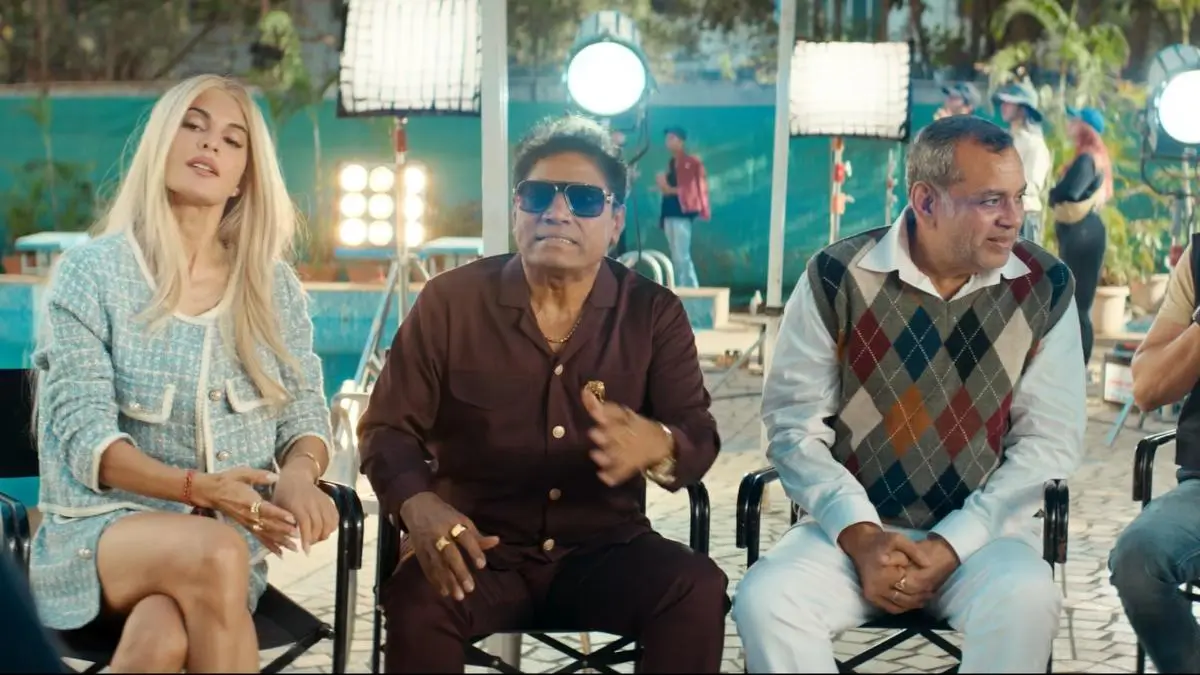
Both of these actors have delivered career-defining work in genuinely good films. Hera Pheri, Ganga Jal, these are performances that defined Bollywood comedy and drama, respectively. Here, they are cast as in-film directors, which should give them the most meta-textually interesting role in the movie. Instead, they are given almost no material to work with. Whatever they produce comes purely from the muscle memory of decades of craft. Watching them work in a film this empty is legitimately sad.
Arshad Warsi & Suniel Shetty
Both present. Both working. Neither given anything that resembles a character arc, a meaningful scene, or dialogue that was clearly written rather than improvised on the day. They fill screen time competently and generate the occasional laugh through personality alone.
Johny Lever
Gets substantial screen time in the first half. Essentially disappears in the second. Whatever his character was meant to contribute to the narrative, there isn’t one, but still, it is abandoned without acknowledgement. The fact that Johny Lever can be wasted in a film this full of comedy actors is its own kind of achievement.
Jackie Shroff as the Villain
The film’s villain is a local warlord with a cavalry of horsemen. His intimidation factor is undermined by a scene where, instead of a genuine confrontation, he sits on horseback watching Akshay Kumar attempt to entertain him, with the camera cutting to Shroff’s reaction shots directed straight into the lens, fourth-wall-break style, in a way that would have felt dated in 2005. Shroff does what he can. The direction gives him nothing.
Jacqueline Fernandez
The film’s self-aware highlight performer. Her character is written as someone who overacts everything, and the film leans into this as intentional comedy. It occasionally works. Jacqueline commits fully to the bit and lands a few genuinely funny lines in a way that suggests she understood the meta-register the film was aiming for better than the director did.
Disha Patani
Present. Glamorous. Acting not in evidence. Her character has no narrative purpose, no comedic function, and no discernible reason to be in the film. If she were removed from every scene she appears in, the film would be identical except slightly shorter. This is not an attack on Disha Patani as a person or a model. It is an observation about a casting decision that serves no creative purpose whatsoever.
Tusshar Kapoor
Visible in the first half. Completely absent from the second half in any meaningful sense, despite technically being present on screen. Has perhaps four lines in the final 45 minutes of a three-hour film. The explanation is almost certainly the same production chaos that defines everything else about this film: shooting began in 2023, was halted indefinitely, and resumed with whatever actor availability could be renegotiated. Tusshar Kapoor appears to have been renegotiated for very limited availability.
Welcome to the Jungle Direction — Ahmed Khan
Ahmed Khan’s filmography tells you everything you need to know about Welcome to the Jungle before you watch a frame of it: Baaghi, Baaghi 2, Baaghi 3, Heropanti 2. Every entry in that list is a film where spectacle substituted for substance and budgets were spent primarily on things that look impressive for thirty-second clips rather than on storytelling.
With Welcome to the Jungle, he has arrived at a new low, a film where even the spectacle has been outsourced to AI and where the direction is essentially indistinguishable from having pointed cameras at a group of comedy actors and told them to improvise until something was usable.
The most revealing directorial choice in the film is the editing strategy: almost no scene runs longer than two seconds. In action cinema, rapid cutting builds tension. In comedy, it destroys it; punchlines require setup time, reactions require space, and timing requires rhythm. Ahmed Khan has applied an action film’s editing tempo to a comedy film and produced something that feels visually jagged and tonally incoherent. By the time you have adjusted to the cutting pace, roughly an hour into the film, you have also adjusted your expectations downward to the point where nothing can surprise you anymore.
Welcome to the Jungle Screenplay — Farhad Samji
Farhad Samji wrote Baaghi 4, Housefull 5, Kisi Ka Bhai Kisi Ki Jaan, Heropanti 2, Bacchan Pandey, Baaghi 3, Housefull 4, Baaghi 2. That is his complete filmography. You now know exactly what Welcome to the Jungle’s screenplay is like.
There is no three-act structure. There is no character development. There are no scenes that connect to other scenes through causation rather than proximity. The film’s concept, a fictional bad film being made by fictional bad filmmakers, is the entire script. Everything that follows is improvisation padded with song sequences, AI-generated establishing shots, and green screen footage that was clearly not planned to cohere with the live-action material it bookends.
The most damning evidence of the screenplay’s non-existence is a song that plays at the interval. During this sequence, Akshay Kumar appears on screen holding a popcorn bucket and addresses the audience directly: he tells them that he and Disha Patani shot a song that didn’t fit anywhere in the film, so they are placing it here, at the interval, because there was nowhere else to put it. This is presented as a joke. It is also simply true. A song was shot without any plan for where it would appear in the narrative. In a film with a script, that does not happen.
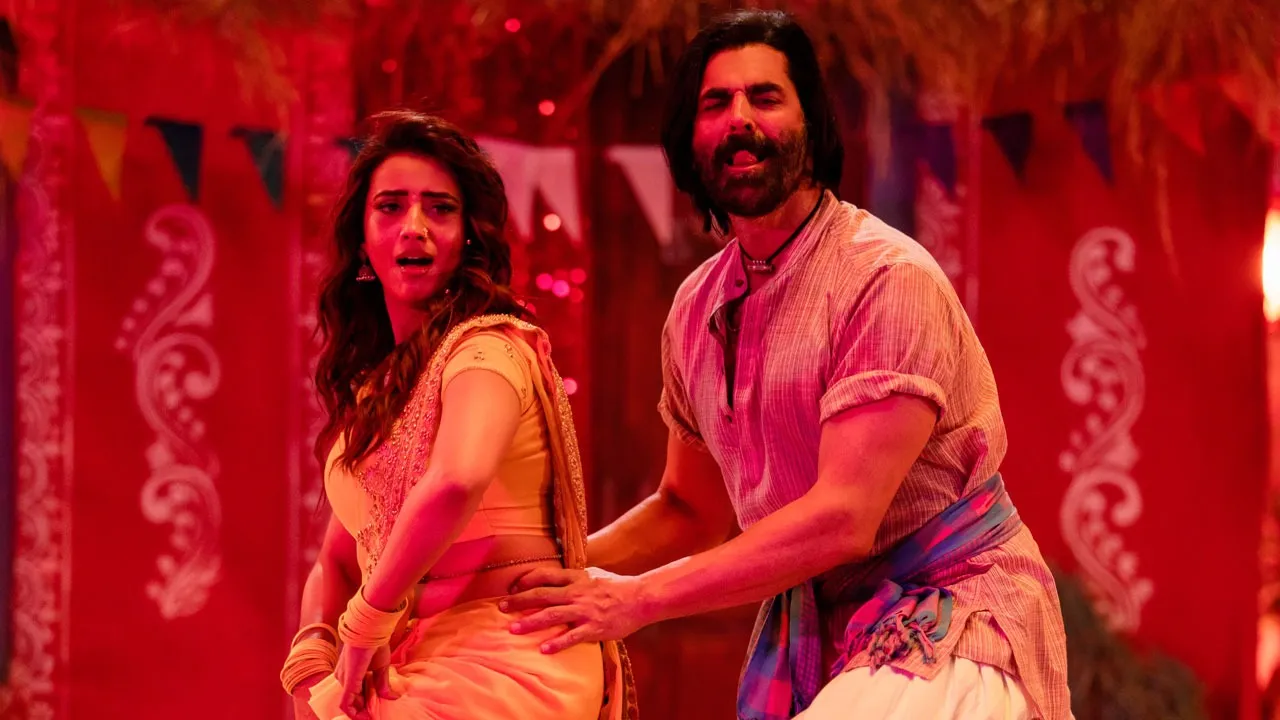
Welcome to the Jungle Cinematography & Visuals Review
The film was shot almost entirely on a sound stage. Two sets, both cheap, both obviously fake to any viewer who has seen a Bhojpuri production with the same budget and more location ambition. The visual aesthetic is: green screen everywhere, AI for any shot requiring scale or an outdoor environment, and practical lighting that appears to have been set up by someone who learned cinematography from YouTube tutorials published in 2008.
The font treatment in the film’s title cards and text overlays, a reliable indicator of how much care a production brought to its craft, is a black border slapped around white text. That is it. No design intent. No visual language. The digital equivalent of opening Microsoft Word and typing directly onto the screen.
There is a scene that appears to be shot on the set of OMG 2. Not metaphorically, the production design is visually identical to a scene from the Akshay Kumar-starring film from 2023. Whether this represents actual set reuse or simply the absence of any distinct visual identity, the effect is the same: a film that cannot tell you what it looks like, because it does not know.
Welcome to the Jungle CGI & AI-Generated Visuals Review
Jackie Shroff’s cavalry, the threatening warlord’s horseback army, is entirely AI-generated. The landscape shots. Establishing wide shots. The army sequences. All AI. The film’s best-looking individual frames are the AI-generated ones, which means the best visual moments in Welcome to the Jungle were produced by a software prompt, not by any creative decision made by the filmmakers.
This would be forgivable if the AI work were good. It is not. The AI-generated sequences are obviously artificial, inconsistent with the practical footage they are intercut with, and produced at a quality level that suggests a basic subscription to a consumer AI image tool rather than any professional-grade visual effects pipeline. For a film with a reported budget that accommodated the combined salaries of its enormous cast, the decision to spend that budget on actor fees and virtually nothing on visual quality is the clearest possible statement about where this production’s priorities actually were.
Welcome to the Jungle Editing Review
The editing of Welcome to the Jungle is the film’s most technically catastrophic element. The fundamental problem: no shot runs long enough for any scene to exist. Comedy requires timing. Timing requires duration. A punchline that arrives before the setup has been absorbed is not a punchline. It is noise.
Beyond comedy timing, the editing reveals the production’s core chaos. Characters appear prominently in the first half and essentially vanish in the second, not because their story concluded, but because their dates were not available when reshoots happened. Scenes that should connect, a confrontation, a consequence, a revelation, are separated by cuts that make clear these sequences were not filmed in the same month, possibly not in the same year. The editor’s job was impossible: take footage that was never designed to form a coherent film and make it look like one. The result, understandably, does not look like a coherent film.
Welcome to the Jungle Music & Songs Review
The film contains approximately four songs. One of them, as described above, has no narrative placement and is inserted at the interval with an on-screen acknowledgement that it does not belong anywhere in the story. The others function as padding; they extend the runtime without advancing anything. None of the songs is memorable. None of them has the kind of hook or visual execution that would make them work as standalone pieces of content, which in 2025 is the minimum standard a commercial Bollywood song needs to meet to justify its existence.
Welcome to the Jungle Ending Explained
The film resolves in the way that films without plots resolve: things stop happening. The terrorist subplot is neutralized. The film-within-a-film gets made. The money situation is resolved through a mechanism that the movie introduces and completes too quickly to register emotionally. Characters who were present in the first half are present again at the end, having contributed nothing to whatever passed for a second act.
There is no earned climax. There is no moment where the film’s themes, if it has themes, crystallize into something that makes the journey feel worthwhile. The ending is simply the point at which Welcome to the Jungle decides it has run long enough and stops.
The most honest version of the ending was already delivered mid-film, when Akshay Kumar told the audience a song was being placed at the interval because no one knew where else to put it. That is the film’s real ending, explained: nobody planned for one.
Does Welcome to the Jungle Have a Post-Credits Scene?
Not confirmed in the theatrical cut reviewed here. Given that the film’s main runtime already contains content that was placed arbitrarily because it had nowhere else to go, the presence or absence of a post-credits scene would be equally arbitrary.
What Welcome to the Jungle Gets Right
Akshay Kumar’s comic instincts. His timing is genuine, his energy is present, and his commitment to making something funny out of thin material is the film’s only consistent positive. This is what the original Akshay Kumar comedy era looked like, and seeing it here, however briefly and however wasted, is a reminder of what he is capable of.
Jacqueline Fernandez’s self-aware performance. The one actor who appears to have understood the meta-register the film was reaching for and calibrated her performance accordingly. Her deliberately over-the-top character lands more consistently than anything else in the film.
Scattered ensemble moments. Five or six scenes across a three-hour runtime where the assembled comedy veterans produce something genuinely funny through pure professional instinct. Not enough to justify watching the film. Present enough to prove that the talent was there and the filmmaking was not.
The interval joke. The Akshay Kumar/popcorn bucket moment, where the film acknowledges its own structural failure while placing a misfit song is the closest Welcome to the Jungle gets to intentional meta-comedy. It is funny. It is also an accident of creative failure presented as a joke.
Welcome to the Jungle Pros & Cons
✓ Pros
- Akshay Kumar’s comic timing is still intact and occasionally visible
- Jacqueline Fernandez understands the meta-comedy register
- A handful of genuinely funny ensemble moments
- The interval self-aware joke actually lands
- Veteran cast (Paresh Rawal, Johny Lever) bring professional craft to scenes that don’t deserve it
✗ Cons
- No script, no story, no structure, a concept mistaken for a film
- Editing is so rapid that no comedy has room to breathe
- AI-generated visuals of poor quality for a high-budget production
- Green screen sets that look cheaper than Bhojpuri film productions
- Font and title card design at a level suggesting zero production investment
- Disha Patani’s character serves no narrative or comedic function
- Half the cast disappears after the interval with no explanation
- Songs placed with no structural logic
- Three-hour runtime with no narrative momentum
- Director Ahmed Khan and writer Farhad Samji’s combined filmography is a warning, not a recommendation
How Welcome to the Jungle Compares With the Welcome Franchise
| Film | Director | Rating |
|---|---|---|
| Welcome (2007) | Anees Bazmee | ★★★★☆ (4/5) |
| Welcome Back (2015) | Anees Bazmee | ★★☆☆☆ (2/5) |
| Welcome to the Jungle (2025) | Ahmed Khan | ★☆☆☆☆ (1/5) |
The original Welcome is a legitimate comedy classic, tight, structured, with genuine character work and Nana Patekar and Anil Kapoor at the top of their comedic game. Welcome Back was weaker but still recognizable as a film made by someone who understood how comedies work. Welcome to the Jungle represents a complete severing from the franchise’s DNA. It shares nothing with its predecessors except some cast members and a title.
Is Welcome to the Jungle a Hit or Flop?
Based on available opening week data and audience reception, Welcome to the Jungle is tracking as a commercial disappointment relative to its production and marketing costs. The film’s enormous ensemble cast commands significant fees. The production period, beginning in 2023, was halted, resumed in 2024, and added costs without proportionally adding quality. Marketing spend for a multi-starrer of this scale is substantial.
Against these costs, the film opened to mixed-to-negative audience word of mouth. While theatres were not empty on opening weekend, ensemble star power still drew initial curiosity, the kind of strong audience response that drives second-week holds, and breakeven theatrical runs were not in evidence. The film’s self-proclaimed prediction, that critics would give it one star and audiences five, appears to be running closer to the critic assessment than the audience one.
OTT streaming rights would likely provide a floor for the film’s financial performance. For a film this conceptually weak, the couch is a more forgiving setting than a theatre, which may improve streaming numbers even if theatrical performance proves disappointing.
Is Welcome to the Jungle Suitable for Kids?
The film is a broad comedy without graphic violence. The terrorist subplot and a few adult-themed jokes push it toward a teen-and-above audience, but it is not inappropriate in any serious sense for children who watch typical Bollywood masala films. Parental discretion for younger children primarily around the action sequences, which are brief and consequence-free.
Where Can You Watch Welcome to the Jungle After Theatres?
Welcome to the Jungle is a Tips Films production. Post-theatrical streaming is expected on a major OTT platform, likely Netflix or Amazon Prime Video, depending on streaming deal arrangements. A confirmed streaming date has not been announced at the time of publication. Given the production history and audience response, a streaming window shorter than the typical 8-week theatrical exclusivity period is possible.
Welcome to the Jungle Final Verdict
| Category | Score |
|---|---|
| Story / Script | ★☆☆☆☆ |
| Direction | ★☆☆☆☆ |
| Comedy | ★★☆☆☆ |
| Performances | ★★☆☆☆ |
| Editing | ★☆☆☆☆ |
| Visuals / CGI | ★☆☆☆☆ |
| Music | ★★☆☆☆ |
| Production Design | ★☆☆☆☆ |
| Overall | ★☆☆☆☆ (1/5) |
Welcome to the Jungle is what happens when everyone involved in a film decides that the film’s existence is sufficient, that showing up is the job, that pointing cameras at famous faces constitutes direction, and that an audience’s affection for a franchise title will carry a product that has no connection to what made that franchise worth affection in the first place.
Akshay Kumar’s original comedy era was built on genuine comic craft, properly structured scripts, and directors who understood timing. Welcome to the Jungle disrespects that era, disrespects its audience’s intelligence, and disrespects the craft of filmmaking itself. The self-aware framing, we know this is bad, we’re celebrating that, does not excuse the laziness. It is armor for incompetence.
The original Welcome is still available to stream. Watch that instead.
Welcome to the Jungle Frequently Asked Questions
Q. What is the release date of Welcome to the Jungle?
Ans. Welcome to the Jungle released in theatres on 25 Jun, 2026. It is the third instalment in the Welcome franchise, following Welcome (2007) and Welcome Back (2015). An OTT streaming date has not been confirmed at the time of publication.
Q. Has Welcome 3 been released?
Ans. Welcome to the Jungle, also referred to as Welcome 3, is the third Welcome film and has been released in theatres. It stars Akshay Kumar, Arshad Warsi, Suniel Shetty, Paresh Rawal, Johny Lever, Jackie Shroff, Disha Patani, Jacqueline Fernandez, Raveena Tandon, and Lara Dutta, among others.
Q. Is Welcome to the Jungle a hit or a flop?
Ans. Based on opening week performance and audience reception, Welcome to the Jungle is tracking as a commercial underperformer relative to its production costs and the box office expectations a multi-starrer of this scale would typically carry. Word of mouth has been mixed-to-negative, which typically signals weak second-week theatrical holds.
Q. Is Welcome to the Jungle a good movie?
Ans. No. Welcome to the Jungle has no coherent script, no narrative structure, editing that destroys its own comedy through excessive cutting, AI-generated visuals of poor quality, and a production approach that prioritized cast assembly over filmmaking craft. Individual performers, particularly Akshay Kumar and Jacqueline Fernandez, produce scattered funny moments. The film as a whole does not work.
Q. Is Paresh Rawal in Welcome to the Jungle?
Ans. Yes. Paresh Rawal appears in Welcome to the Jungle in a role as an in-film director character, alongside Rajpal Yadav in a similar capacity. Both are underserved by the material and given far less to work with than their talent deserves.
Q. Who is the villain in Welcome to the Jungle?
Ans. Jackie Shroff plays the primary antagonist, a dangerous local warlord with a cavalry of horsemen. His character’s army is depicted entirely through AI-generated sequences. Shroff brings professional presence to the role but is undermined by a direction that stages his intimidation scenes without any genuine menace or craft.
Q. Is Welcome to the Jungle connected to the original Welcome (2007)?
Ans. Welcome to the Jungle shares cast members with the original Welcome films but has no direct narrative continuation with the Anees Bazmee-directed originals. It is a new story, not a sequel to the specific plots of Welcome or Welcome Back. The only meaningful connection is the franchise name and some returning actors.
Welcome to the Jungle is currently in theatres. OTT streaming date to be announced. The original Welcome (2007) is recommended as an alternative.
Looking for your next movie or TV review? Check out our Supergirl Review, Toy Story 5 Review, The Death of Robin Hood Review, and A Knight of the Seven Kingdoms Episode 1 Review